




PAN Card
PAN Card Fraud: How Check For The Misuse, Report, and ProtectPAN Card Fraud: How Check For The Misuse, Report, and Protect
Written by Shubham Jain
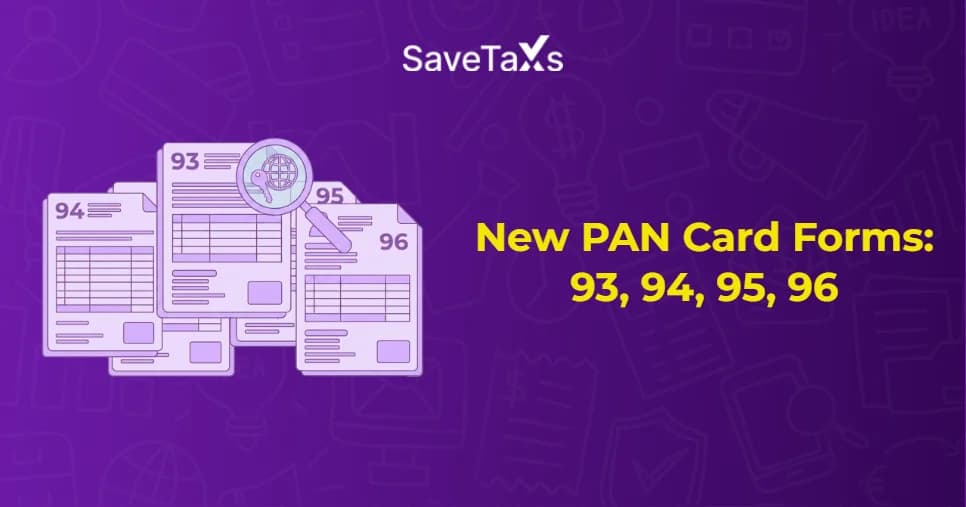
Starting from 1st April, 2026, four new PAN application forms are in effect: Forms 93, 94, 95, and 96. Each form is designed for different types of applicants, including Indian citizens, foreign individuals, and companies, etc. The two old PAN allotment forms, Form 49A and Form 49AA, have now been replaced. Hence, applications submitted using old forms after 1st April will not be processed.
Any PAN applications that are pending as of the 31st of March, 2026, will be considered valid, and you don't need to submit a fresh application. However, any application filed on or after the 1st of April must use the new PAN forms. These forms can be downloaded through Protean (formerly NSDL), UTIITSL, or the Income Tax Department's website. Keep reading to learn which new PAN card form you need to use and more.
The new PAN (Permanent Account Number) card forms are introduced to address the needs of Indian and foreign applicants, both individuals and entities. To ensure compliance with the latest legal and regulatory rules, each form is designed under Rule 158 and Section 262 of the Income Tax Act, 2025.
The new PAN forms are categorized into four types. Apart from that, two other forms are also introduced to use when making changes/corrections in the PAN.
| Form No. | Applicant Type | Reference Rule/Section | Download |
|---|---|---|---|
| Form 93 | Individual (Being a citizen of India) or NRIs | Rule 158, Sec 262 | Click here to download Form 93 |
| Form 94 | Non-individual Indian entities | Rule 158, Sec 262 | Click here to download Form 94 |
| Form 95 | Individual (Not being a citizen of India) | Rule 158, Sec 262 | Click here to download Form 95 |
| Form 96 | Non-individual foreign entities | Rule 158, Sec 262 | Click here to download Form 96 |
| PAN CR-01 (Correction Form) | Individual | - | Click here to download PAN CR-01 |
| PAN CR-02 (Correction Form) | Non-individual | - | Click here to download PAN CR-02 |
Any person, whether an individual or an entity, who wants to apply for PAN allotment needs to file PAN forms. It includes the following:
In short, anyone who requires a PAN must file the relevant form based on their classification.
Each PAN form collects important information in 6 key sections. The table below lists the 6 major sections and the information required in each section:
| Section | Information |
|---|---|
| Personal Details | Name, gender, address, date of birth/incorporation, contact details, etc. |
| Parent's Details | Name and information of the parent. |
| Income Source | Details about the nature and source of income or business activity. |
| Assessing Officer Code | Details of jurisdiction |
| Representative Assessee Details | Name, address, contact details, etc. of the Representative Assessee. |
| Declaration | A declaration statement along with the date and place for signature and thumb impression. |
Here are the changes made in the new PAN card forms (93/94/95/96):
The table below lists the differences between old PAN forms and new PAN forms:
| Feature | Old Form (49A/49AA) | New Forms (93/94/95/96) |
|---|---|---|
| Number of Forms | 2 | 4 |
| Photo Size | Small (Standard) | Big (increased for verification) |
| Contact details | Optional | Mandatory (Mobile & Email) |
| Mother's Name | Optional | Mandatory on Form 93 |
| Instructions | Lengthy and complex | Clear, precise, and self-explanatory |
Applying for a PAN card is easy and has straightforward steps. First, you need to fill out the PAN allotment application form and submit it. You need to submit proof of identity, proof of address, and proof of date of birth/ date of incorporation. Then, you must pay the required fees. After that, you need to submit the completed form either online or by visiting an authorized PAN service provider (SP) in person.
The service provider will digitize the application if you submit the form physically. They will verify the supporting documents against the information filled in the form. The data is sent to the Income Tax department upon successful verification of details and documents. Lastly, a PAN is allotted to you. In case you request a physical card, you will receive it at your registered address.
Connect with Savetaxs and apply for NRI PAN with expert guidance.
The Income Tax Department introduced the new PAN forms to simplify the process, improve data accuracy, and enhance verification. The new forms have clearer and more precise instructions, with larger photograph requirements to tighten identification. Ensure to use Form 93, 94, 95, or 96 if you are applying for a PAN after the 1st of April, 2026.
If you are unsure about which form to use, seek assistance from an expert at Savetaxs to ensure compliance. At Savetaxs, we have a team of experts who can help you select the relevant form based on your classification. They can guide you with everything, from filling out the form to reviewing the documents to submitting your application. Connect with us right away, as we are actively working around the clock across all time zones.
This article is for general informational purposes only and does not constitute tax, legal, financial, or investment advice. Laws, regulations, rates, and procedures may change over time and may vary based on individual circumstances.
While SaveTaxs makes reasonable efforts to keep the information accurate and up to date, readers should verify applicable rules with official authorities or consult a qualified professional before making decisions based on this information.
Vipul Jain is the Co-Founder of SaveTaxs and a tax expert with experience in Indian and NRI taxation. He advises individuals, NRIs, and businesses on tax filing, tax planning, capital gains, DTAA, and compliance matters. He focuses on making complex tax concepts simple and helping taxpayers make informed, compliant decisions. See Full Bio
Want to read more? Explore Blogs
_1780641850455.webp&w=828&q=75)
_1780465430494.webp&w=828&q=75)
_1780318424443.webp&w=828&q=75)
The forms prescribed for PAN application are: