


_1785327342628.webp&w=828&q=75)
NRI Banking Services
What Should NRIs Know Before Choosing an NRI Account?What Should NRIs Know Before Choosing an NRI Account?
Written by Shubham Jain

For NRIs, remittance means sending money from their country of residence back to India or transferring funds for various expenses. It is crucial for the financial well-being of families and communities living abroad. For many Non-Resident Indians (NRIs), sending money is more than just about helping their family: it often provides essential income that supports households in developing countries.
An NRI gets several options for sending money to India, mainly using online money transfer, bank wire transfers, money transfer operators, etc. With more options for money transfers available than ever before, an NRI must understand how remittances work.
In this blog, we will explain key points of sending money home, including important terms, and what legal and tax terms you need to know.
The word "remittance" is derived from the word "remit, meaning to send back. When talking about remittance in financial terms, it means sending money to family and friends living abroad. This is mostly done by people who work in a foreign country and send a part of their income back home to their families.
These remittances sometimes act as a primary income source for families living in a slow-growth economy and developing countries. It helps families meet basic needs and invest. It also helps during times of disasters by providing help in disaster relief funds.
Remittances are commonly made via digital money transfers and can be done by the electronic payment system provided by banks or through money transfer services.
Understanding the main remittance terms is important for anyone who is sending or receiving money across borders. Here are some of the important key remittance terms you must know:
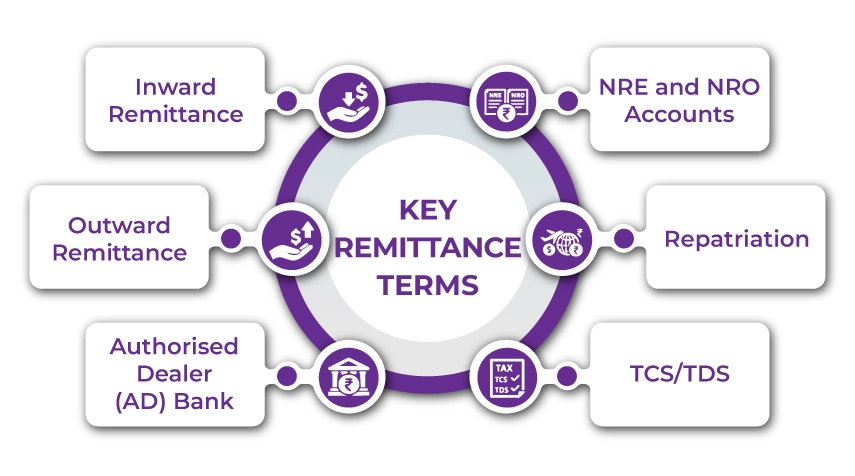
Inward remittance is the process of receiving money into your local savings account from abroad. It allows NRIs to transfer funds to support family, invest in assets, pay for services, or manage financial responsibilities back home. It is regulated by the India RBI under FEMA laws.
Your foreign currency gets converted into Indian rupees via official banking channels when you initiate an inward remittance to India.
Outward remittance is the process of transferring money from India to another country or region through authorized banking channels. Generally, these transfers can be made only for the purposes listed by the Foreign Exchange Management Act (FEMA) of 1999. It includes sending money to cover tuition fees or living expenses, pay for medical treatments, buy assets, etc.
The framework for such transactions is provided by the Liberalised Remittance Scheme (LRS), which allows residents to transfer up to 250,000 USD per financial year for various approved purposes. For NRIs, the remittance limit is higher.
Authorised Dealer (AD) banks are commercial banks and financial institutions that are authorized by the RBI (Reserve Bank of India) to handle foreign exchange transactions. The primary function of these banks is to serve as intermediaries for NRIs, Indian companies, and foreign businesses in managing cross-border financial transactions and ensuring compliance with the regulatory framework.
A bank is not allowed to process cross-border payments without this authorization, whether it is for imports, exports, or investments.
NRE (Non-Resident External) accounts hold foreign income in India, offer tax-free interest, and allow full repatriation, while NRO (Non-Resident Ordinary) accounts handle India-sourced income (rent, dividends) are subject to Indian taxes, with a limited repatriation limit of 1 million USD per year.
Both accounts are rupee-denominated, but NRE funds come from abroad (converted INR), while NRO funds are Indian income.
Repatriation is legally sending money out of India, typically for NRIs from their NRO account to their overseas account after fulfilling FEMA (Foreign Exchange Management Act) rules and paying the applicable taxes.
Tax Collected at Source under Section 206C (1G) applies to certain outward foreign remittances, while TDS (Tax Deducted at Source) applies to various types of Indian income.
Achieve easy and compliant ITR filing as an NRI with expert guidance.
Keep the following things in mind before sending money to India as an NRI to ensure compliance, accuracy, and prevent delays:
Choosing the right remittance channels for sending money to India is important. This is because it will directly impact how your family or friends will receive it. For transferring the money, you get several options with each offering various benefits based on your requirements. Here are the available remittance channels for you to send money to India:

Many NRIs wonder and get confused, thinking, "Is there any tax on the money I send to India?" Now, the answer to this question depends on whether the amount is your own foreign income being remitted or taxable Indian income being transferred. Let's understand this situation in detail:
Simply transferring your after-tax foreign salary or savings from an overseas bank account into your Non-Resident External (NRE) or Non-Resident Ordinary (NRO) account in India generally does not, in itself, create a fresh Indian income tax liability.
Tax implications arise only when there is India-sourced income or when you become an Indian resident. The FEMA (Foreign Exchange Management Act) allows NRIs to remit such freely via normal banking channels. However, this is subject to KYC and source-of-funds checks.
Any income credited into an NRO account is subject to taxation in India, including interest, rent, and capital gains. Additionally, banks generally deduct TDS (Tax Deducted at Source) at applicable rates for NRIs.
Before transferring from an NRO to an overseas account (beyond current income). NRIs generally require a CA certification (Form 15CB) and Form 15CA filing to confirm that the taxes have been paid.
TCS (Tax Collected at Source) under section 206C(1G) applies on outward remittances from India under LRS (Liberalised Remittance Scheme) by residents, not on NRIs sending money from abroad into India.
Also, clarifications note that NRO-to-overseas remittances under the 1 million USD schemes for NRIs are not considered as LRS remittances and thus, they are not subject to TCS. However, the underlying income must still be properly declared and taxed in India according to its nature.
Inward remittances must be coded properly and routed via authorised channels: some business or large transactions may attract reporting obligations for banks under the directions of FEMA and RBI.
NRIs repatriating funds from an NRO account to overseas accounts must respect the overall annual ceiling, which is commonly up to 1 million USD per financial year for eligible assets. However, this is subject to documentation and tax compliance.
Get expert solutions for complex global remittance.
As an NRI, managing your remittances doesn't have to be complicated or hard. You can make the process easier by understanding the basics. Problems can be avoided by understanding the rules, whether you are sending money to support your family or for investment in India. Additionally, to get personalized help with your remittance while staying compliant with Indian tax rules, reach out to the experts at Savetaxs.
We have a team of experts who can assist you with remittance by offering comprehensive tax and compliance support, mainly for NRIs. By choosing us, you can ensure that the entire process is legal, tax-compliant, and stress-free. Contact us today, as we are working 24*7 across all time zones.
This article is for general informational purposes only and does not constitute tax, legal, financial, or investment advice. Laws, regulations, rates, and procedures may change over time and may vary based on individual circumstances.
While SaveTaxs makes reasonable efforts to keep the information accurate and up to date, readers should verify applicable rules with official authorities or consult a qualified professional before making decisions based on this information.
Shubham Jain is the Founder of SaveTaxs and has extensive experience in Indian and NRI taxation. He advises individuals, NRIs, and businesses on tax filing, tax planning, capital gains, DTAA benefits, fund repatriation, and compliance matters. He regularly writes about taxation and related financial topics. His focus is on making complex tax concepts easy to understand. Through his articles, he helps taxpayers stay informed, avoid common mistakes, and stay compliant with Indian tax laws. See Full Bio

Want to read more? Explore Blogs

_1784120197435.webp&w=828&q=75)