-for-401(k)_1790057066765.webp&w=828&q=75)
US Tax Filing and Compliance
Net Unrealized Appreciation (NUA) for 401(k): A Guide for NRIs Moving to IndiaNet Unrealized Appreciation (NUA) for 401(k): A Guide for NRIs Moving to India
Written by Vipul Jain

_1786691789051.webp&w=3840&q=75)
If you are an Indian student in the United States who sends money to India, what follows is more than important for you to know. Under the One, Big, Beautiful Bill Act (OBBBA), a new 1% federal remittance transfer tax applies to certain transfers from the United States to recipients abroad beginning January 1, 2026. The tax generally applies when the sender funds the transfer with cash, a money order, a cashier's check, or another taxable physical instrument. Transfers funded from certain financial accounts or with qualifying debit or credit cards are generally excluded. The good aspect here is that understanding this tax and how to avoid it is easy, as the implementation of the tax depends only on the method you are using to send money to India.
In this blog, we will talk about the hype around the 1% remittance tax, who this tax applies to, how you, as an Indian student in the USA, can avoid this tax, and more. This guide also covers a bonus tax benefit for Indian students in the US that you must know about.
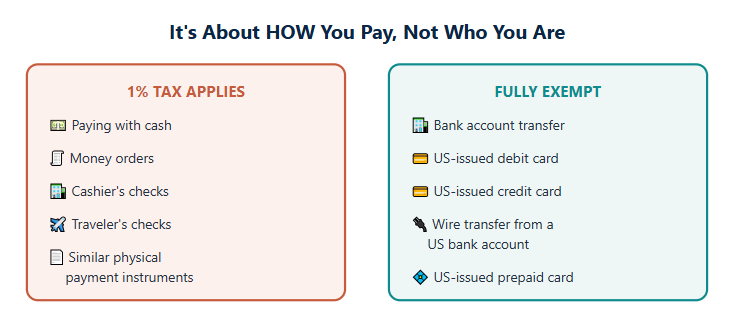
Beginning January 1, 2026, Section 4475 of the Internal Revenue Code imposes a 1% excise tax on certain remittance transfers from the United States to recipients abroad. The tax generally applies when the sender funds the transfer with cash, a money order, a cashier's check, or another taxable physical instrument. Transfers funded from qualifying financial accounts or with debit or credit cards generally are not subject to the tax.
Treasury and the IRS issued proposed regulations in April 2026 providing additional guidance, including treatment of traveler's checks, prepaid cards, checks, and anti-avoidance rules. Because some of these rules are contained in proposed regulations, taxpayers should check for subsequent final regulations or IRS guidance before relying on a specific payment method.
What has actually changed is that under the new US tax law, part of the bigger tax bill, a 1% US remittance tax for NRIs has been added to money transfers from the US to India and other such countries. This 1% tax applies to transfers made on and after January 1, 2026.
The tax is charged only on the transfer you are making and not on the income saved directly. You are not required to file anything extra for this, as the company you are using to send the money with will automatically add the tax at checkout and then pass it to the government.
The 1% remittance transfer tax is not limited to Indian students, NRIs, or non-U.S. citizens. It can apply to a domestic sender making a qualifying remittance transfer from the United States to a recipient outside the United States. The key issue is generally how the transfer is funded.
For example, a transfer funded with cash, a money order, a cashier's check, or a traveler's check can be subject to the 1% tax. A qualifying transfer funded from a financial account or with a debit or credit card generally is not subject to the tax.
Myth vs. Fact: The IRS remittance tax is applicable only to noncitizens or people on visas.
Well, the fact here is that the earlier draft of this law had an exemption for US citizens, but the exemption was removed before the law passed. Hence, the factor that actually decides whether you pay the tax is your payment method and not your visa status or citizenship status.
Indian students studying or working in the United States often send money back to their family in India on a monthly or weekly basis for the purpose of saving, paying back the education loan, supporting the family, or anything else. As a student, this matters because if you do not have a US credit history yet, this new 1% tax will add up to your remittance every single time if you plan to remit the money either by money order or cash transfer.
However, the good news is that for most students, that is a completely avoidable cost if you know how to transfer money to India smartly.
It is important to understand what this tax does it cover, as the tax is only applicable to the money that is sent out of the US to another country. The new tax has nothing to do with money coming into the US. For instance
Savetaxs helps NRIs in filing their India-US cross-border taxes by providing expert guidance on tax preparation and filing.
Because the tax depends on the payment method, avoiding it is generally simple. All you have to do is:
Having an understanding of what money medium to use and what not to use as a student who has just arrived in the US and hasn't opened a US bank account yet is essential. Because such students are often those who are most likely to pay the 1% tax. For students who regularly send money abroad, having access to a qualifying U.S. financial account can make it easier to use a funding method that is generally outside the 1% remittance tax.
Now that we are talking about the Indian student tax benefits in the USA, it is also worth knowing about a different but great tax benefit for international students. Many international students studying in the USA on a visa are taxed as NRAs nonresident aliens), and traditionally they are unable to claim the standard deduction that the general US taxpayers get.
However, there is a specific segment in the US-India tax treaty that allows Indian students and trainees in the US to claim the same standard deduction due to the fact that you are filing as an NRA. This benefit is wiee rare, and a lot of students from different counties do not have the access but but Indian students in the US do get it, and this benefit can significantly reduce the tax on any US-based stipend or income you are earning while studying in India.
Ananya is a graduate student in Ohio. Every month, she sends her mom $300 to India to help her repay the education loans that her parents took for her. For the first few months in the United States, Assume Ananya funds each $300 remittance with cash at a remittance provider. If the transaction is a qualifying remittance transfer subject to Section 4475, the 1% tax would be $3 on that $300 transfer.
After opening a U.S. bank account, she begins funding qualifying transfers directly from her account. Because transfers funded through qualifying financial accounts generally fall outside the tax, those transfers would generally not be subject to the 1% remittance tax.
Before you make an international money transfer from the US, keep the following points in mind.
Just keeping the above-mentioned points in mind, you can reduce the transfer remittance costs and stay informed about your overall US tax obligations
Savetaxs provides expert guidance on how to send money from the USA to India efficiently and in compliance of the US tax law.
In a nutshell, the new US 1% remittance tax is not applicable to every international transfer of money; however, understanding when it applies and how to avoid it can help you save taxes on every transfer. As an Indian student, NRI, or an individual sending money to India from the US, the deciding factor that you will pay this tax or not is the payment method you use, not your residential status, visa status, or any status, but the method of payment you use.
By using a US-issued debit or credit card, a US bank, instead of a money order to cash transfer, you can avoid paying the remittance tax. That said, as an Indian student residing in the USA, you must also make the most of your available tax benefits, such as the US-India tax treaty, which can help reduce your overall US tax liability.
As an Indian student, an NRI, a green card holder, or a US taxpayers seeking professional assistance with cross-border financial obligations, Savetaxs is the name to trust. Our US-India tax experts will provide experience-backed guidance on remittance tax, benefits you can claim under the US-India treaty, cross-border tax compliance, and US To India money transfer tax. The experts will further ensure that your US taxes are filed in compliance and that everything is done under the India and the US regular framework.
Connect with the US today as we serve our clients 24/7 across time zones.
This article is for general informational purposes only and does not constitute tax, legal, financial, or investment advice. Laws, regulations, rates, and procedures may change over time and may vary based on individual circumstances.
While SaveTaxs makes reasonable efforts to keep the information accurate and up to date, readers should verify applicable rules with official authorities or consult a qualified professional before making decisions based on this information.
Vipul Jain is the Co-Founder of SaveTaxs and a tax expert with experience in Indian and NRI taxation. He advises individuals, NRIs, and businesses on tax filing, tax planning, capital gains, DTAA, and compliance matters. He focuses on making complex tax concepts simple and helping taxpayers make informed, compliant decisions. See Full Bio

Want to read more? Explore Blogs