Business Setup

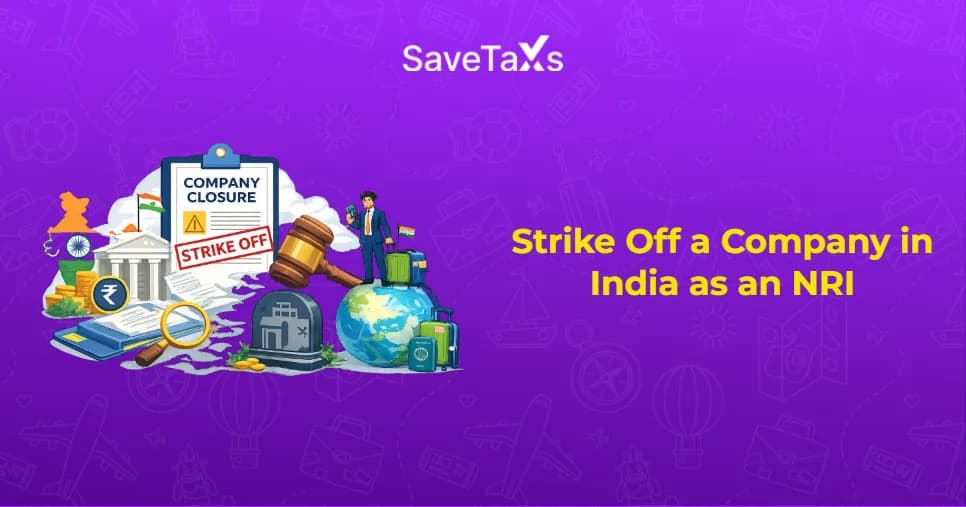
Strike Off a Company in India as an NRI

Hatim Dudhiyawala
Updated on: April 28, 202620 mins Editorial Standards
NRI Strike Off a Company in India

In the growing business world, a company, for various reasons, may cease operations. Considering this, one of the legal and popular processes for ceasing business activities is to strike off a company. Under the Companies Act, 2013, it is a formal process in which dormant or inactive companies are struck off from the official register maintained with the Registrar of Companies (ROC). The strike off a company in India for NRIs remains the same as for residents. However, they need to follow certain compliance requirements stated by FEMA regulations. 

Want to know more about striking off a company in India as an NRI? Read the blog. It explains the concept of striking off a company, types, eligibility for NRIs, process, and more

Key Takeaways
  • Only companies that have ceased business operations, have no pending liabilities, and have completed the required compliance filings are generally eligible to apply for strike off.
  • All pending annual returns and financial statements should be filed up to the financial year end of commercial activity.
  • The process includes the ROC publishing a notice, allowing a 30-day period for public objections, before removing the name of the company from the register. 
  • When striking off, the government filing fee for Form STK-2 is INR 10,000, while the total professional closure cost varies depending on certifications, pending filings, and NRI documentation requirements.
  • As NRIs, all documents (bonds/ affidavits) should be notarized in the resident country, then apostilled or consularied and sent to India for filing. 

What is the Strike Off of a Company?

A Strike off of a company can be defined as the "legal process by which the company is removed from the official register of companies by the Registrar of Companies (ROC)." Additionally, the Companies Act, 2013, also provides a straightforward mechanism to close the company through striking off. 

Sections 248 to 252 and the Companies (Removal of Names of Companies from the ROC) Rules, 2016 mention the process of striking off the name of a company. The process can start either through the ROC or through the company by voluntary application. It is designed to offer a time-saving and efficient alternative to dissolving a company. 

In simple words, strike off a company ceases it to exist as a legal entity. It is different from winding up. Under this, the name of the company is removed from the ROC, and it no longer carries on active business operations; however, past liabilities, regulatory defaults, or director responsibilities may still be examined under law. 

This was all about the strike off of a company. Moving ahead, let's know the types of it.

Fulfill Your NRI Business Tax Obligations on Time

With expert guidance from Savetaxs, fulfill your tax obligations on time and stay compliant with laws.

Types of Strike Off a Company

Under the Companies Act, 2013, there are two ways to strike off a company, i.e., voluntary strike off and striking off by the Registrar of Companies (ROC). The second method is undertaken by the suo moto for defaulting and inactive companies. Let's know about both types in detail:

Voluntary Strike Off by the Company

If a company has stopped doing business and formally wants to shut down, by filing Form STK-2 with the ROC, it can apply for strike off. It is one of the most common ways private limited companies and startup to close down that no longer operate.

Further, the following are the conditions for voluntary strike off a company:

  • Not conducting any business activity in the last two financial years
  • All filings are up to date
  • No unresolved liabilities, pending statutory defaults, or active legal disputes
  • Consent from all shareholders/ directors

Suo Motu (Compulsory) Strike Off by ROC

Under certain circumstances, the ROC or the Centre for Processing Accelerated Corporate Exit (C-PACE) can start the strike off a company process on their own (suo-moto). Here are the following conditions to close a company in India under the ROC:

  • Within 1 year of incorporation, the company has not started its business.
  • For the last two financial years, it has not done any business and has not applied for dormant status. 
  • Not replying to ROC notices.
  • Not having a valid registered office.
  • The company fails to file annual returns or other statutory filings.

Once a company is struck off, it is no longer permitted to operate, enter into contracts, or hold assets. 

These are types of strike off a company in India. These methods also remain the same for NRIs having a company in India. Now, moving further, let's know the eligibility for NRIs to strike off a company in India. 

Eligibility for NRIs to Strike Off a Company

Before NRIs start the process of striking off a company in India, they need to fulfill statutory conditions. At this stage, non-compliance with the Companies Act, 2013, is the most general cause of rejection. Considering this, core eligibility parameters for NRIs to strike off a company include:

  • The company has ceased its operations, or after incorporation, never started its business.
  • All ROC filings, including AOC-4, MGT-7 are up to date
  • There are no outstanding liabilities present in the name of the company. It includes creditors, taxes, and statutory dues. 
  • Consent of a minimum of 75% of shareholders (by paid-up capital)
  • There are no legal proceedings.

Moreover, for an NRI founder, striking off a company includes an additional layer, i.e., ensuring any foreign investment compliances (RBI/ FEMA filings) are fully closed.

This was all about the eligibility criteria for NRIs to strike off a company in India. Moving forward, let's know the process of voluntarily striking off a company in India.

Process to Voluntary Strike Off a Company

Here are the steps for the voluntary procedure to strike off a company in India:

  • Step 1: Board Resolution
    • To approve the strike-off decision from the ROC, the board of directors of the company should first pass a board resolution. 
  • Step 2: Clearance of Liabilities
    • An NRI should clear all its outstanding dues before applying for the strike off of a company in India. It includes settling liabilities and debts, and certifying that the company is free from financial obligations. Additionally, if there are no liabilities in the name of the company, a declaration should be made to this effect. 
  • Step 3: Extraordinary General Meeting (EGM)
    • To pass a special resolution, a company should convene an Extraordinary General Meeting (EGM). To start the strike-off process, a special resolution is needed. Additionally, in terms of paid-up capital, a consent of at least 75% of shareholders is also required.
  • Step 4: Filing of Form MGT-14
    • Once the special resolution is passed, the company with the ROC should fill out e-form MGT-14. Within 30 days of the resolution passing, this form should be filled out, and a copy of the passed special resolution in the EGM should be attached to it. 
  • Step 5: Filing of E-form STK-2
    • After that, a company should then fill out the E-form STK-2 with the Registrar. It is a formal application that needs to be filed during the strike-off of the company name. Additionally, along with this form, the company needs to submit a few documents. The government filing fee for Form STK-2 is INR 10,000. Further, the total cost of striking off a company generally ranges between INR 12,000 and INR 20,000+, depending on professional certification, documentation, pending compliance filings, and NRI-related document execution requirements.
  • Step 6: Public Notice and Objections
    • Once the application is processed, a notice is published in the Official Gazette and in two newspapers by the ROC, inviting public objections. This is mentioned in Form STK-5A. Within 30 days, if no objections are raised, the process will move forward.
  • Step 7: Final Strike-Off Notification
    • If there are no objections from the public and the ROC is satisfied with the register, the company name will be struck off. Considering this, in the Form STK-7, a final dissolution notice will be issued. It is published on the Ministry of Corporate Affairs (MCA) and on the Official Gazette website. From this publication date, the company will then stand dissolved.

This is how NRIs can voluntarily strike off a company in India. Now, moving ahead, let's know the procedure of striking off a company by the ROC. 

Procedure for Striking Off a Company by ROC

Striking off a company by the ROC includes several steps. It certifies that the name of the company is officially removed from the Register and its legal existence comes to an end. The process includes:

  • Notice from ROC: The ROC will send a formal notice, i.e., E-form STK-1, to the company. It showcases the intention of it to strike off the name of the company from the Register. To respond to the notice, 30 days' time is given to the company with any supporting documents or valid objections. 
  • Public Notice: In case the company does not respond to the notice on time or provide no satisfactory explanation, the ROC in E-form STK-5 will publish a public notice. It invites the objection from the public. After that, this notice is published in the Official Gazette, on the MCA website, and in two newspapers.
  • Objections and Response: If the public raises any objection, the ROC will review them and check whether to proceed with the strike-off or not. Within 30 days, if no objection is raised by the public, the strike-off process will proceed. 
  • Strike-Off Confirmation: Once the notice period expires and in the absence of objections, a final notification in E-form STK-7 will be issued by the ROC. It is declared in the Official Gazette, confirming the strike-off of the company. From the publication date, the company is considered dissolved and its name removed from the ROC. 

So, this is how the ROC strikes off a company. Moving further, let's know the key compliance for NRIs.

Key Compliance for NRIs

While the striking-off process remains the same for NRIs and residents. However, NRIs need to navigate additional compliance. This includes:

  • FEMA and RBI Compliance if the company had foreign investment.
    • Ensure all FEMA filings, like annual returns and FC-GPR, are complete
    • No pending reporting obligations
  • Tax Compliance
    • All income tax returns are up to the closure date
    • Reconcile with Form 26AS/ AIS
    • Clear all outstanding tax demands
  • ROC Filings
    • Before applying for strike-off, complete all pending annual filings.
    • Non-filings can lead to disqualification or penalty risks.
  • Digital Signatures (DSC)
    • Active DSCs are vital for directors, specifically when filing remotely. In NRI founder strike off a company cases, expired DSCs are a frequent bottleneck.

This is the key compliance for NRIs when striking off a company in India. Moving forward, let's know the documents required for an NRI to strike off a company. 

Stay Updated with Business & Compliance Insights

Connect with Savetaxs and get expert updates on company registration, tax filings, startup compliance, and investment planning.

Get Started!

Documents Required for NRI Strike Off a Company

Documents required for NRI strike off a company include:

Mandatory Documents

  • Board resolution
  • Indemnity Bond in STK-3 (notarized)
  • Affidavit by directors (STK-4)
  • Special resolution or consent from a shareholder
  • CA-certified Statement of Accounts not older than 30 days from the application date.
  • Bank closure certificate
  • PAN and certificate of incorporation

Additional for NRIs

  • Copy of passport
  • Overseas address proof
  • Apostilled documents (if executed abroad)

Further, inconsistent or improper documentation can trigger resubmissions and a long procedure. 

Final Thoughts

Lastly, the strike-off of a company is a formal way of closing down a company when it fails to meet regulatory requirements or is no longer needed. While it provides a clean exit for businesses, it is vital to follow the proper legal procedure. Additionally, ensure that all debts of the company are cleared and no tax obligations are left unresolved. To strike-off a company in India as an NRI, you need to follow the same process as residents. 

To avoid potential complications such as issues with creditors or personal liability, seek legal advice. For this, you can connect with Savetaxs. Our experts will guide you throughout the process and make all things easy for you.

Note: This guide is for information purposes only. The views expressed in this guide are personal and do not constitute the views of Savetaxs. Savetaxs or the author will not be responsible for any direct or indirect loss incurred by the reader for taking any decision based on the information or the contents. It is advisable to consult either a CA, CS, CPA or a professional tax expert from the Savetaxs team, as they are familiar with the current regulations and help you make accurate decisions and maintain accuracy throughout the whole process.

About Author
Hatim Dudhiyawala
Hatim Dudhiyawala Certified Public Accountant (CPA)

Hatim Dudhiyawala is a Certified Public Accountant (CPA) with SaveTaxs and specializes in Indian and NRI taxation. He advises individuals, NRIs, and businesses on income tax filing, capital gains taxation, DTAA benefits, fund repatriation, and tax compliance. With experience in cross-border tax matters, Hatim helps taxpayers understand complex regulations and make informed decisions. Through his articles, he shares practical insights to help readers stay compliant and manage their tax obligations with confidence. See Full Bio

FREE Assistance
Start Your Business in India as an NRI

Get expert help with company registration, compliance, and tax setup in India.

Get Assistance
source bage
Recent Post

Want to read more? Explore Blogs

Frequently Asked Questions

Striking off a company means removing the name of the company from the Register of Companies maintained by the Registrar. Considering this, once struck off, the company cannot continue its business operations or hold any assets in its name. Additionally, it ceases to legally exist.

Strike off of a company is a simplified closure process with no assets, liabilities, or operations. In contrast, winding up is a formal legal process. It includes settlement of liabilities, liquidation of assets, and tribunal intervention. Additionally, the winding-up process is more comprehensive, whereas strike off is faster.

In India, the strike-off process generally takes three to six months from the application date. During this procedure, the ROC verifies documents, issues a public notice, and if it does not receive any objections, through notification, the company is officially dissolved.

A company that has not been conducting business operations for two consecutive financial years and has no pending liabilities can apply for voluntary strike off. Additionally, it must obtain approval from the shareholders or directors.

No, a company with outstanding liabilities cannot apply for strike off. All dues, debts, and statutory obligations should be settled beforehand. The ROC requires indemnity bonds and a declaration confirming there are no pending liabilities before approving the application.