
NRI Income Tax Compliance
How to Claim Excess TDS Refund After Selling Property in India as an NRIHow to Claim Excess TDS Refund After Selling Property in India as an NRI
Written by Shubham Jain
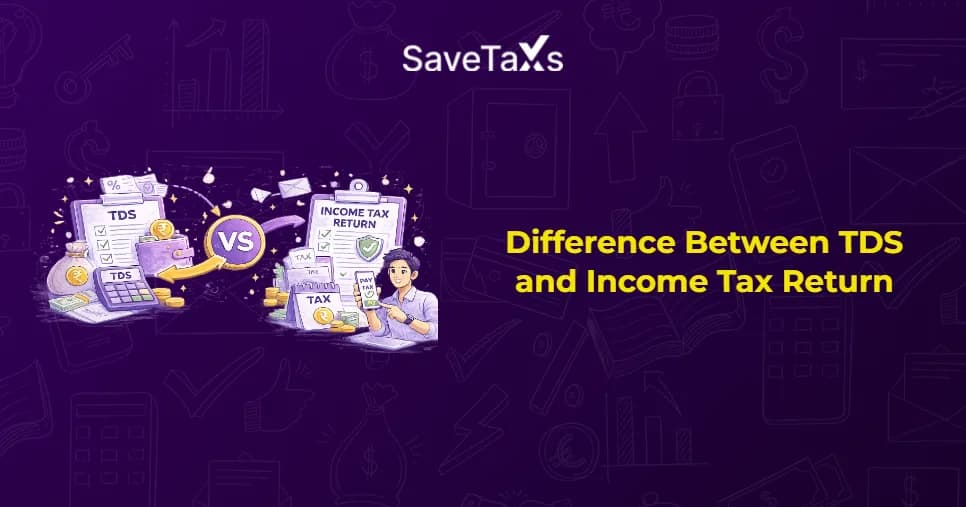
For NRIs earning income in India through rent, bank interst, dividend, or property sale, it's quite common to come across two terms that create a lot of confusion. These terms are TDS and ITR. Many NRIs have this wrong assumption that their tax obligation gets over once tax is deducted at source.
This wrong assumption often costs them lakhs of rupees in unclaimed refunds every year. In this blog, we will cover TDS vs ITR for NRIs in simple terms, know the current rates, and understand when and why you need to file a return even after TDS has been deducted already.
Under Section 195 of the Income Tax Act, TDS (Tax Deducted at Source) is a mechanism where anyone paying you, like a bank, tenant, or company, deducts income tax before the money reaches you and deposits it directly with the government.
For Non-Resident Indians (NRIs), this tax is automatically taken out at a much higher flat rate than for residents because the government cannot easily track an NRI's global income. The most important thing to remember is that this high TDS rate is just a temporary estimate, not your final tax bill,
Here are the common TDS rates for NRIs based on the type of income:
| Type of Income | TDS Rate |
|---|---|
| Dividend income | 20% + surcharge & cess |
| Rental income | 31.2% (30% + surcharge + cess) |
| Interest on NRO account/deposits | 30% + surcharge & cess |
| Long-term capital gains on property held for more than 24 months | 13% |
| Short-term capital gains on property | As per the slab rate |
| Other payments under Section 195 | Typically 20%, subject to DTAA treaty |
**Note: No TDS applies on interest on NRE and FCNR accounts as these are fully tax-exempt in India under Section 10(4)(iii) and 10(15)(iv). However, you must still report it in your ITR as exempt income.
Contact Savetaxs and file your ITR easily with no stress or hassle.
An Income Tax Return (ITR) is the annual filing where you report your total Indian income, apply the correct deductions and exemptions, calculate your actual tax liability, and reconcile it against the TDS already deducted.
Now, this is where the two terms connect. TDS is the tax collected automatically throughout the year, while an ITR is the final record that shows the government exactly what you owe and helps you get back any excess money you already paid.
An NRI must mandatorily file an ITR if their total Indian income exceeds the basic exemption limit, which is:
Even if your income is below the exemption limit, you should file an ITR if excess TDS has been deducted and you wish to claim a refund. This is because filing an ITR is the only way to claim a refund for the excess TDS deducted.
For FY 2025-26, the deadline to file an ITR for NRIs with no audit cases is the 31st of July 2026 (unless extended).
The Indian government deducts tax (TDS) automatically from your income at flat, high rates. They don't check your actual financial situation automatically. So, if you don't file an ITR, you will lose the money because the system ignores:
If you do not file your ITR within the applicable time limits, you may lose the opportunity to claim a refund of excess TDS.
Sakshi is an NRI who holds a fixed deposit in an NRO account and earns ₹1 lakh in interest, with no other Indian income. The bank automatically deducts TDS at 30%, which is ₹30,000. However, since her total Indian income is below the ₹2.5 lakh threshold (or ₹4 lakh under the new regime), she owes zero tax.
Also, her entire ₹30,000 remains with the tax department instead of being refunded unless she files an ITR.
Instead of waiting for a refund after excess payments, NRIs can take the following steps:
For NRIs, the correct ITR forms depend entirely on the source of income:
NRIs cannot file ITR-1, as it is strictly reserved for resident Indians.
The table below lists the key differences between TDS vs ITR for NRIs:
| Factor | TDS (Tax Deducted at Source) | ITR (Income Tax Return) |
|---|---|---|
| What is it | TDS is the tax deducted upfront by the payer | ITR is the annual return filed to report total income |
| When it happens | At the time of payment/credit | Once a year, after the end of the financial year |
| Who does it | Payer (bank, tenant, buyer) | The NRI taxpayer |
| Purpose | Provisional tax collection | Final tax calculation and reconciliation |
| Can it be reduced? | Yes, by submitting DTAA/Form 13 | Not applicable as this is where you claim refunds |
| Is filing mandatory? | Not applicable as it is deducted automatically | Yes, if income exceeds the exemption limit or the refund is due |
You must keep the following documents ready before filing the ITR:
Hire an expert at Savetaxs and get personalized assistance throughout the ITR filing process.
TDS and ITR are not competing concepts; instead, they are two halves of the same process. TDS is collected by the government upfront, while ITR is used to tell them what you actually owe and claim back the rest. Failing to file ITR after TDS has been deducted will leave your money on the table.
If you also had tax deducted on Indian income this year, don't assume that your tax obligation ends here; file your return and claim your rightful refund. If you find it overwhelming, contact an expert at Savetaxs. Our experts can help you file an accurate ITR on time to ensure compliance and help you claim your refunds. Contact us right away as we are actively working 24/7 across all time zones.
This article is for general informational purposes only and does not constitute tax, legal, financial, or investment advice. Laws, regulations, rates, and procedures may change over time and may vary based on individual circumstances.
While SaveTaxs makes reasonable efforts to keep the information accurate and up to date, readers should verify applicable rules with official authorities or consult a qualified professional before making decisions based on this information.
Shubham Jain is the Founder of SaveTaxs and has extensive experience in Indian and NRI taxation. He advises individuals, NRIs, and businesses on tax filing, tax planning, capital gains, DTAA benefits, fund repatriation, and compliance matters. He regularly writes about taxation and related financial topics. His focus is on making complex tax concepts easy to understand. Through his articles, he helps taxpayers stay informed, avoid common mistakes, and stay compliant with Indian tax laws. See Full Bio
Want to read more? Explore Blogs