US Tax Filing and Compliance
S Corporation Salary vs Distributions: How Owners Should Pay ThemselvesS Corporation Salary vs Distributions: How Owners Should Pay Themselves
Written by Shubham Jain
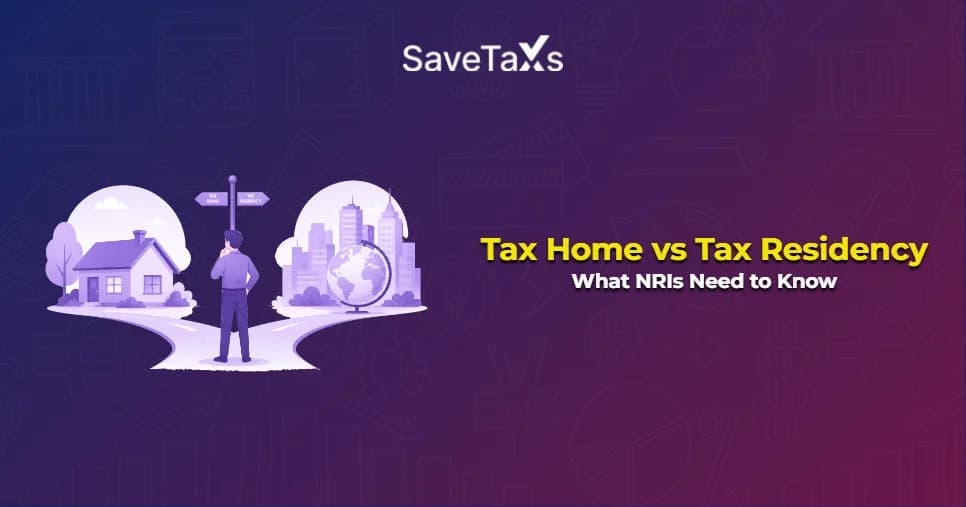
Tax home and tax residency are two terms often used interchangeably in conversation. They may sound similar, but they are two different concepts. Tax residency and tax home are different concepts. Tax residency helps determine how and where you are taxed, while tax home generally refers to the location of your main place of work or business. For the Foreign Earned Income Exclusion (FEIE), having a foreign tax home is one of the required conditions, along with meeting either the bona fide residence test or physical presence test.
When your family lives in one country, while you work in another, your home, tax residency, and personal ties may indicate different places. It's important to understand the difference to avoid incorrect filings or missed tax benefits. To help you, this blog covers the difference between the two terms: tax home vs tax residency.
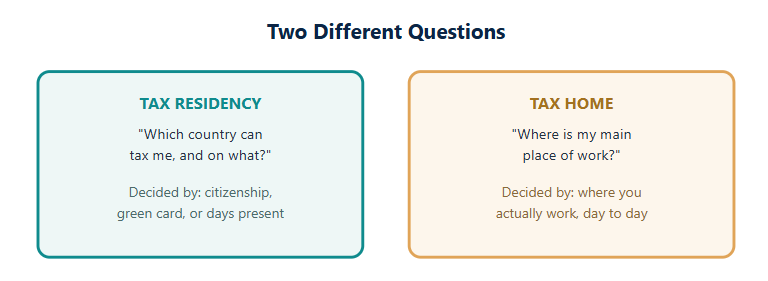
If we talk about the difference between these two concepts in one line: tax residency determines your overall tax status and whether a country can tax your income. On the other hand, tax home typically refers to the place where your main work or business is located and determines whether you qualify to claim the foreign-earned income exclusion (FEIE).
One easy way to remember this is:
It's possible to have a foreign tax home while also being a tax resident in the US; this can occur when a US citizen works full-time in India. Hence, it's crucial to understand this difference. Now, let's understand both the terms separately in detail.
The decision of whether a country will tax you at all and, if so, on what income is determined by considering your tax residency. So,
In the US, you will be considered a tax resident if you satisfy any of the following conditions:
You will be considered a tax resident in India mainly based on the number of days you spend there during any financial year. The count can be roughly half the year or more.
You may or may not have tax residency for a particular year. It means it is mainly about where you happen to be at a given moment, and it doesn't change every day.
Further, let's understand what tax home is in detail.
The particular city or area where your regular job, business, or place of duty is situated is basically your tax home. In simple words, the tax home is your main place of work. It's mainly considered for two purposes:
As a US citizen, you can have your tax home in Mumbai while also being a US resident. These two situations will not conflict at all.
You might have heard about tax residency and its importance earlier, but why does the tax home matter? Let's learn about that.
For a US citizen or green card holder living and working outside the US, it may be possible to exclude a significant portion of their foreign salary entirely from US tax if they qualify. This particular benefit is known as the foreign earned income exclusion.
Now, to be eligible to claim this benefit, one key requirement is that your tax home must be a foreign country. Your actual regular place of work is considered, not where your family lives or where you cast your vote.
You might end up claiming a benefit that you didn't qualify for or miss out on a valid tax break if you don't get your tax home right.
Next comes the main part that confuses many people: the "abode" trap. Let's look at what this is.
If you have a job or live outside the U.S., it doesn't always mean that you qualify for the foreign earned income exclusion. Confusing right? This is where the "Abode" trap situation comes into the picture.
The "abode" trap refers to a situation in which you live or work outside the U.S., but the IRS may still consider your abode to be in the U.S. due to your strongest personal, family, or economic ties being there. In this situation, your eligibility to claim the exclusion may be affected.
Still didn't understand? Don't worry, let's look at a real-world example to make it easier.
Rajesh works full-time in India, and his spouse and children still live in the United States. He holds his main bank accounts in the U.S. and travels there frequently. Now, for Rajesh, the "abode" trap situation might occur.
Although his actual place of work is in India, he may still find his "abode" treated as being in the US. As a result, he might lose eligibility to claim the foreign earned income exclusion even if he has a foreign job.
Apart from the abode trap, there's another question that confuses many individuals: whether a person can be a US tax resident while having a foreign tax home. Let's discuss that.
Yes, as mentioned above, it's actually the normal requirement to qualify for the foreign earned income exclusion. A US citizen working in India will still be a tax resident of the US while also having a tax home in India.
These two facts fit well together, and neither cancels out the other. However, if you are not a US tax resident but trying to use a US-specific tax home rule, this situation may become unusual. Once you become a US tax resident, the concept of tax home becomes especially important.
To recap everything, let's look at a comparison table.
The table below lists the key differences between tax home vs tax residency status:
| Features | Tax Residency | Tax Home |
|---|---|---|
| What it decides | Whether a country taxes you and, if so, on what income | Whether you qualify for the foreign earned income exclusion and certain travel deductions |
| Based On | Citizenship, green card, or the number of days spent in the country | The place where your regular job or business is based |
| Can it change during the year? | Generally, it's a full-year status but can change year to year | It can shift when your main place of work changes |
| Does the family's location matter? | Not directly | Indirectly, through the related "abode" test |
| Who usually cares about this? | Anyone figuring out their overall filing obligations | Mainly US citizens, green card holders who work abroad and claim the FEIE |
For easier understanding, let's look at an example.
Kinjal is a US citizen who moved to Bangalore to take a full-time job at a local company. In this case, her tax residency is clear and will not be affected by her shifting. Since she's a US citizen, she will still be considered a tax resident in the US, regardless of where she lives.
However, her tax home will change. So, since Bangalore is now her workplace, her tax home is India. Now comes another part, "abode".
After some time, her spouse and household relocate with her, which effectively makes her "abode" centered in India rather than the US. Now, as we can see, both her tax home and abode are clearly foreign; she might qualify to claim the foreign earned income exclusion on her Indian salary. Even while staying and continuing to file as a US tax resident, she can still enjoy this benefit.
Lastly, we will look at a quick checklist to consider when determining your tax residency and tax home.
Connect with Savetaxs for professional US tax guidance, planning, advice, and support.
You must now have a clear idea of the difference between tax home vs tax residency. For NRIs, US citizens, or green card holders living and working in India, it becomes significantly important to understand this difference. Tax residency determines your overall tax and filing obligations, while tax home is important when determining your eligibility to claim the foreign earned income exclusion (FEIE).
Moreover, having US tax residency doesn't automatically mean you can't have a foreign tax home. Besides, you can still be a US tax resident while having India as your tax home by working full time in India as a US citizen.
Still confused about your tax home, tax residency, FEIE eligibility, or abode? Connect with the experts at Savetaxs. Our expert team can offer cross-border tax guidance and help you understand your tax home and tax residency. We will ensure you claim all the benefits you are eligible for while staying compliant with all the rules and regulations. Contact us right away, as we are actively working 24/7 across all time zones.
This article is for general informational purposes only and does not constitute tax, legal, financial, or investment advice. Laws, regulations, rates, and procedures may change over time and may vary based on individual circumstances.
While SaveTaxs makes reasonable efforts to keep the information accurate and up to date, readers should verify applicable rules with official authorities or consult a qualified professional before making decisions based on this information.
Vipul Jain is the Co-Founder of SaveTaxs and a tax expert with experience in Indian and NRI taxation. He advises individuals, NRIs, and businesses on tax filing, tax planning, capital gains, DTAA, and compliance matters. He focuses on making complex tax concepts simple and helping taxpayers make informed, compliant decisions. See Full Bio

Want to read more? Explore Blogs