NRI Income Tax Compliance
Income Tax Forms Renamed in 2026: Old vs New Form NumbersIncome Tax Forms Renamed in 2026: Old vs New Form Numbers
Written by Vipul Jain


If you are an NRI who regularly visits India, 1 April 2026 may look like a major deadline because the Income-tax Act, 2025 replaces the earlier tax law. But the important point is that the new Act does not completely rewrite the basic individual tax-residency tests. In this guide, you'll learn the full residential status rules for NRIs, what changed, what stayed the same, and how to assess your residential status for FY 2026–27.
The Income-tax Act, 2025 applies from FY 2026–27, while FY 2025–26 continues under the Income-tax Act, 1961.
The basic individual residency tests remain unchanged, including the 182-day test and applicable 60-day plus 365-day framework.
The 120-day rule continues for qualifying Indian citizens and persons of Indian origin visiting India when specified non-foreign-source income exceeds ₹15 lakh.
Deemed residency continues under the new Act for qualifying Indian citizens meeting the prescribed conditions.
RNOR conditions remain substantially unchanged, including the nine-out-of-ten-year and 729-days-or-less tests.
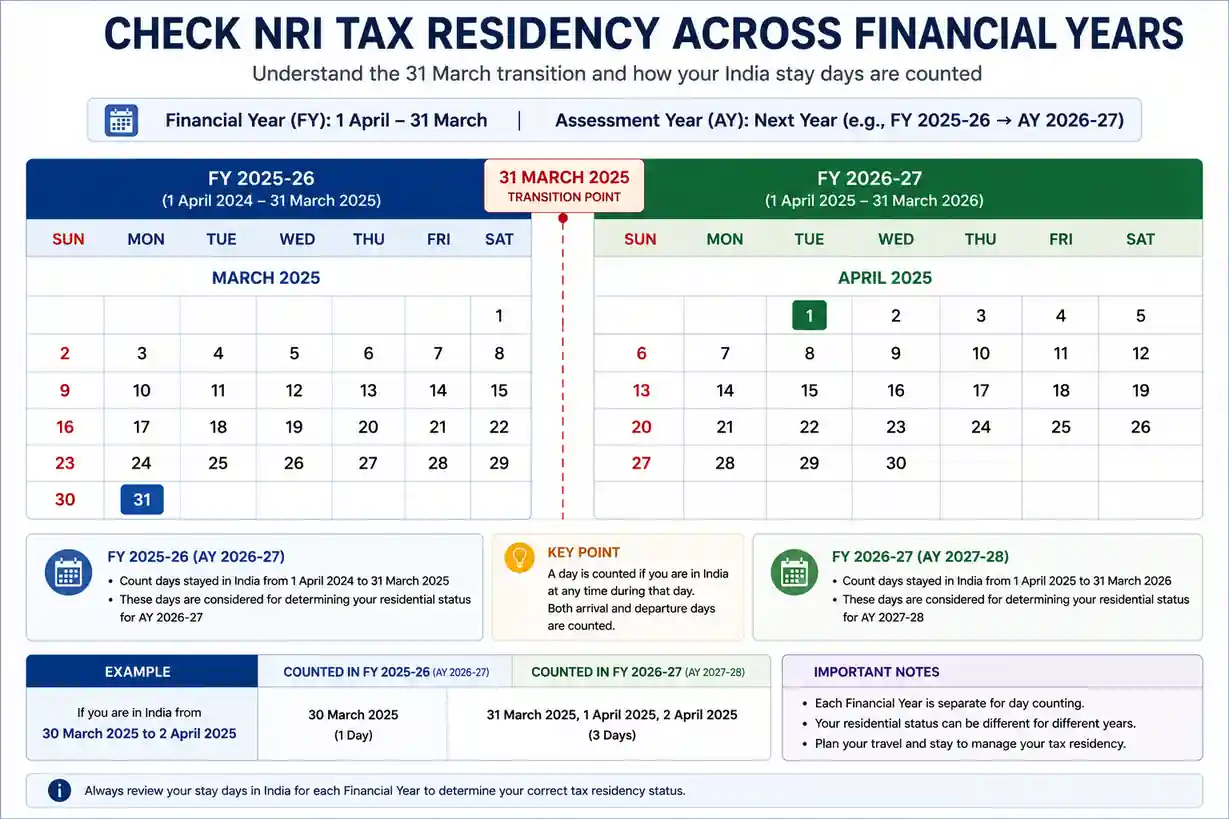
Residential status is determined separately for each tax year, so a stay crossing 31 March 2026 must be assessed under both applicable laws.
NRIs should track India stay days and relevant income carefully rather than assuming that staying below 182 days automatically means non-resident status.
NRI tax residency rules determine whether an individual is Resident, Non-Resident, or Resident but Not Ordinarily Resident (RNOR) for a particular Indian tax year. For FY 2026–27, these rules are contained in the Income-tax Act, 2025.
First, the most important clarification is that the fundamental individual residency conditions did not change under the new Act. The Income Tax Department confirms that an individual generally becomes resident if they stay in India for 182 days or more during the relevant tax year, or satisfy the applicable 60-day stay plus 365-day stay in the preceding four years test.
For example, an individual who spends 190 days in India during FY 2026–27 generally crosses the 182-day threshold, subject to the specific rules and exceptions applicable to that person.
At the same time, 1 April 2026 is still an important transition date because the Income-tax Act, 2025 applies to tax years beginning on or after that date. Tax years beginning before 1 April 2026 remain governed by the 1961 Act.
Tax residency matters because residential status determines the framework used to establish the scope of Indian income-tax liability. Therefore, determining your status is an important first step before assessing your broader Indian tax position.
Moreover, India primarily uses physical presence as part of its residency tests, making accurate travel records essential. For example, an NRI who believes they stayed for 115 days but actually stayed for 125 days may need to examine the special 120-day provisions.
The transition also matters because the same individual may be assessed under different Acts for consecutive years. FY 2025–26 uses the 1961 Act, whereas FY 2026–27 uses the 2025 Act.
The core NRI individual residency tests did not materially change from 1 April 2026; the major change is that the Income-tax Act, 2025 now governs tax years beginning on or after that date. The Income Tax Department expressly confirms that the basic conditions for individual residency remain unchanged.
| Residency aspect | FY 2025–26 | FY 2026–27 |
|---|---|---|
| Applicable law | Income-tax Act, 1961 | Income-tax Act, 2025 |
| 182-day test | Applies | Applies |
| 60-day + 365-day framework | Applies, subject to exceptions | Applies, subject to exceptions |
| Special 120-day framework | Applies | Continues |
| Deemed residency | Applies under old Act | Corresponding provision continues |
| RNOR continuity tests | Apply | Continue |
First, this means you should not treat April 2026 as the introduction of an entirely new NRI residency regime. The new legislation reorganizes and replaces the earlier framework, while the core individual residency conditions continue.
The applicable law follows the beginning of the tax year, not the date on which an income-tax return, assessment, or reassessment takes place. The Income Tax Department specifically confirms that residential status for a tax year beginning before 1 April 2026 continues to be determined under the 1961 Act.
For example, income earned during FY 2025–26 is reported for AY 2026–27 under the 1961 Act, even if the return is filed after 1 April 2026.
The 120-day rule applies to qualifying Indian citizens and persons of Indian origin visiting India where total income, other than income from foreign sources, exceeds ₹15 lakh and the prescribed conditions are satisfied. The rule can affect individuals who stay in India for 120 days or more but less than 182 days.
First, the ₹15 lakh threshold is critical because 120 days alone does not automatically trigger the special provision. The relevant income condition and preceding-year stay requirement must also be examined.
For example, an eligible PIO who spends 130 days in India and has more than ₹15 lakh of specified non-foreign-source income should not assume that staying below 182 days automatically preserves non-resident status.
Second, the applicable framework also considers 365 days of stay during the preceding four years. Therefore, historical India visits can affect the analysis even when the current year's stay is below 182 days.
For example, someone spending 130 days in India during FY 2026–27 who also satisfies the relevant 365-day historical condition needs to examine the special 120-day provisions carefully.
Deemed residency continues under the Income-tax Act, 2025 for qualifying Indian citizens with more than ₹15 lakh of income other than income from foreign sources who are not liable to tax elsewhere because of domicile, residence, or a similar criterion.
Moreover, RNOR criteria have not been modified under the new Act. An individual can qualify as RNOR where they were non-resident in nine out of the ten preceding years or stayed in India for 729 days or less during the seven preceding years, subject to the applicable provisions.
For example, a former NRI who becomes resident under the basic residency test may still qualify for RNOR status if they satisfy the relevant historical conditions.
A stay crossing 31 March 2026 must be evaluated separately for FY 2025–26 and FY 2026–27 under the law applicable to each tax year. The Income Tax Department confirms that earlier-year stay can still be relevant when applying look-back conditions under the new Act.
First, calculate the relevant India stay for FY 2025–26 through 31 March 2026 under the 1961 Act. Then calculate the FY 2026–27 position from 1 April 2026 under the 2025 Act.
For example, if an NRI stays in India from 1 March to 30 April 2026, the March portion belongs to FY 2025–26 and the April portion belongs to FY 2026–27. The two tax years require separate residential-status assessments.
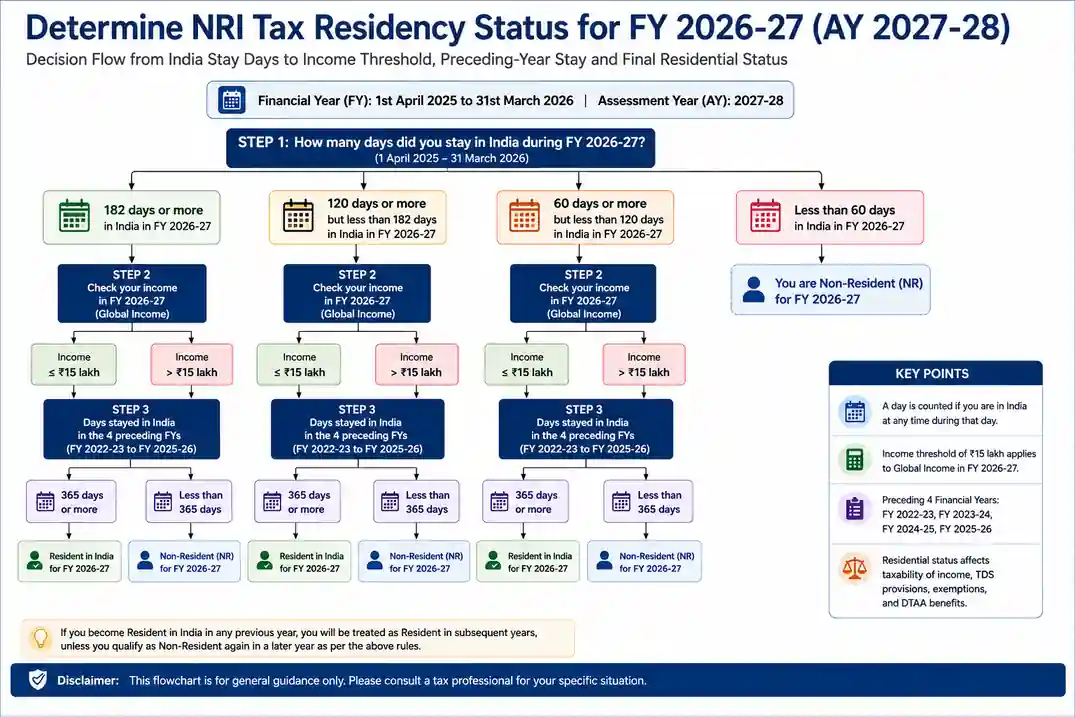
You can determine your residential status by following a year-specific day-count process rather than relying on your general NRI status.
First, follow these steps:
Identify the tax year you are assessing.
Count your India stay days using passport, immigration, ticket, and travel records.
Apply the 182-day test where relevant.
Check the applicable 60-day plus 365-day test and any exceptions.
Examine the 120-day and ₹15 lakh conditions if you are a qualifying Indian citizen or PIO visiting India.
Review deemed-residency and RNOR conditions where applicable.
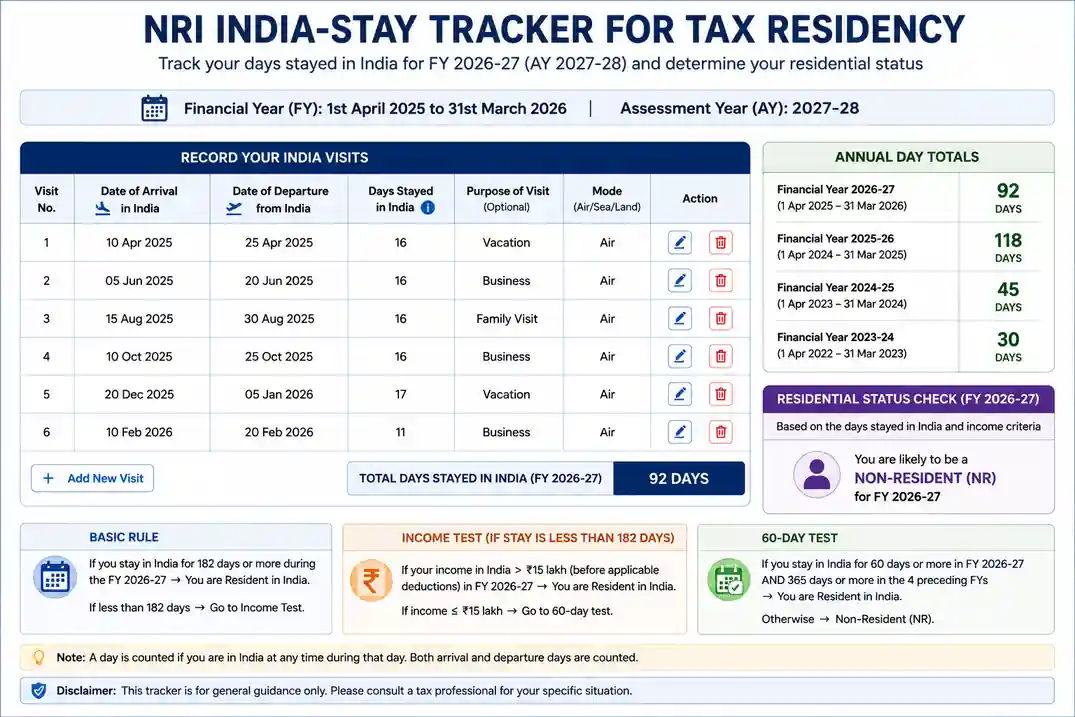
NRIs should maintain a documented India-stay record for every financial year and reassess their residential status annually. A simple tracker can reduce errors when you make several trips to India.
Moreover, maintain records covering:
Arrival and departure dates for every India visit.
Total India stay during the relevant tax year.
India stay during applicable preceding years.
Income relevant to the ₹15 lakh threshold.
Supporting travel documentation.
Finally, do not confuse Indian tax residency with residency under another country's domestic law or a tax treaty. If your stay is close to a statutory threshold or you may be tax resident in more than one country, professional tax advice can help assess the facts correctly.
The main NRI tax residency change from 1 April 2026 is the transition to the Income-tax Act, 2025, rather than a wholesale rewrite of individual residency rules. The 182-day test, applicable 60-day plus 365-day framework, special 120-day provisions, deemed residency, and RNOR continuity rules continue under the new framework.
Therefore, NRIs should focus on the correct tax year, actual India stay, relevant income threshold, and historical stay records. By maintaining accurate travel documentation and applying the correct Act to each year, you can make your residential-status assessment more reliable.
This article is for general informational purposes only and does not constitute tax, legal, financial, or investment advice. Laws, regulations, rates, and procedures may change over time and may vary based on individual circumstances.
While SaveTaxs makes reasonable efforts to keep the information accurate and up to date, readers should verify applicable rules with official authorities or consult a qualified professional before making decisions based on this information.
Vipul Jain is the Co-Founder of SaveTaxs and a tax expert with experience in Indian and NRI taxation. He advises individuals, NRIs, and businesses on tax filing, tax planning, capital gains, DTAA, and compliance matters. He focuses on making complex tax concepts simple and helping taxpayers make informed, compliant decisions. See Full Bio

Want to read more? Explore Blogs