NRI Income Tax Compliance
CBDT Form 173A: Eligibility, Tax Exemption Rules and Details Required (2026)CBDT Form 173A: Eligibility, Tax Exemption Rules and Details Required (2026)
Written by Shubham Jain
_1764918370.webp&w=3840&q=75)
An Indian who moves to the United States, a green card holder who returns to India, or an NRI who maintains significant connections with both countries may need to review tax residency under both Indian and U.S. law. Each country applies its own residency rules, and those rules do not always produce the same result.
This situation is commonly called dual tax residency. It can affect which income must be reported, which tax returns may be required, and whether relief under the India–US Double Taxation Avoidance Agreement (DTAA) or foreign tax credit rules is available.
However, being a tax resident of both countries does not automatically mean that every item of income will be taxed twice. The outcome depends on the type and source of income, domestic tax rules, applicable treaty provisions, and the taxpayer’s individual circumstances.
Dual tax residency occurs when two countries treat the same individual as a tax resident under their respective domestic tax laws for a relevant period. This does not automatically mean that both countries will tax every item of income or that the individual will have the same residence status under the applicable tax treaty.
For example, an Indian citizen may move to the United States for employment but retain income from Indian property. Depending on their days of presence, residential status, and other circumstances, both countries may have a basis to treat that person as resident for tax purposes.
The key point is that tax residency is not determined solely by citizenship, visa type, or the country where a person currently lives. The applicable domestic law must be examined for each country and tax period.
These terms are not interchangeable.
| Term | Meaning |
|---|---|
| Dual tax residency | Two countries treat a person as a tax resident under their respective domestic rules. |
| U.S. dual-status taxation | A person is generally a U.S. resident alien for part of a tax year and a nonresident alien for another part. |
| Double taxation | The same income is taxed by two countries, subject to any available relief. |
The IRS expressly distinguishes dual-resident taxpayers from dual-status taxpayers. Someone who arrives in or departs from the United States during the year may have a dual-status filing issue even if the person’s situation is not the same as a broader India–US dual-residency conflict.
If your main concern is a change in U.S. tax status during your arrival or departure year, read Savetaxs U.S. Dual-Status Tax Rules guide.
Get help understanding your India and U.S. tax filing obligations, income reporting, and applicable tax relief.
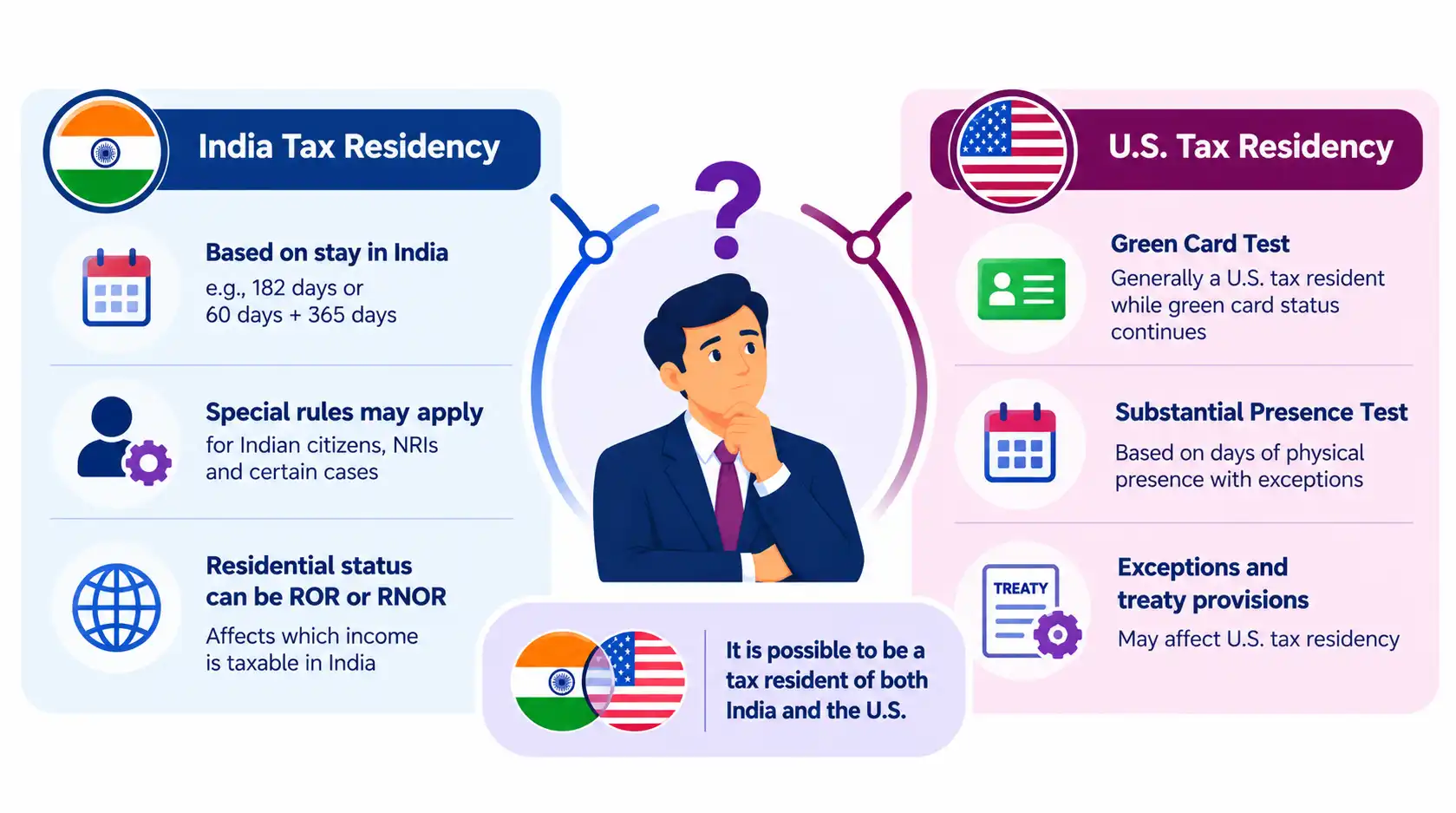
India and the United States use different rules to determine individual tax residency. U.S. citizens generally remain subject to U.S. federal income tax on worldwide income while living abroad. For individuals who are not U.S. citizens, U.S. tax residency generally depends on the Green Card Test or the Substantial Presence Test, subject to applicable exceptions and treaty provisions. Indian residential status must be determined independently under the Indian law applicable to the relevant tax year.
For Indian tax purposes, residential status generally depends on the applicable statutory tests, including the person’s stay in India during the relevant tax year and, where applicable, their presence in preceding years. Special rules can apply to certain Indian citizens leaving India for employment abroad, Indian citizens or persons of Indian origin visiting India, and specified cases involving income and deemed residency.
For tax years beginning on or after 1 April 2026, India’s Income-tax Act, 2025 applies. The Income Tax Department states that the basic individual residency conditions continue under Section 6, including the applicable 182-day test and the 60-day-plus-365-day test, subject to relevant exceptions and special rules. The correct test must be selected based on the taxpayer’s circumstances and tax year. For tax years beginning before 1 April 2026, the relevant provisions of the Income-tax Act, 1961 continue to apply.
After determining whether an individual is resident or non-resident, check whether the individual qualifies as Resident and Ordinarily Resident (ROR) or Resident but Not Ordinarily Resident (RNOR), where applicable. This classification can affect the scope of income taxable in India. ROR taxpayers are generally taxable on worldwide income, subject to applicable law and treaty relief. For RNOR taxpayers, foreign income is generally outside the Indian tax net unless it falls within specified statutory rules, including certain income from a business controlled in India or a profession set up in India. The source, receipt and accrual of each income item should be reviewed separately.
For an individual who is not a U.S. citizen, U.S. tax residency generally depends on the Green Card Test or the Substantial Presence Test, subject to applicable exceptions and treaty provisions.
A green card holder will generally be treated as a U.S. tax resident under the Green Card Test while lawful permanent resident status continues. Moving to India or spending fewer days in the United States does not, by itself, necessarily end this status. Giving up a green card or claiming treaty residence in another country can involve additional filing and tax consequences, including possible expatriation-tax rules for certain long-term residents.
The Substantial Presence Test uses days of physical presence across the current and preceding years, with special rules and exceptions.
Meeting a U.S. residency test does not automatically mean that the person is a tax resident of India—or that they are not. The Indian and U.S. tests need to be applied separately.
For the detailed U.S. day-count calculation and applicable exceptions, see the Savetaxs guide to the IRS Substantial Presence Test.
The consequences depend on the person’s status in each country, the nature and source of their income, and any applicable treaty relief.
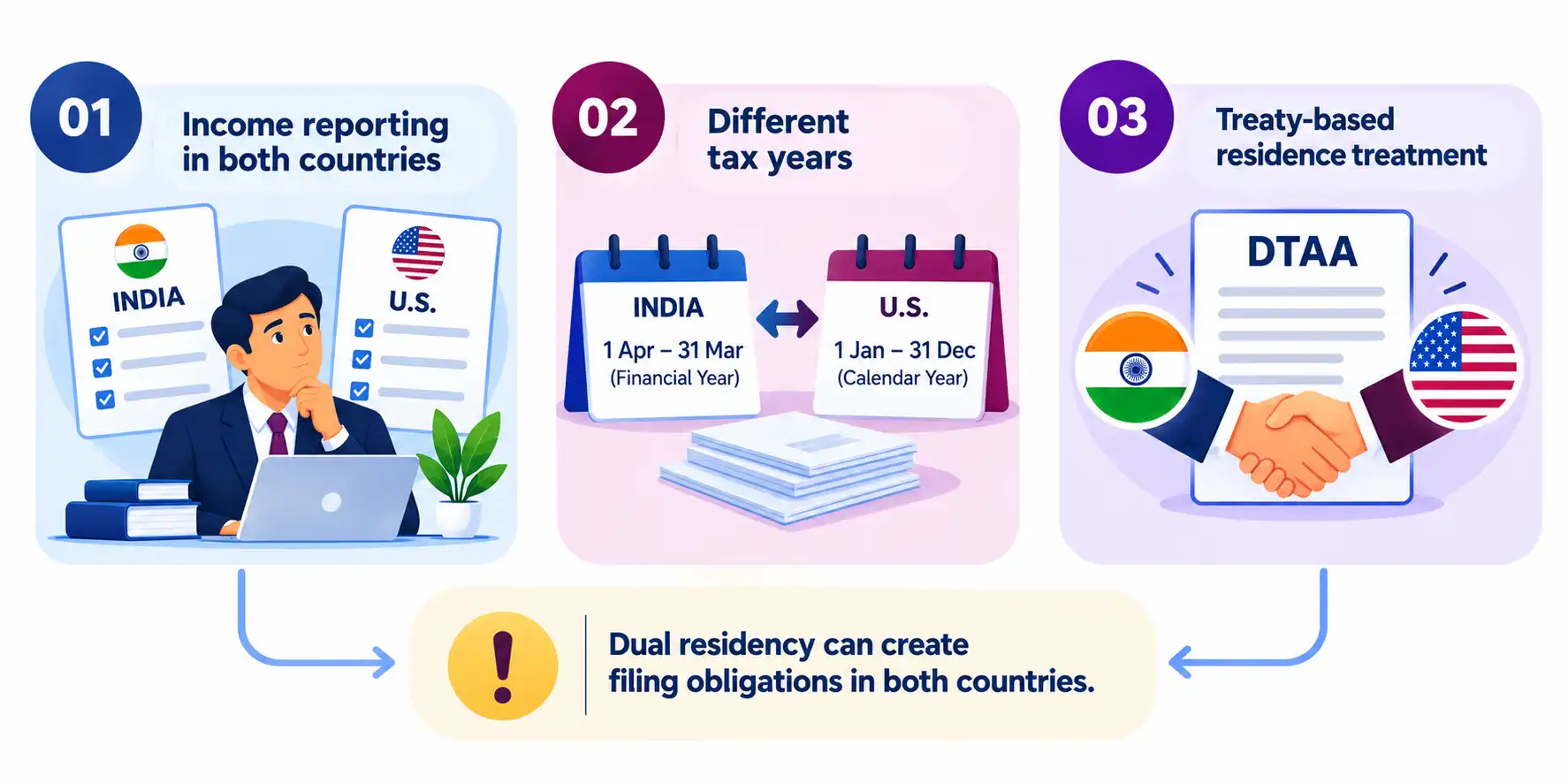
A person treated as resident under a country’s domestic tax rules may have broader income-reporting obligations than a nonresident. The exact scope differs between India and the United States.
U.S. citizens and resident aliens are generally subject to U.S. federal income tax on worldwide income, while nonresident aliens are generally taxed on U.S.-source income and income effectively connected with a U.S. trade or business, subject to exceptions. In India, the scope of taxable income depends on residential status, including ROR or RNOR classification where applicable, as well as source, receipt and accrual rules. The treatment of each income item should therefore be checked separately in both countries.
For example, a person living in the U.S. who earns rental income from Indian property may need to consider U.S. reporting rules as well as Indian tax on that property income. Whether and how the income is taxed, and whether credit is available, depends on the applicable rules.
Do not assume that filing a return in one country removes the need to file in the other. Equally, do not assume that every person with income in both countries automatically has a filing obligation in both. Filing requirements must be checked independently.
India generally uses a financial year running from 1 April to 31 March, while the U.S. individual federal income tax year generally follows the calendar year.
This difference can complicate income reconciliation, foreign tax credit claims, and documentation. An NRI should retain income statements, tax payment records, withholding certificates, and return calculations for the relevant periods.
Where both countries’ domestic laws treat an individual as resident, the India–US DTAA may contain rules for resolving conflicting claims of residence for treaty purposes. The treaty analysis is fact-specific and should not be treated as an automatic cancellation of all domestic tax obligations.
The U.S. IRS explains that a dual-resident taxpayer who qualifies for treaty treatment may be treated as a nonresident alien for purposes of figuring U.S. income tax, while still being treated as a U.S. resident for certain other purposes. Specific filing and disclosure requirements may apply.
The India–US Double Taxation Avoidance Agreement is intended to address specified cross-border tax issues, including situations where the two countries’ rules create overlapping claims.
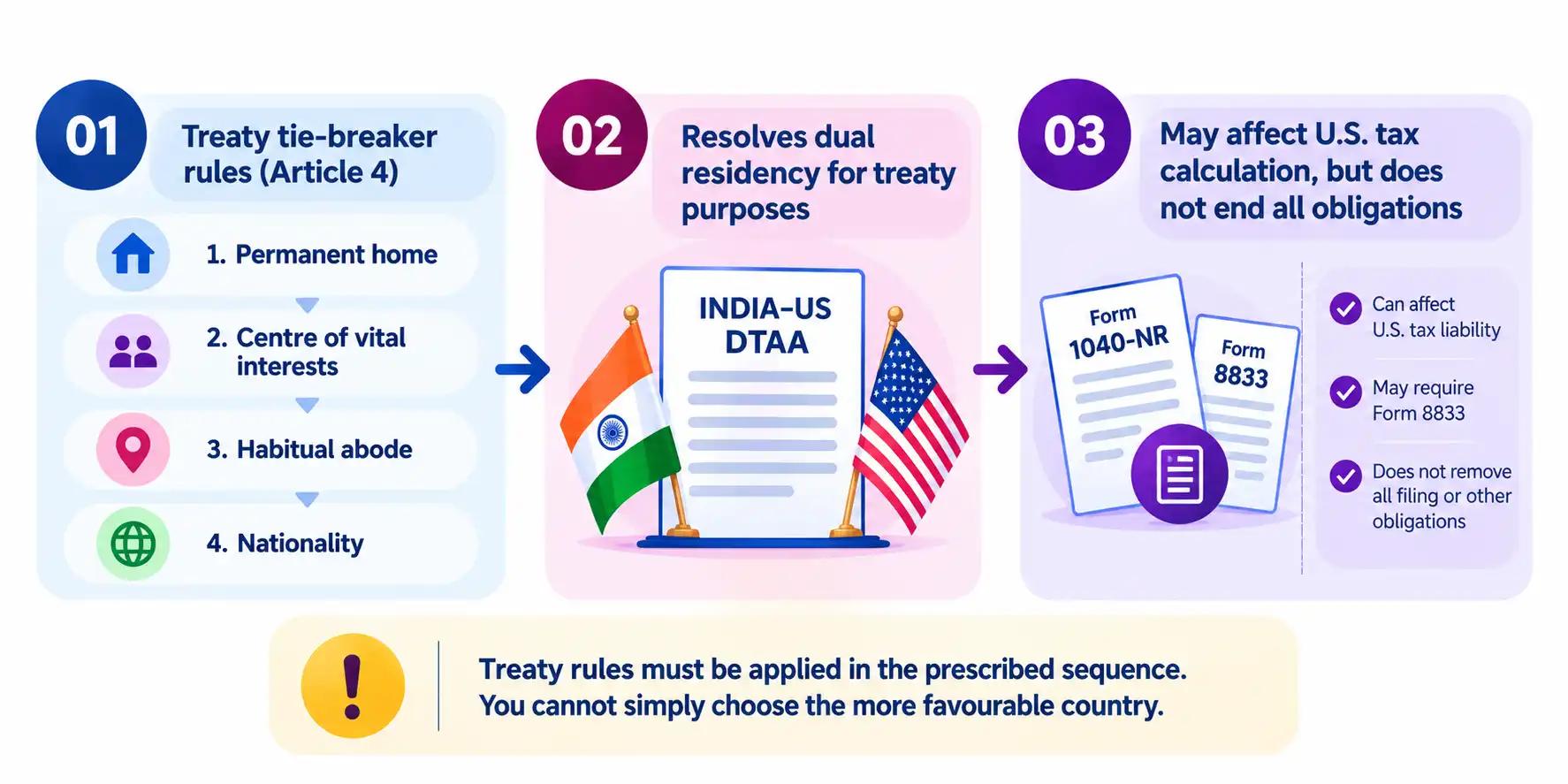
When an individual qualifies as a resident under the domestic laws of both treaty countries, Article 4 of the treaty may provide a sequence of tests to resolve the conflict for treaty purposes.
The analysis generally considers the availability of a permanent home first. If a permanent home is available in both states, the centre of vital interests is considered, which generally involves the person’s closer personal and economic relations. If that does not resolve the issue, or no permanent home is available in either state, habitual abode is considered, followed by nationality and, where necessary, resolution by the competent authorities through mutual agreement. These factors must be assessed in the prescribed sequence; a taxpayer should not simply choose whichever country appears more favourable.
For a detailed explanation, see U.S.–India Tax Treaty Tie-Breaker Rules.
No. A treaty-based position can affect how U.S. income tax is calculated, but it does not necessarily remove all U.S. filing or other obligations. U.S. citizens and green card holders should be particularly careful: their circumstances and the consequences of claiming treaty benefits may differ.
A dual-resident taxpayer who validly claims treaty residence in India and is treated as a nonresident alien for calculating U.S. income tax generally files Form 1040-NR. Form 8833 may be required to disclose the treaty-based position. Under IRS guidance, a dual-resident taxpayer determining residence under a treaty generally must attach Form 8833 when the relevant payments or income items total more than $100,000, subject to applicable rules and exceptions. Other treaty-based positions may also require disclosure, so the current IRS instructions should be checked before filing.
There is no single method that applies to every NRI. The appropriate approach depends on residency, income type, source-country taxing rights, and the requirements of the relevant relief provision.
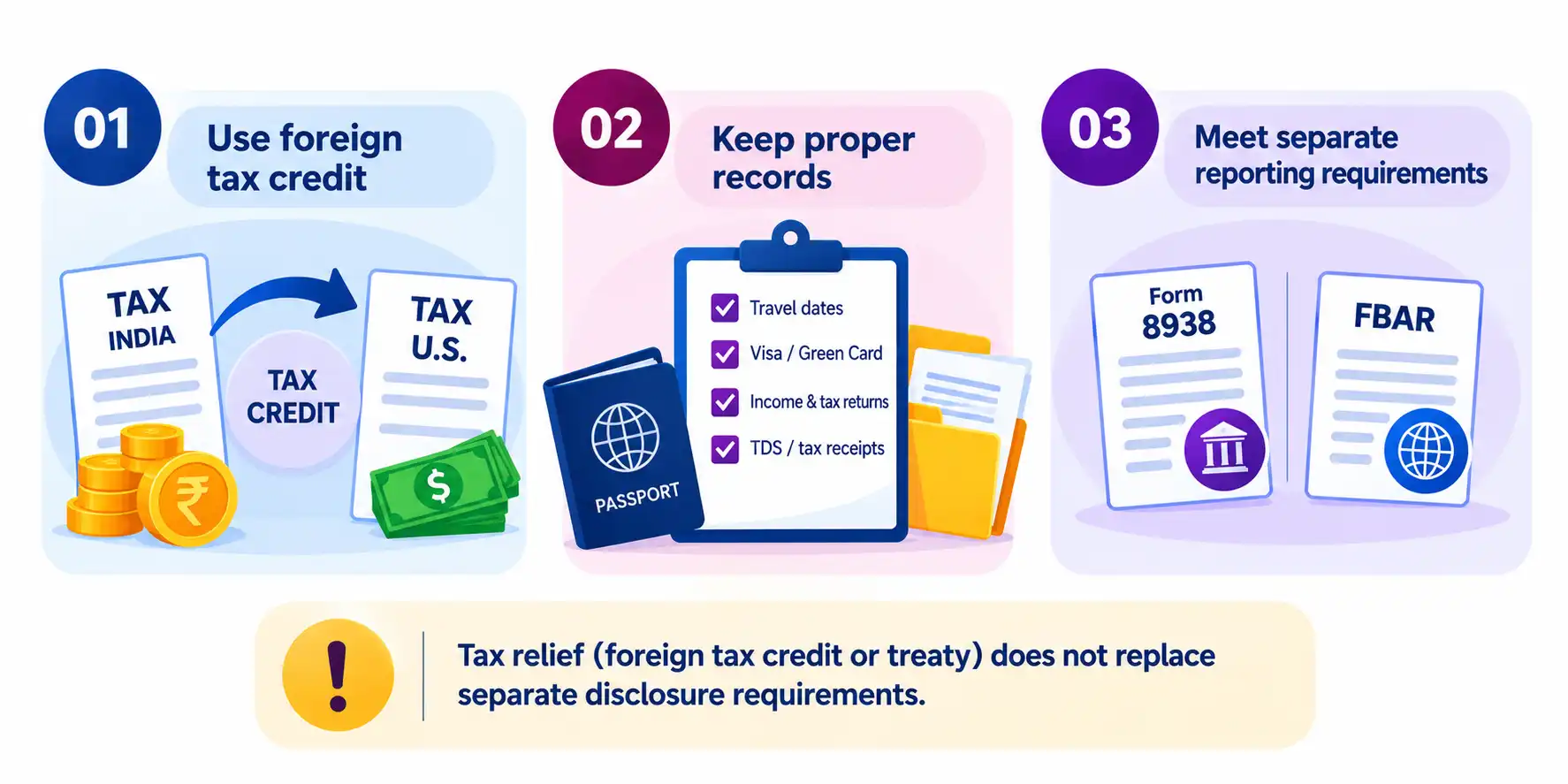
A foreign tax credit may allow qualifying foreign income tax paid to one country to offset tax payable in the other, subject to applicable limitations, income categories, source rules, and documentation.
For example, an NRI with Indian rental income may need to establish how that income is treated in each country and whether Indian tax paid can qualify for a U.S. foreign tax credit. The result should be calculated under the relevant rules rather than assumed.
For U.S. taxpayers, foreign tax credit claims commonly involve Form 1116, where required. Only qualifying foreign taxes may be credited, and the allowable amount is subject to income-category, sourcing and limitation rules. The credit is generally limited to the qualifying foreign tax paid or accrued or the applicable U.S. tax limit, whichever is lower. Certain taxpayers may qualify for an exception from filing Form 1116, subject to IRS requirements.
NRIs should keep records of:
These records can help support residency conclusions, income reporting, and relief claims if either tax authority requests further information.
A foreign tax credit or treaty claim does not automatically satisfy every separate reporting requirement. Depending on the taxpayer’s U.S. tax status and circumstances, foreign financial assets may require reporting on Form 8938, while foreign financial accounts may separately trigger an FBAR filing. These are distinct reporting regimes with different requirements, and filing one does not automatically satisfy the other. Determine whether either requirement applies rather than assuming that treaty relief or a foreign tax credit covers the disclosure obligation.
Understand how Indian and U.S. residency rules may apply to your situation and what you should review before filing.
Before preparing a return, review the following points for the relevant tax period.
If your case involves a green card, a return to India, or a change in U.S. residency status during the year, do not rely on a generic dual-residency checklist alone. The facts can change both the filing process and the tax consequences.
Dual tax residency can make cross-border tax compliance more complicated, but the first step is to determine residency under Indian and U.S. law separately. Then evaluate the India–US DTAA, foreign tax credits, filing requirements, and any relevant disclosure obligations.
Keep clear records and avoid assuming that a treaty or a tax credit automatically removes every obligation. Where a green card, a move between countries, or overlapping residency claims are involved, a case-specific review can help establish the correct filing position.
This article is for general informational purposes only and does not constitute tax, legal, financial, or investment advice. Laws, regulations, rates, and procedures may change over time and may vary based on individual circumstances.
While SaveTaxs makes reasonable efforts to keep the information accurate and up to date, readers should verify applicable rules with official authorities or consult a qualified professional before making decisions based on this information.
Shubham Jain is the Founder of SaveTaxs and has extensive experience in Indian and NRI taxation. He advises individuals, NRIs, and businesses on tax filing, tax planning, capital gains, DTAA benefits, fund repatriation, and compliance matters. He regularly writes about taxation and related financial topics. His focus is on making complex tax concepts easy to understand. Through his articles, he helps taxpayers stay informed, avoid common mistakes, and stay compliant with Indian tax laws. See Full Bio
Want to read more? Explore Blogs