US Tax Filing and Compliance
S Corporation Salary vs Distributions: How Owners Should Pay ThemselvesS Corporation Salary vs Distributions: How Owners Should Pay Themselves
Written by Shubham Jain

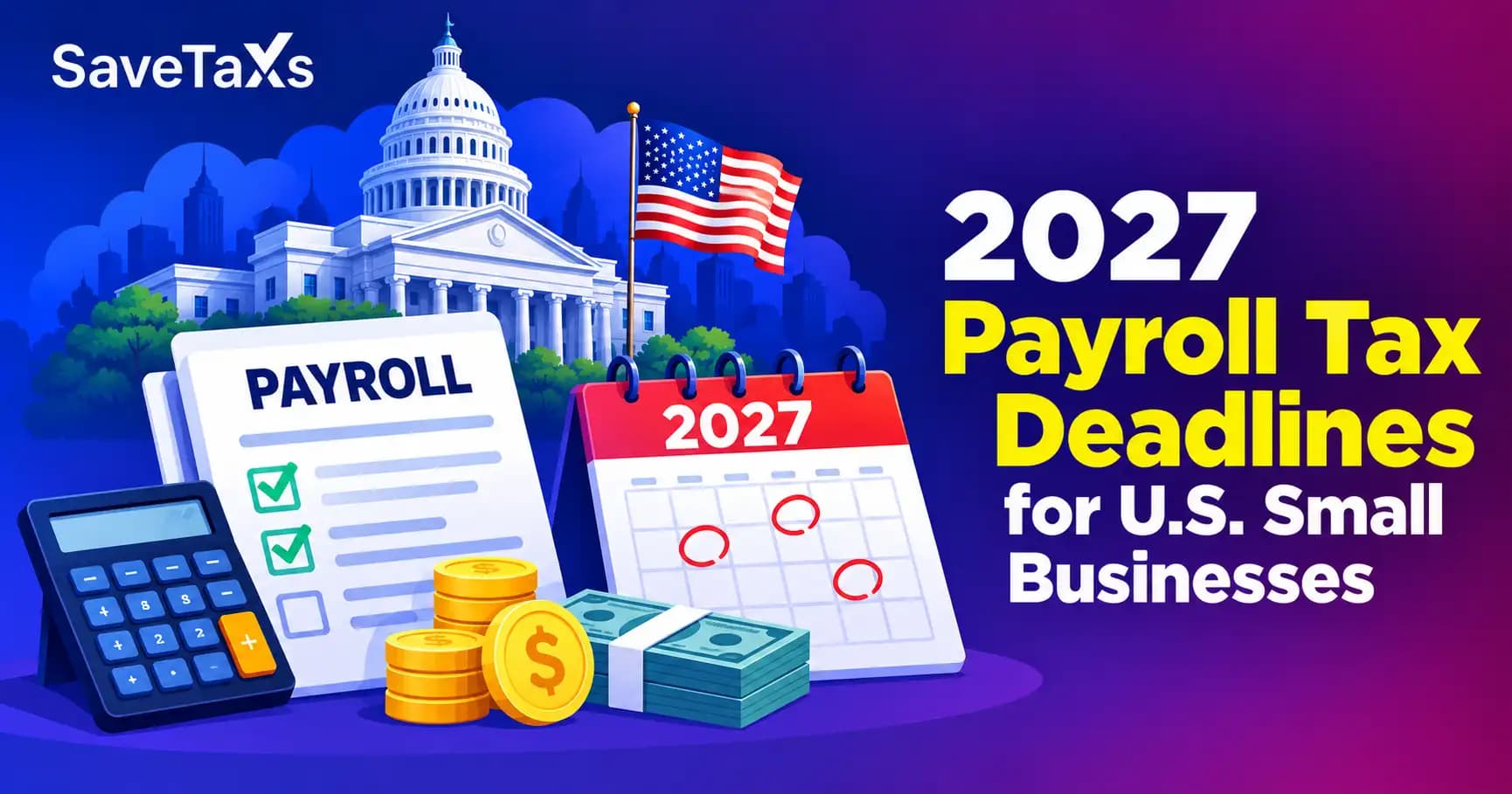
U.S. small business owners with employees must track payroll tax deposits, employment tax returns, and annual wage and payment reporting. Missing a deadline can lead to penalties, interest, or additional compliance work.
The 2027 payroll tax deadlines covered in this guide mainly relate to wages paid and reportable payments made during 2026, along with quarterly payroll reporting for 2027. The exact obligations depend on your business, the forms you file, and your IRS deposit schedule.
Use this guide as a planning reference and confirm dates and requirements against the latest IRS instructions.
The following dates are useful for employers planning their federal payroll and information-reporting obligations. They distinguish annual reporting for 2026 from quarterly payroll reporting for 2027.
| Deadline | Filing or obligation | Applies to |
|---|---|---|
| February 1, 2027 | Forms W-2 and W-3 | Employers reporting 2026 employee wages |
| February 1, 2027 | Form 941 for Q4 2026 (and Form 944 for 2026, if the IRS has notified you to file annually) | Employers required to file employment tax returns |
| February 1, 2027 | Form 940 for 2026 | Employers required to report FUTA tax |
| February 1, 2027 | Form 1099-NEC for 2026 payments | Businesses required to report qualifying nonemployee compensation |
| April 30, 2027 | Form 941 for Q1 2027 | Employers required to file quarterly employment tax returns |
| August 2, 2027 | Form 941 for Q2 2027 | Employers required to file quarterly employment tax returns |
| November 1, 2027 | Form 941 for Q3 2027 | Employers required to file quarterly employment tax returns |
| January 31, 2028 | Form 941 for Q4 2027 | Employers required to file quarterly employment tax returns |
The February 1, 2027 dates reflect the fact that January 31, 2027 falls on a Sunday. The July 31 and October 31, 2027 Form 941 dates also fall on a weekend, so the deadlines move to the next business day.
These are return and information-reporting dates, not a complete schedule of payroll tax deposits. Deposit obligations can arise more frequently.
Savetaxs helps you understand your tax forms and compliance responsibilities.
Most employers use Form 941 to report federal income tax withheld from employee wages and Social Security and Medicare taxes. It is generally due by the last day of the month following the end of each calendar quarter.
The fourth-quarter 2026 Form 941 is also due February 1, 2027, because January 31, 2027 falls on a Sunday.
For 2027, the usual quarterly deadlines are:
Certain employers that have deposited all required taxes in full and on time may qualify for an additional 10 calendar days to file the return. Check the current IRS Form 941 instructions for the applicable conditions.
Employers subject to the Federal Unemployment Tax Act (FUTA) generally file Form 940 annually.
For the 2026 tax year, Form 940 is generally due February 1, 2027, because January 31 falls on a Sunday. Employers must also follow the separate FUTA deposit rules. If the required tax has been deposited in full and on time, an additional filing period may be available under IRS rules.
Review the IRS employment tax due dates before filing.
Employers generally must furnish Form W-2 to employees and file Forms W-2 and W-3 with the Social Security Administration for 2026 wages by February 1, 2027.
Form W-2 reports employee wages and withholding. Form W-3 transmits the applicable wage statements to the Social Security Administration.
For detailed instructions on W-2 reporting and changes, see SaveTaxs' existing 2026 Form W-2 guide. This article focuses on the wider employer deadline calendar rather than repeating the full W-2 guide.
Businesses that make reportable payments to independent contractors or other nonemployees may need to file Form 1099-NEC.
For qualifying payments made during 2026, the general deadline to furnish the recipient's statement and file with the IRS is February 1, 2027, because January 31 falls on a Sunday. For payments made after December 31, 2025, the general Form 1099-NEC reporting threshold is $2,000 (previously $600). Reporting requirements depend on the payment, recipient, and applicable rules.
Do not assume every contractor payment requires Form 1099-NEC or that all information returns share the same deadline. Consult the current IRS instructions for the specific form.
Small businesses can reduce deadline errors by building a process that separates tax deposits from tax return filing.
The IRS provides a business tax calendar and detailed employment tax due dates. Check these resources regularly rather than relying on a saved calendar alone.
Get guidance from Savetaxs to understand your U.S. business tax filing obligations.
Payroll tax compliance involves more than remembering annual return dates. Businesses need to understand which forms apply, when deposits are due, and how wage and contractor records support accurate reporting.
SaveTaxs can help U.S. business owners understand their tax filing responsibilities, organize relevant compliance tasks, and identify questions that need professional review. The right approach depends on your business structure, payroll activity, and federal filing obligations.
Tracking 2027 payroll tax deadlines helps U.S. small business owners manage federal employer reporting and reduce avoidable filing errors. Confirm the forms that apply to your business, maintain accurate payroll records, and keep tax deposits separate from return deadlines.
Because filing requirements can vary, verify the dates with the IRS before acting. For W-2-specific reporting details, use the existing SaveTaxs W-2 guide rather than duplicating that information here.
This article is for general informational purposes only and does not constitute tax, legal, financial, or investment advice. Laws, regulations, rates, and procedures may change over time and may vary based on individual circumstances.
While SaveTaxs makes reasonable efforts to keep the information accurate and up to date, readers should verify applicable rules with official authorities or consult a qualified professional before making decisions based on this information.
Shubham Jain is the Founder of SaveTaxs and has extensive experience in Indian and NRI taxation. He advises individuals, NRIs, and businesses on tax filing, tax planning, capital gains, DTAA benefits, fund repatriation, and compliance matters. He regularly writes about taxation and related financial topics. His focus is on making complex tax concepts easy to understand. Through his articles, he helps taxpayers stay informed, avoid common mistakes, and stay compliant with Indian tax laws. See Full Bio

Want to read more? Explore Blogs