-for-401(k)_1790057066765.webp&w=828&q=75)
US Tax Filing and Compliance
Net Unrealized Appreciation (NUA) for 401(k): A Guide for NRIs Moving to IndiaNet Unrealized Appreciation (NUA) for 401(k): A Guide for NRIs Moving to India
Written by Vipul Jain

_1786354883560.webp&w=3840&q=75)
Are you planning to invest in US stocks, bonds, mutual funds, or ETFs from outside the US? You must be aware that you will be treated very differently from a US taxpayer and from how most of you assume the IRS treats you. While some of you may need to submit a form that can be entirely new to you, others' income will be taxed automatically at the source and might need no returns at all.
Moreover, there is also one part of the tax code that is nowhere relevant to income tax at all. In this blog, we will cover everything related to US taxation for FPIs.
The term FPI or Foreign Portfolio Investor is often used generally. It may sometimes be used to explain any non-US person who holds a portfolio of US securities or even as a regulatory label (like SEBI-registered FPIs investing in India.
However, when considering US tax purposes, the label that is actually important is nonresident alien (NRA) for individuals, or foreign corporation/foreign partnership/foreign trust for entities and funds. If you are under the misconception that the IRS will ask you about what you call yourself, come out of that assumption. The IRS will only ask you if you have satisfied the substantial presence test or if you hold a green card.
Ensure you get one thing clear. Most FPIs who reside abroad and buy US stocks, bonds, or ETFs via a domestic or international brokerage are treated as nonresident aliens even when they have no ties to US residency. This status affects the specific set of rules we will cover in this blog.
Quick Tip: You will remain outside the US tax net entirely if you invest through a foreign mutual fund, foreign-domiciled ETF, or foreign pension wrapper. However, NRA withholdings come into the picture when you own US-domiciled securities directly through US stocks, US bonds, or US-domiciled ETFs.
Further, as a nonresident alien, any income that you earn from US sources will fall under two categories. Do you know what these categories are? These categories are FDAP and ECI; let's discuss this in detail.
As a non-resident alien, every dollar that you earn from a US source will fall into one of two categories. After which, the classification will determine everything else. These two categories are:
Now comes the important part: If you are the usual FPI, nearly all your US-source income will fall under FDAP. This means the answer to what you are liable to pay and what you need to file must be determined based on the rules for FDAP, not ECI.
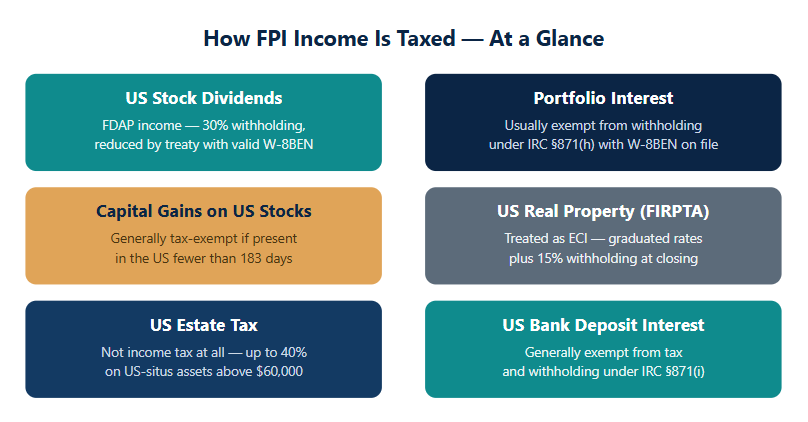
Once you have understood the category under which your income falls in the US, the next step is to file a return. But the main question is which forms do you need to use as an FPI. There are various forms for different situations, and it's crucial to select the correct one. To help you out, next we will discuss the major US tax forms that every FPI must stay familiar with.
Most FPIs never file their annual return at all, unlike a US taxpayer. The reason behind this is that withholding at source settles their entire tax obligation. You might think this means there is no need to understand the forms then. Well, this is where you are wrong. There are a few forms that you must know about, either to claim the reduced withholding rate or to manage certain situations. Here is a table that lists the major US tax forms along with their purpose and individuals who file them:
| Form | Purpose | Who Files It |
|---|---|---|
| Form W-8BEN | Proves foreign status and claims a reduced treaty withholding rate | Individual FPIs who receive US dividends or interest |
| Form W-8BEN-E | It serves the same purpose as W-8BEN for entities | Foreign corporations, funds, or trusts investing in the US |
| Form 1040-NR | US income tax return for nonresident aliens | FPIs with ECI, FIRPTA dispositions, or a treaty/refund claim not resolved at source. |
| Form 1042-S | Reports US-source income paid to a foreign person and tax withheld | It is issued by your broker or payer, and you must keep every copy safely |
| Form W-7 (ITIN application) | To obtain a US individual taxpayer identification number | FPIs who need to file a return or claim a refund but don't have an SSN |
| Form 8804/8805 | Reports withholding on a foreign partner's share of partnership ECI | FPIs invested through a US partnership or fund structured as one |
| Form 706-NA | US estate tax return for a nonresident alien decedent | Filed by the executor if US-situs assets exceed $60,000 at death |
Moving forward, we will discuss dividend withholding and treaty rates, along with how to reduce the standard rate.
What FPIs usually don't need: These were the forms that FPIs might encounter, but is there any form that they don't need to file? Well, yes, if you are a pure nonresident alien with no ties to US residency, you typically don't need to file FBAR (FinCEN Form 114), Form W-9, or Form 8938. These two forms apply to "US persons. It acts more like a reverse of your situation, meaning the US is the foreign country in which you are investing as an FPI.
First, remember that dividends acquired from US corporations fall under FDAP income. So, before you receive the dividend payment, the broker will tax it at a flat 30% withheld directly. However, this rate can be reduced by claiming benefits of the tax treaty between the US and your country of residence, if there is one.
This is the point where Form W-8BEN becomes relevant. So, the broker will consider and levy the default 30%, irrespective of whether there is a treaty or not, if you file with your custodian without submitting Form W-8BEN.
Thinking about how much the treaty reduces? Well, the reduced rates on dividends after claiming the treaty will vary significantly based on the country and sometimes even the shareholding size. So, it will commonly be somewhere between 15% and 25% for portfolio-level holdings under most US treaties. However, remember that the exact rate will depend entirely on the specific treaty you select.
Most importantly, don't assume a round number just because you think you are correct. Instead, always confirm the current rate by checking IRS Table 3 of Publication 515 or by simply checking the treaty text.
Further, interest income also falls under FDAP by default. However, there is one benefit: it is exempt from taxation under IRC §871(h). It's common to think that dividends are taxed and interest is not, so let's clear up this confusion and understand how interest is exempt.
As mentioned above, interest is also treated as FDAP income by default. So, why is it exempt? It is because Congress introduced one of the most valuable exemptions in the entire NRA tax code. This exemption was for portfolio interest under IRC §871(h). Hence, interest acquired on most US bonds and other registered debt obligations is exempt from the 30% withholding entirely. However, this rule applies as long as:
Additionally, under IRC §871(i), NRAs remain exempt from taxation on bank deposit interest earned on US savings and checking accounts, irrespective of the portfolio interest rules.
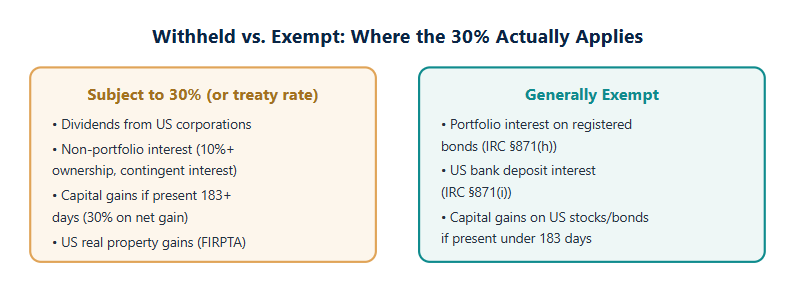
Now comes the surprising part: exemption on capital gains. Yes, capital gains from typical US investments (stocks or bonds) are not taxable for a nonresident alien at all. However, there is one condition. Let's see what this condition is.
If you are a nonresident alien, you will remain exempt from paying tax on capital gains acquired from selling US stocks, bonds, or US-domiciled ETFs. However, it's not that easy; this rule applies only if
The disadvantage is that if you exceed this 183-day threshold in a calendar year, the entire treatment will change. It means you will become liable to pay tax on US-source capital gain at a flat rate of 30%, reported on Schedule NEC of Form 1040-NR.
Don't think that since you have satisfied the substantial presence test, which is used to determine residency status, you don't need to consider this rule. This 183-day count is a completely separate rule, and it's important to remember this distinction. However, you can also spend 183 days or more in the US in a single year and still be treated as a nonresident alien.
Don't confuse the two 183-day tests: The substantial presence test is used to determine your residency status, and it's a weighted three-year formula. Conversely, the 183-day rule for capital gains focuses only on the current calendar year. It means if you are exempt under one rule, that doesn't automatically make you exempt from the other as well.
Many FPIs never file a US return since most FDAP tax is settled automatically through withholding at the source. However, you generally need to file Form 1040-NR if you:
If your broker withheld the correct tax on your dividends under a tax treaty and your other income types were exempt, you typically don't need to file with the IRS for that specific year. Lastly, we will discuss the filing deadline and the common mistakes that FPIs must know.
Nonresident aliens generally need to file Form 1040-NR by the 15th of April if you had US wages subject to withholding. If not, the due date is June 15. Ensure you get your Form 1042-S from the withholding agent by the 15th of March. If anything depends on this form, you must wait until you receive it before filing.
Further, the common mistakes made by FPIs include:
Let the experts at Savetaxs manage your taxes so you enjoy maximum refunds and more savings.
When you think of investing in US stocks, bonds, ETFs, and other securities as an FPI, apart from looking at the benefit, you must also think about the set of US rules that come along. Since most FPIs are treated as nonresident aliens (NRAs), your tax obligations will be determined based on the type of income you earn. It also determines whether you are eligible to claim treaty benefits and whether you have submitted the correct IRS forms. Moreover, there are various terms that you must stay aware of, including FDAP income, effectively connected income (ECI), dividend withholding, etc.
Further, whether you are an NRI, foreign portfolio investor, or an international investor holding US securities, connecting to Savetaxs can help you navigate the complexities of US tax laws. At Savetaxs, we have an entire team of experts who can help you with Form W-8BEN filing, claim treaty benefits, complete Form 1040-NR, US-India tax compliance, and more. Contact us today to stay compliant with IRS regulations and maximize your after-tax returns.
This article is for general informational purposes only and does not constitute tax, legal, financial, or investment advice. Laws, regulations, rates, and procedures may change over time and may vary based on individual circumstances.
While SaveTaxs makes reasonable efforts to keep the information accurate and up to date, readers should verify applicable rules with official authorities or consult a qualified professional before making decisions based on this information.
Vipul Jain is the Co-Founder of SaveTaxs and a tax expert with experience in Indian and NRI taxation. He advises individuals, NRIs, and businesses on tax filing, tax planning, capital gains, DTAA, and compliance matters. He focuses on making complex tax concepts simple and helping taxpayers make informed, compliant decisions. See Full Bio

Want to read more? Explore Blogs