



US Tax Forms
IRS Form 8962 for NRIs: Premium Tax Credit and APTCIRS Form 8962 for NRIs: Premium Tax Credit and APTC
Written by Shubham Jain
_1786351636667.webp&w=3840&q=75)
The number of US tax forms that an NRI earning income, holding investments, or working in the US might encounter is unpredictable. Various IRS forms like 1040NR, W-8BEN, FBAR, 8938, etc. are some common examples of US tax forms that you might come across. It's not necessary that you have an understanding of each and every form, but there are a few key forms that you must stay aware of.
Also, there is no such term as "NRI" in the U.S., and you may be classified as either a resident or non-resident alien. So, based on your status, the forms you may receive or may need to use will vary. To help you out, in this blog, we will cover the core US taxation forms for NRI, determining your residency status, reporting foreign assets, and much more.
Under the Income Tax Act in India, NRI is a residency status, but there is no such term used in the U.S. at all. Instead, every individual is classified as either a resident alien or a nonresident alien for tax purposes in the US by the IRS (Internal Revenue Service).
So, suppose you are an Indian who lives outside the U.S., but you earn US-sourced income, such as rental income, dividends, capital gains, or consulting fees. In this case, you will be treated as a nonresident alien unless you satisfy the specific U.S. residency tests.
Sounds normal and not that important? This is where you are wrong. It's highly important to know the difference and determine your U.S. residency status. Based on your residency status, you will decide which US tax form you need to file, the tax rate applicable to you, and the income that will be taxed.
Now that we know it's important to determine your residency status, let's learn about the two residency statuses given in the U.S.
In the U.S., the IRS conducts a substantial presence test to determine an individual's residency status. In which, you will be considered a resident of the US for tax purposes if you satisfy two key conditions:
Now, most NRIs visit the US for a short duration, and they don't stay in the U.S., which basically means they don't meet the test. So, if you don't satisfy the test, you will be treated as a non-resident alien.
Additionally, US citizens and residents can use Form 1040, but non-resident aliens are not allowed to use the same form, and they must use Form 1040-NR.
**Quick Tip: If you are a green card holder, you will be automatically considered a resident alien for tax purposes, irrespective of the number of days you spend in the U.S.
We have now understood how you can determine your residency status; we will now learn about the key tax forms that every NRI might encounter and must stay aware of.
The table below breaks down the most common US taxation forms that NRIs encounter, along with their purpose and who is required to file them:
| Form | Purpose | Who Files it |
|---|---|---|
| Form 1040-NR | Annual US income tax return for nonresident aliens | NRIs with US-sourced taxable income |
| Form W-8BEN | Certifies foreign status to claim reduced withholding tax under a tax treaty | NRIs receiving US dividends, interest, or royalties |
| Form W-9 | Provides taxpayer ID to a US payer (used by US persons only) | Resident aliens/ US citizens, not typically NRIs |
| Form 8843 | Statement for exempt individuals (students, teachers, trainees) | NRIs on F, J, M, or Q visas with no income |
| Form 8938 | Reports specified foreign financial assets | Resident aliens meeting asset thresholds |
| FinCEN Form 114 (FBAR) | Reports foreign bank accounts exceeding $10,000 | US persons, including resident aliens |
| Form 1042-S | Reports US income paid to foreign persons and tax withheld | Issued by payers to NRIs receiving US income |
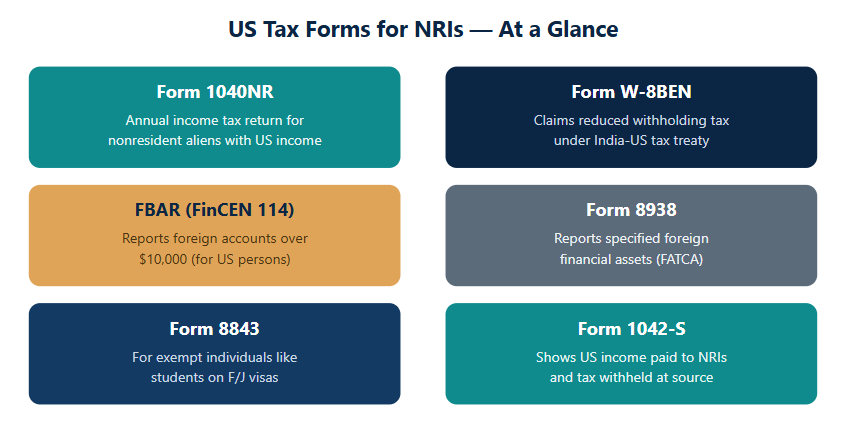
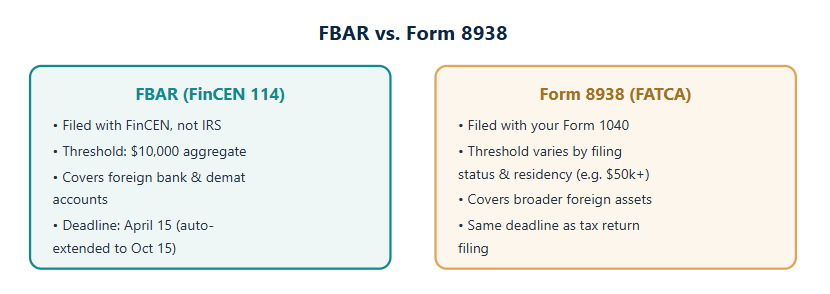
These were all the key US forms that you might encounter. So, it's crucial for you to stay aware of the purpose behind each of them. Now, it's common to be confused between two forms from the table: Form 8938 and FBAR (FinCEN Form 114), as both focus on reporting foreign financial accounts. To clear this confusion, let's understand the difference between the two.
This is a common point where many people get confused, but don't worry; there is nothing to be confused about. We know that FBAR and Form 8938 are both used to report foreign financial accounts. However, they are not the same, as they apply to different situations and serve different purposes.
If you are a U.S. person, including resident aliens, you need to use FBAR (filed via FinCEN Form 114) if the value of your combined foreign financial accounts exceeds ₹10,000 at any point during the year. On the other hand, you need to file Form 8938 with your tax return as per the rules under FATCA. It also carries higher residency status-dependent thresholds.
One key point to remember is that if you are a nonresident alien, you don't need to file an FBAR or Form 8938. However, this rule applies only until you choose to be treated as a resident for tax purposes. For example, a nonresident alien who marries a U.S. citizen and chooses to file jointly.
So, what about NRIs with no residency ties to the US? Well, the good part is that such NRIs are not liable to fulfill any of these requirements, but they must still verify their residency status, as there are exceptions.
We hope you have understood your foreign asset reporting obligation. Now, it's also important for you to understand how your cross-border income will be taxed. Don't worry, this isn't the scary part, and your income will not be taxed twice. Confused? So, there is a mechanism that helps you reduce or prevent double taxation. Let's see what this is.
The US and India have signed a Double Taxation Avoidance Agreement (DTAA), which helps prevent the same income from being taxed twice, once in the US and then in India. To make it easy, suppose you are an NRI earning US-sourced income like dividends, interest, or royalties; you can submit Form W-8BEN to your US payer.
Once you submit this form, instead of the standard 30% withholding rate, the payer will apply the reduced treaty tax rate at source.
In India, you can use Form 67 and Section 90 of the Income Tax Act while filing ITR to claim credit for the taxes you have paid in the US. However, this requires proper documentation, such as Form 1042-S.
Since we now know the important forms, it's also important to know the due dates for them. Hence, lastly, we will discuss the filing deadlines along with the common mistakes you should avoid.
If you are a nonresident alien, the due date to file Form 1040-NR generally falls on April 15, provided you had US wages subject to withholding. If you didn't, the deadline extends to June 15. Similarly, the deadline to file FBAR is the same as Form 1040-NR; it means April 15. However, it enjoys an automatic extension to October 15.
Further, the common mistakes that an NRI makes include:
Connect with Savetaxs and stay compliant with your US tax obligations.
If you have good knowledge of the US tax forms, you can turn the complex tax filing season into a simple one. Once you get a good familiarity with the common or key forms, you can file them correctly, report income accurately, claim the eligible deductions, and most importantly avoid costly penalties from the IRS.
Moreover, if you still have doubts or need assistance during the tax filing season, connect with an expert at Savetaxs. We have a team of experts who can help you clear up any confusion and answer all your queries patiently. Connect with us right away, as we are working 24/7 across all time zones.
This article is for general informational purposes only and does not constitute tax, legal, financial, or investment advice. Laws, regulations, rates, and procedures may change over time and may vary based on individual circumstances.
While SaveTaxs makes reasonable efforts to keep the information accurate and up to date, readers should verify applicable rules with official authorities or consult a qualified professional before making decisions based on this information.
Vipul Jain is the Co-Founder of SaveTaxs and a tax expert with experience in Indian and NRI taxation. He advises individuals, NRIs, and businesses on tax filing, tax planning, capital gains, DTAA, and compliance matters. He focuses on making complex tax concepts simple and helping taxpayers make informed, compliant decisions. See Full Bio

Want to read more? Explore Blogs

_1786539671275.webp&w=828&q=75)