-for-401(k)_1790057066765.webp&w=828&q=75)
US Tax Filing and Compliance
Net Unrealized Appreciation (NUA) for 401(k): A Guide for NRIs Moving to IndiaNet Unrealized Appreciation (NUA) for 401(k): A Guide for NRIs Moving to India
Written by Vipul Jain

If you came across this page, then you have likely received an IRS Notice of Deficiency (CP3219A/N) and are looking for information about it. This notice is a formal letter informing you that the IRS believes you owe additional taxes, along with applicable interest and penalties, due to discrepancies in your tax return or information reported by third parties. If you do not respond within the applicable response period, the IRS may assess the proposed tax and begin collection actions such as liens or levies.
For taxpayers whose last known address on file with the IRS is outside the United States, the response period is generally extended from 90 days to 150 days.
Want to know more about IRS Notice of Deficiency (CP3219A/N)? Read this guide to understand what the notice means, why NRIs receive it, how to respond, and how to avoid similar notices in the future.
The Statutory Notice of Deficiency (CP3219A/N), commonly known as the "90-Day Letter," is one of the most important federal tax notices issued by the IRS. It is generally sent when the IRS identifies differences between the tax return you filed and information received from third parties, such as employers, banks, brokerage firms, or other financial institutions.
The notice informs taxpayers about the IRS's proposed additional tax liability and explains their options to either agree with the proposed changes or dispute them before the tax is officially assessed.
Unlike notices such as CP2000, which propose adjustments and invite taxpayers to provide additional information, a Notice of Deficiency represents the IRS's final administrative determination before assessment. For taxpayers whose last known address is outside the United States, the response period is generally extended to 150 days.
Although the IRS issues this notice because it believes additional tax is due, its determination is based on the information currently available. If the IRS calculation is incorrect, you may reduce or eliminate the proposed deficiency by providing supporting documentation or filing the appropriate tax return.
Additionally, before the response period expires, the IRS is generally prohibited from assessing the proposed tax or beginning collection activities.
This was all about an IRS Notice of Deficiency (CP3219A/N). Now, let's understand what documents are typically included with this notice.
A Notice of Deficiency package generally includes several documents to help taxpayers understand the IRS's determination and their available response options. These commonly include:
Review every document carefully before deciding whether to accept the IRS's determination or challenge it.
The two IRS notice numbers indicate different situations:
IRS Notice CP3219A generally follows an IRS audit or an unresolved CP2000 income-matching notice. If you do not respond to a CP2000 notice or fail to resolve the reported discrepancies, the IRS may issue a CP3219A Notice of Deficiency.
IRS Notice CP3219N is generally issued when the IRS has no record of your filed tax return. In this situation, the IRS calculates your proposed tax liability using third-party information, such as Forms W-2, 1099, and 1042-S, without considering deductions, credits, exemptions, or treaty benefits you may actually qualify for.
For NRIs, CP3219N deserves special attention because the IRS prepares the proposed tax calculation solely from available third-party data. As a result, it may significantly overstate your tax liability by excluding:
Filing the correct tax return is often the most effective way to correct the IRS's proposed assessment.
So, these are the primary reasons why the IRS issues Notice CP3219A/N. Next, let's understand what NRIs should do immediately after receiving this notice.
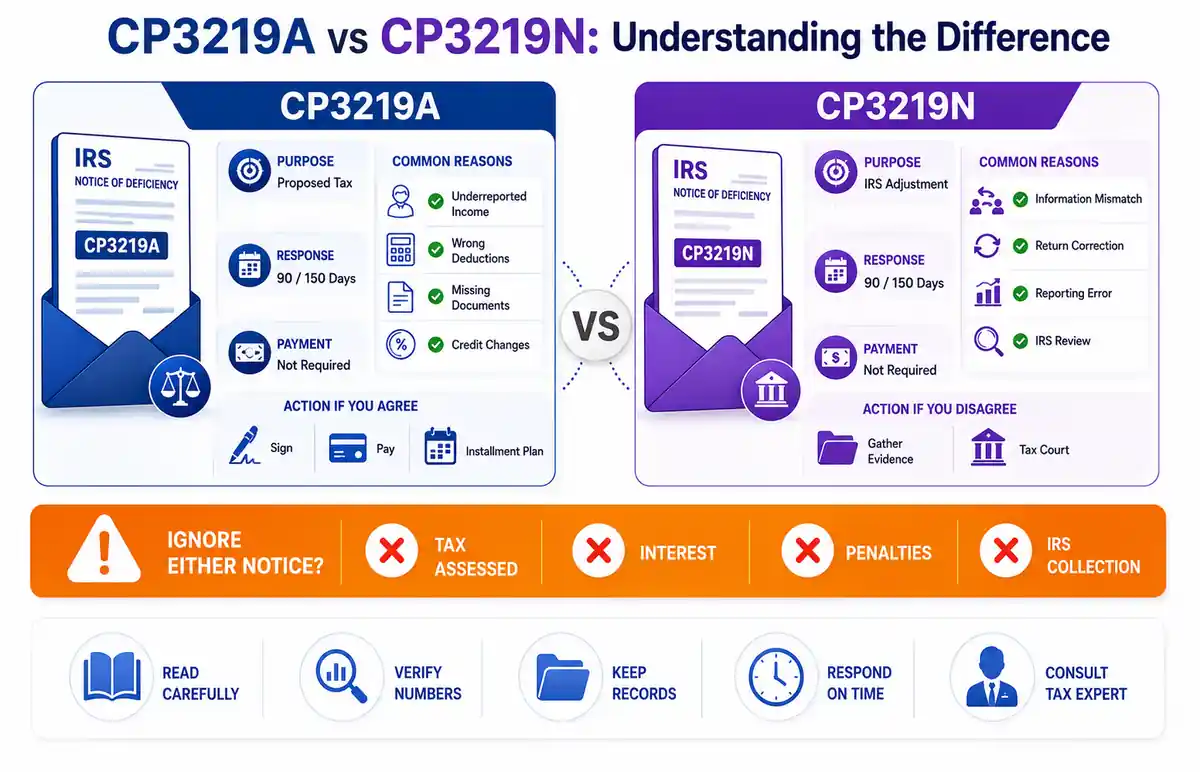
The moment you receive this notice, take the following steps:
This is what NRIs should do immediately after receiving a Notice of Deficiency.
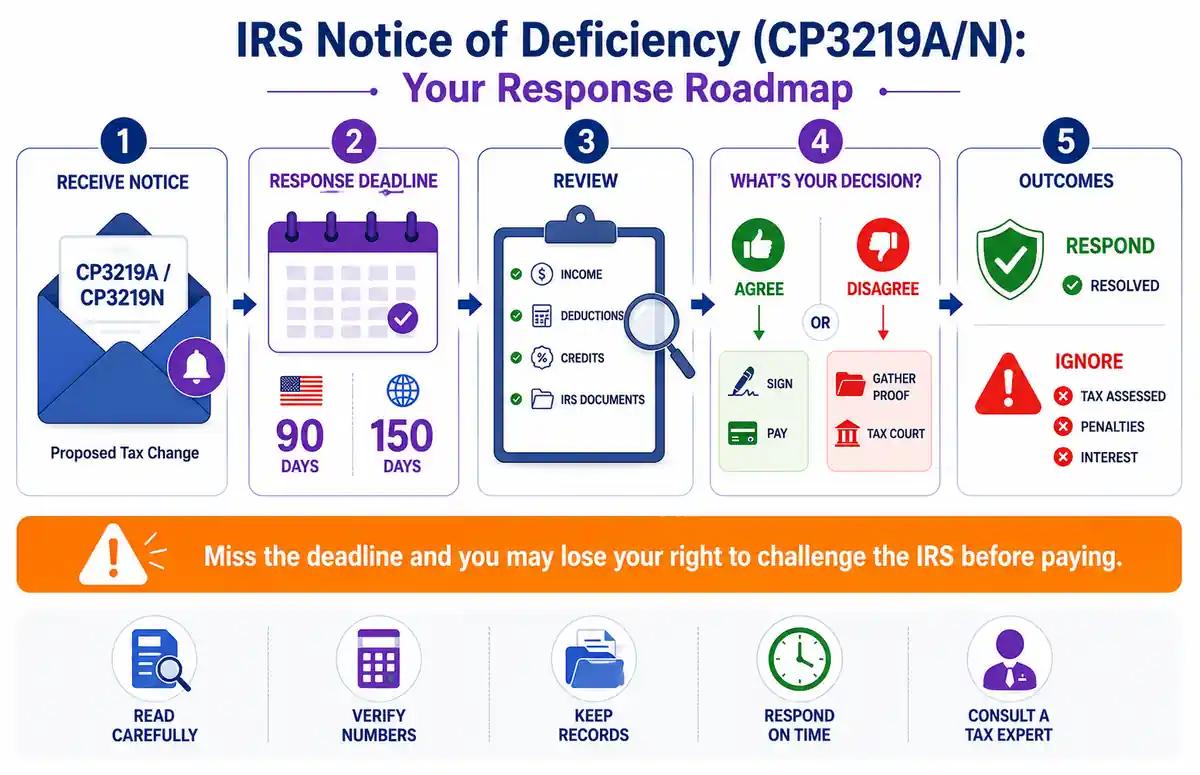
After reviewing the notice carefully, choose the response option that best fits your situation. Acting within the applicable response period is important to protect your rights and avoid unnecessary penalties or collection actions.
If you believe the IRS's proposed changes are correct, you can accept the determination by signing and returning Form 5564 (Notice of Deficiency Waiver) included with your notice package.
After agreeing with the notice, you should:
By agreeing with the notice, you waive your right to challenge the proposed deficiency in the U.S. Tax Court, allowing the IRS to assess the tax and close the matter more quickly.
If you believe the IRS's determination is incorrect, the appropriate response depends on the type of notice you received.
For CP3219A, you should gather documentation supporting your position and determine whether filing a petition with the U.S. Tax Court within the applicable response period is necessary to challenge the proposed deficiency.
For CP3219N, filing your actual tax return is often the most effective way to correct the IRS's proposed assessment. Your return should accurately report your income, claim eligible deductions and credits, apply any available tax treaty benefits, and reflect your correct residency status.
If your case involves foreign income, tax treaties, or cross-border reporting requirements, consulting a qualified cross-border tax professional can help ensure your response is complete and accurate.
If you want to challenge the IRS's determination before paying the proposed tax, you can file a petition with the United States Tax Court.
Generally, you must file your petition:
Keep these important points in mind:
For many NRIs, filing a Tax Court petition provides an opportunity to resolve the dispute before paying the proposed tax. This can be particularly valuable when the IRS's calculation fails to account for treaty benefits, nonresident tax treatment, or other cross-border tax considerations.
A Notice of Deficiency package generally includes an explanation of the IRS's proposed adjustments, a calculation of the proposed tax liability, instructions for responding, information about petitioning the U.S. Tax Court, and, where applicable, Form 5564 (Notice of Deficiency Waiver) for taxpayers who agree with the proposed changes. Review these documents carefully before deciding how to proceed.
So, this is how you should respond to IRS Notice of Deficiency (CP3219A/N). Next, let's understand what happens if you ignore the notice.
If you do not respond within the applicable 90-day or 150-day response period, the IRS generally proceeds with the proposed assessment. As a result:
Although certain administrative remedies may still be available after the deadline, they generally provide fewer legal protections than filing a timely Tax Court petition.
Let's understand this with an example.
Arjun worked in the United States on an L-1 visa for two years before returning to India after completing his assignment. During his final partial tax year in the U.S., he received salary income from his employer along with consulting income. Believing the consulting income was relatively small, he did not file the required U.S. tax return.
Several months later, after settling in India, Arjun received IRS Notice CP3219N. The IRS calculated his proposed tax liability using information reported on his Forms W-2 and 1099, but it did not consider his eligible deductions, proper filing status, business expenses, or applicable nonresident tax treatment. As a result, his proposed tax liability was nearly three times higher than the amount he actually owed.
Fortunately, the IRS had Arjun's current overseas address on file, making him eligible for the 150-day response period. He consulted a cross-border tax professional and filed Form 1040-NR, correctly reporting his nonresident status, claiming the allowable business expenses against his consulting income, and applying the relevant tax treaty provisions within the prescribed deadline.
After reviewing the corrected return, the IRS significantly reduced the proposed tax liability, allowing Arjun to resolve the matter without paying the originally proposed amount.
This example demonstrates why NRIs should never assume the IRS's proposed tax liability is correct and why responding within the applicable deadline is essential.
An IRS Notice of Deficiency (CP3219A/N) is one of the most important tax notices issued by the IRS because it provides a limited opportunity to challenge the IRS's proposed tax liability before it is officially assessed. Missing the response deadline may result in losing your right to petition the U.S. Tax Court, after which the IRS can assess the proposed tax and begin collection proceedings.
If you are an NRI, responding promptly is even more important because cross-border tax matters often involve tax treaty benefits, foreign tax credits, residency rules, and international reporting requirements that may not have been considered in the IRS's initial calculation.
If you are unsure how to respond, do not handle the matter alone. A qualified cross-border tax professional can review your notice, determine whether the IRS's calculations are accurate, prepare the required documentation, and represent your interests throughout the resolution process.
At Savetaxs, our cross-border tax professionals assist NRIs with IRS notices, U.S. tax return corrections, tax treaty claims, and international tax compliance. From reviewing your notice to preparing your response and guiding you through the resolution process, our team works to help you resolve your tax matter accurately and on time.
This article is for general informational purposes only and does not constitute tax, legal, financial, or investment advice. Laws, regulations, rates, and procedures may change over time and may vary based on individual circumstances.
While SaveTaxs makes reasonable efforts to keep the information accurate and up to date, readers should verify applicable rules with official authorities or consult a qualified professional before making decisions based on this information.
Vipul Jain is the Co-Founder of SaveTaxs and a tax expert with experience in Indian and NRI taxation. He advises individuals, NRIs, and businesses on tax filing, tax planning, capital gains, DTAA, and compliance matters. He focuses on making complex tax concepts simple and helping taxpayers make informed, compliant decisions. See Full Bio

Want to read more? Explore Blogs