NRI Income Tax Compliance
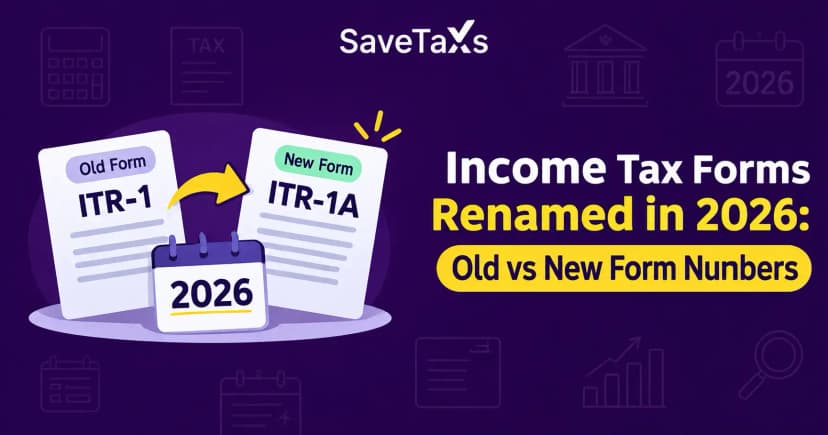
Income Tax Forms Renamed in 2026: Old vs New Form NumbersIncome Tax Forms Renamed in 2026: Old vs New Form Numbers
Written by Vipul Jain
For NRIs, filing ITR can be a daunting task. Every year, the government makes amendments to the tax rules for self-employed individuals in India, including freelancers, business owners, and senior citizens with income sources in India. Filing your ITR accurately and on time ensures cross-border compliance and helps you avoid penalties as NRIs.
However, in recent years, the Income Tax Department of India has made all the services available online to make the tax process more efficient. Yet, along the way, NRIs can find the entire ITR filing process time-consuming, confusing, and error-prone. This is where a professional CA comes in.
In this guide, we will explain to NRIs how to file their ITR in India, when they need a CA to file it, and when they can file it without a CA.
As an NRI, filing an ITR without professional assistance of a CA is entirely possible for many taxpayers, especially salaried individuals with straightforward finances.
Over the years, the Income Tax Department has significantly improved the Income Tax filing system, and most information is now reported through AIS and Form 26AS.
You can self-file your taxes confidently if :
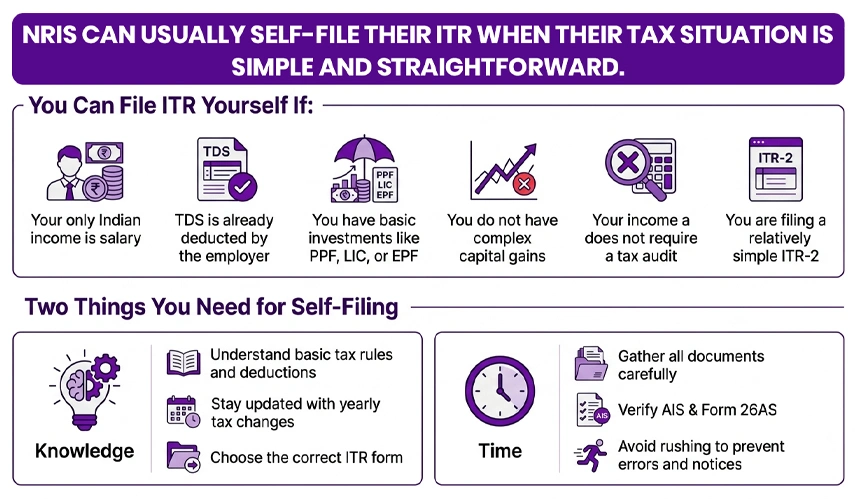
Filing your taxes yourself requires two main components.
If you have a signed source of income in India, predominantly from salary, you can easily file your taxes. But before you proceed, you must have the essential knowledge and resources to file your ITR correctly. Having a solid understanding of tax laws and regulations is essential for filing your taxes correctly.
Every financial year, a new financial budget comes with certain tax rules changes, so it is important for you to stay updated if you are filing your return on your own. Tax laws in India are subject to change; hence, stay informed and do your best to take advantage of tax deductions, credits, and exemptions.
As a taxpayer, before you sit down to file your taxes, ask yourself a simple question: Do I have enough time to plan and file my taxes on my own?
If the response is yes and you think this is a manageable task, you can proceed with filing your taxes. Asking this question of yourself is impractical because filing taxes requires a certain amount of time and effort, as you have to gather all the necessary documents, get a grasp of the current tax year already, pick the right tax form, and more.
Now, how long it will take to file your taxes depends on the complexity of your financial situation; it might take several hours or maybe days to complete the entire process accurately. Make sure you give yourself enough time, as rushing can lead to mistakes or omissions, which in turn result in audits and penalties.
Savetaxs helps NRIs file their ITR in India on time, under expert guidance, with 100% accuracy.
Well, there are several benefits for individuals who can accurately file their ITRs themselves.
Direct Access to Financial Information: You can maintain complete control over your financial data and tax records.
There is no doubt that self-filing is convenient, but even a small mistake can lead to an income tax notice, a defective return, or a delayed refund.
As an NRI, hiring a chartered accountant is important because your income structure, tax liability, or compliance requirements are generally more complex than a standard salary-based return. A CA will help you from start to end to avoid errors, legally reduce your tax liability, and ensure timely and accurate filing of the return.
You must not give a second thought before hiring a CA for ITR filing services if:
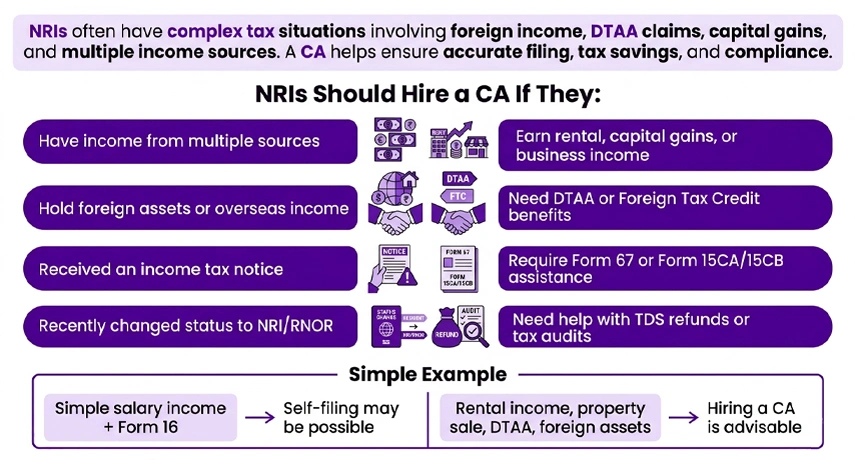
An Example to Understand: Let us understand when an NRI needs a CA or when an NRI does not need a CA with an example situation.
As an NRI earning a salary in India with Form 16 and standard education, you can generally self-file your ITR easily using the income tax portal.
However, if you are an NRI earning rental income in India, claiming DTAA relief, selling property, or repatriating foreign assets, you are likely to face complex tax rules and documentation requirements. Therefore, in such cases, hiring a qualified CA can help you improve and ensure accurate filing, proper planning, and maximum eligible tax savings while avoiding the penalties and notices.
A CA does a lot more than just filing your ITR. Hiring a CA for filing taxes in India has been beneficial because a CA helps you with
The following table clearly compares self-filing and hiring a CA.
| Factor | Self-Filing The Taxes | Hiring A CA To Do Your Taxes |
|---|---|---|
| The Cost | Free or low cost | Professional fees are involved. |
| Best For | Simple Salary income. | Complex financial situation. |
| Accuracy | Depends on the user's knowledge | Generally a bit higher |
| Tax Planning | Limited | Better optimization. |
| Capital Gains Handling | Difficult for beginners | Professionally managed |
| Notice Support | Self - managed | CA assistance available. |
| Time Required | Lower for simple returns | Saves time in the complex cases |
| Risk of errors | Higher | Lower |
Savetax's experts guide NRIS at every step of your business incorporation in India.
Being honest, as an NRI dealing with Indian taxes, there is no one-size-fits-all kind of answer while choosing between filing ITR yourself and hiring a chartered accountant. However, if your finances are simple, you can file your income tax return on the income tax portal itself. This is fast, cost-effective, and convenient. However, if your income structure is quite complex and involves capital gains, DTAA benefits, foreign assets, business income, tax notices, or more, professional CA assistance can help you avoid costly mistakes.
But whatever the case, having a professional CA by your side is always a wise decision. Because even with simple returns, you never know where and with what you can go wrong. Above all, the most important thing is that you file the ITR on time, report all the income from all the sources correctly, reconcile the AIS and Form 26AS properly, and maintain accurate tax records every year.
However, as an NRI, if you are uncertain about your tax situation, consulting a qualified CA before filing can help you avoid future notices, compliance issues, and penalties. And when it comes to a CA with expertise in NRI taxation and cross-border tax compliance, Savetaxs is the name to trust. Our team of experts will help you with residential status assessment, income computation, tax deductions, claiming benefits under tax treaty, form filing, e-filing, compliance, refund, and end-to-end client advisory on foreign assets reporting and FEMA regulations.
Connect with us as we serve our clients 24/7 across all time zones.
This article is for general informational purposes only and does not constitute tax, legal, financial, or investment advice. Laws, regulations, rates, and procedures may change over time and may vary based on individual circumstances.
While SaveTaxs makes reasonable efforts to keep the information accurate and up to date, readers should verify applicable rules with official authorities or consult a qualified professional before making decisions based on this information.
Vipul Jain is the Co-Founder of SaveTaxs and a tax expert with experience in Indian and NRI taxation. He advises individuals, NRIs, and businesses on tax filing, tax planning, capital gains, DTAA, and compliance matters. He focuses on making complex tax concepts simple and helping taxpayers make informed, compliant decisions. See Full Bio
Want to read more? Explore Blogs