US Tax Filing and Compliance
S Corporation Health Insurance for 2% Shareholders: Tax Rules and DeductionsS Corporation Health Insurance for 2% Shareholders: Tax Rules and Deductions
Written by Shubham Jain

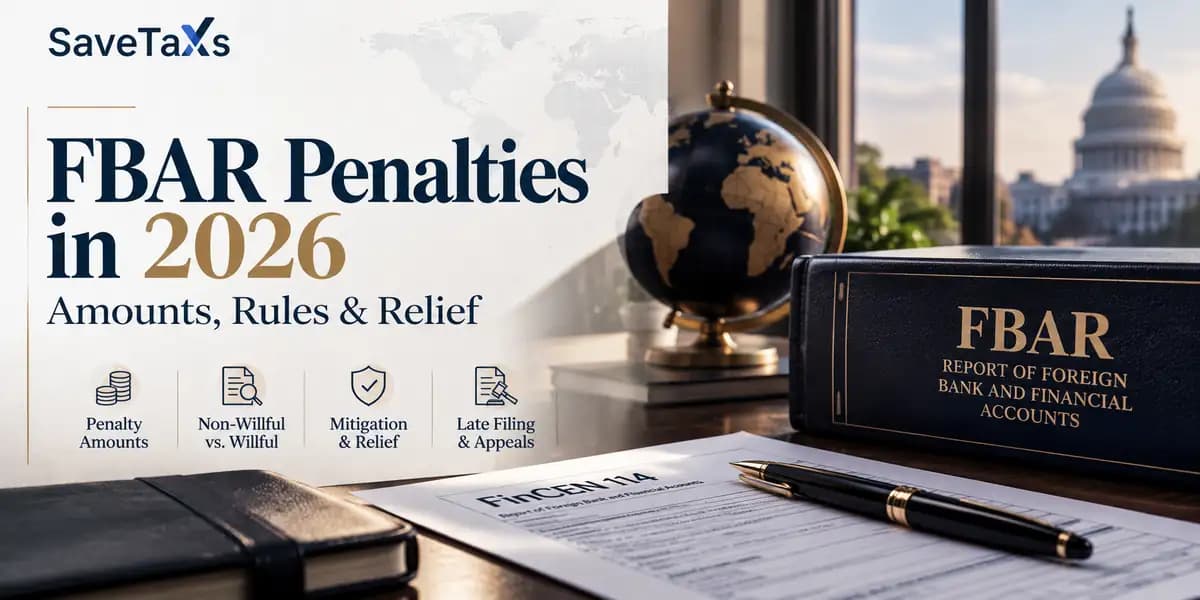
FBAR penalties can be substantial, but the maximum penalty is not necessarily the amount the IRS will assess. For violations subject to the current published limits, the maximum civil penalty for a non-willful FBAR violation is generally $16,536 per violation. For a willful violation, the maximum is generally the greater of $165,353 or 50% of the account balance at the time of the violation, subject to the applicable law.
These amounts remain applicable in 2026 because the federal government cancelled the 2026 civil penalty inflation adjustment. The IRS also gives examiners guidance on reasonable cause, warning letters, penalty mitigation and calculating penalties across multiple years.
The rules differ for non-willful and willful violations. In particular, the Supreme Court's Bittner v. United States decision explains why non-willful penalties generally apply per annual FBAR report rather than per omitted account. Separate IRS examination guidance addresses aggregate penalties across open years.
If you missed an FBAR, determine which reports were required, check whether related income was properly reported, and follow current IRS instructions. If you have received a penalty notice, pay close attention to the response deadline and the available administrative review process.
| Situation | Potential consequence |
|---|---|
| Non-willful violation | Maximum generally $16,536 per violation |
| Willful violation | Maximum generally the greater of $165,353 or 50% of the relevant account balance |
| Multiple non-willful annual reports | Generally one penalty per annual report, not per omitted account |
| Multiple open years under examination | IRS guidance limits aggregate non-willful penalties to 50% of the highest aggregate balance of the relevant accounts |
| Willful violations across open years | Separate calculation and mitigation rules apply, including an overall 100% highest-aggregate-balance limit under IRS guidance |
| Late filing | A penalty may apply, but the maximum is not automatically assessed |
| Reasonable cause | A qualifying non-willful penalty may not apply if the legal requirements are met |
| Proposed penalty notice | A written protest may be available under the instructions and deadline stated in the notice |
The statutory maximum, the Bittner per-report rule, and the IRS manual's aggregate-balance guidance are different concepts. The actual outcome depends on the facts, applicable law and examination posture.
FBAR stands for Report of Foreign Bank and Financial Accounts. It is filed electronically with the Financial Crimes Enforcement Network (FinCEN) using FinCEN Form 114. It is separate from a federal income tax return.
A U.S. person generally must file an FBAR if both conditions apply:
The person has a financial interest in, or signature or other authority over, one or more reportable foreign financial accounts.
The aggregate value of those accounts exceeded $10,000 at any point during the calendar year.
The requirement can apply to U.S. citizens, green card holders, other individuals who qualify as U.S. persons under the applicable rules, and certain entities. It can apply whether the person lives in the United States or abroad.
Reportable accounts may include foreign checking and savings accounts, term deposits, brokerage accounts and other covered financial accounts. The fact that an account generated no taxable income does not, by itself, remove the reporting obligation.
For example, a person with a foreign savings account worth $7,000 and a foreign brokerage account worth $5,000 may cross the threshold if their combined reportable account value exceeds $10,000 at any point during the year.
See the IRS FBAR filing guidance.
The published inflation-adjusted maximums below remain applicable in 2026 because the federal government cancelled the 2026 civil penalty inflation adjustment.
| Violation | Published maximum civil penalty | Important qualification |
|---|---|---|
| Non-willful violation | $16,536 | Subject to the per-report rule and applicable IRS guidance |
| Willful violation | Greater of $165,353 or 50% of the relevant account balance | The statutory formula uses the balance at the time of the violation |
| Late or missing FBAR | Depends on the violation and applicable rules | There is no single automatic late-filing fee for every case |
| Qualifying reasonable-cause case | A non-willful penalty may not apply | The statutory conditions must be met |
These are maximums, not automatic fines. The IRS has discretion to consider the facts and circumstances when determining whether to assert a penalty and how to calculate it.
Sources: 31 CFR § 1010.821 — Penalty Adjustment Table and the Office of Management and Budget's 2026 penalty-adjustment memorandum.
A non-willful violation generally involves a failure that was not intentional. Depending on the circumstances, this can include negligence, inadvertence, a mistake or a good-faith misunderstanding of the reporting requirement.
The published maximum non-willful penalty is generally $16,536 per violation. Three rules matter when evaluating potential exposure.
The Bittner per-report rule. In Bittner v. United States, the Supreme Court held that the non-willful penalty generally applies per annual FBAR report rather than separately for every account omitted from that report.
For example, omitting four accounts from one required annual FBAR does not automatically mean four separate maximum non-willful penalties apply to that report. Missing reports for separate years may involve separate violations.
The IRS aggregate-balance guideline. The IRS Internal Revenue Manual provides that total non-willful penalties across all open years must not exceed 50% of the highest aggregate balance of the relevant foreign financial accounts during the years under examination. This is IRS examination guidance and must be applied to the relevant accounts and years.
Reasonable cause. Under the applicable statute, a qualifying non-willful penalty may not apply when the violation was due to reasonable cause and accurate delinquent or amended FBARs are filed to correct it, subject to the legal requirements.
These rules should be assessed together, not treated as interchangeable calculations.
Willful violations can involve knowingly violating a legal duty, recklessly disregarding the reporting obligation, or deliberately avoiding learning about it. The IRS must support a determination of willfulness with evidence.
Potentially relevant facts include:
Knowingly failing to disclose foreign accounts despite understanding the filing requirement
Providing inaccurate information about foreign accounts on a U.S. tax return
Concealing account ownership or control
Ignoring clear advice about a known reporting obligation
Providing misleading information during an inquiry
No single fact automatically proves willfulness. The circumstances and evidence must be evaluated as a whole.
The maximum civil penalty is generally the greater of $165,353 or 50% of the relevant account balance at the time of the violation. IRS examiner guidance also describes ways to calculate willful penalties across multiple accounts and years and circumstances in which mitigation may apply.
Read the Supreme Court's Bittner v. United States decision and the IRS Internal Revenue Manual on FBAR penalties.
These examples illustrate the published limits and IRS examination guidance. They are not predictions of an individual taxpayer's liability.
A taxpayer missed four required annual FBARs. Multiplying the published per-violation maximum by four gives:
[4 \times $16,536 = $66,144]
This is the arithmetic total of four published maximums, not an automatic penalty assessment.
Now assume the highest aggregate balance of the relevant foreign accounts across the open years under examination was $80,000. Under the IRS manual's aggregate-balance guidance for non-willful violations:
[50% \times $80,000 = $40,000]
For this illustration, the IRS manual's aggregate limit would be $40,000 rather than the $66,144 total obtained by simply multiplying the maximums.
The $40,000 figure illustrates the IRS's examination guidance. It is not a guaranteed penalty or a universal cap outside the described context.
Assume the relevant account balance at the time of a willful violation was $800,000.
Fixed-dollar component: $165,353
50% of the account balance: $400,000
The greater amount is $400,000.
This illustrates the statutory maximum formula for the assumed balance. It does not mean that the IRS will automatically assess $400,000. The applicable violation, facts, examiner discretion and any mitigation must be considered.
The IRS Internal Revenue Manual provides mitigation guidelines for certain qualifying willful violations.
Suppose one relevant account had a maximum balance of $200,000 during the calendar year and the taxpayer met the criteria for Level II mitigation. The preliminary formula generally uses the greater of $5,000 or 10% of that account's maximum balance during the year.
[10% \times $200,000 = $20,000]
The preliminary amount under that formula would be $20,000 for that account.
This is an illustration of the IRS's internal mitigation calculation, not a guaranteed outcome. Eligibility, other applicable limits, the number of accounts and the facts of the examination affect the final determination.
The IRS Internal Revenue Manual instructs examiners to evaluate the facts and circumstances and consider whether a warning letter, rather than a monetary penalty, is appropriate. Examiners must support their penalty determinations and follow the required review process.
Relevant considerations may include:
Whether a warning letter would adequately promote future compliance
Whether the taxpayer has received a prior FBAR warning or penalty
The nature of the violation and the account balances
The taxpayer's conduct and cooperation during the examination
Whether reasonable cause applies
Whether the applicable penalty-mitigation criteria are met
A warning letter or reduced penalty is not guaranteed.
For qualifying willful violations, the IRS manual provides the following preliminary mitigation formulas:
| Level | Highest aggregate balance during the year | Preliminary mitigation formula |
|---|---|---|
| Level I | $50,000 or less | Greater of $1,000 per year or 5% of the maximum aggregate balance of the relevant accounts |
| Level II | More than $50,000 through $250,000 | For each account with a violation, greater of $5,000 or 10% of the account's maximum balance during the year |
| Level III | More than $250,000 through $1,000,000 | For each account with a violation, greater of 10% of its maximum balance during the year or 50% of its balance at the time of the violation |
| Level IV | More than $1,000,000 | For each account with a violation, greater of 50% of its balance at the time of the violation or the applicable statutory maximum |
To qualify, the taxpayer must meet the criteria in the IRS manual, including requirements concerning prior criminal or FBAR penalty history, the source and use of funds, cooperation, and civil fraud determinations.
For qualifying cases, the preliminary mitigated penalty calculation is limited to 50% of the highest aggregate balance of the relevant unreported accounts across all open years. If mitigation does not apply, or the facts warrant a different calculation, the IRS manual describes other approaches. The manual provides that total willful penalties across open years must not exceed 100% of the highest aggregate balance of the relevant foreign accounts, and each penalty must also comply with the applicable statutory maximum.
These are internal IRS examination guidelines, not a public program that taxpayers can automatically claim. The detailed facts determine how the guidance applies.
Source: IRS Internal Revenue Manual, section 4.26.16 and Exhibit 4.26.16-2.
A late FBAR can lead to a penalty, but the IRS does not automatically impose the maximum in every case.
The IRS's current general guidance advises taxpayers who have not been contacted about a late FBAR and are not under civil or criminal investigation to file delinquent reports promptly to keep potential penalties to a minimum.
This is not a guarantee of penalty-free treatment. Follow the current filing instructions rather than relying on an outdated description of a former procedure as a guaranteed penalty waiver.
Before filing, determine:
Which calendar years required an FBAR.
Which accounts were reportable for each year.
Whether related foreign income was correctly reported on the relevant tax returns.
Whether additional tax, interest or information-return obligations remain outstanding.
Whether the IRS has already contacted you or begun an examination.
Why the filing was missed and what records support your explanation.
See the IRS's current FBAR guidance.
A proposed penalty notice requires a different response from discovering a missed filing on your own. The notice identifies the proposed violations, penalty calculation and the deadline for responding.
Letter 3709 is the FBAR 30-day letter. The IRS generally gives the taxpayer 30 days to submit a written protest requesting an administrative appeal of a proposed penalty. The designated response date in the letter controls, and shorter periods can apply in certain circumstances.
A protest should address the proposed findings and calculation and include the information required by the notice. Depending on the case, supporting documents may include:
Copies of the relevant FBARs and any corrected reports
Foreign bank statements and account-balance records
Records showing account ownership or signature authority
Relevant tax returns and proof of income reporting
Evidence supporting reasonable cause or challenging a finding of willfulness
A response to the examiner's penalty calculation
The IRS may permit a reasonable extension in appropriate circumstances, but an extension should not be assumed. If you want to dispute the proposed penalty, act promptly and follow the letter's instructions.
Letter 3708 is the Notice and Demand for Payment of an assessed FBAR penalty. Administrative appeal rights may remain available depending on the procedural history and applicable deadlines. The IRS manual states that only one administrative appeal is available for an FBAR penalty case, whether pre-assessment or post-assessment.
Read the notice carefully, preserve the records supporting your position and seek help from a professional experienced in FBAR penalty cases if the amount or facts are significant.
See the IRS Internal Revenue Manual on FBAR procedures and appeals and FBAR penalties in Appeals.
The threshold is based on the aggregate value of reportable foreign financial accounts at any point during the year. Several accounts that individually remain below $10,000 may collectively trigger the filing requirement.
FBAR reporting generally requires the maximum value of each reportable account during the calendar year. A year-end balance may not reflect that maximum.
FinCEN instructs filers to determine the maximum account value in the account's currency and convert it to U.S. dollars using the Treasury's applicable rate for the last day of the calendar year. If no Treasury rate is available, another verifiable exchange rate may be used, with its source documented.
See FinCEN's official maximum-account-value instructions.
An account may be reportable even when the taxpayer is not its sole owner or does not personally deposit the money. Whether a person has a financial interest, signature authority or other authority must be assessed under the applicable rules.
Joint ownership does not mean that the same penalty is automatically imposed on every co-owner. The IRS makes a separate determination for each co-owner.
FBAR is an account-reporting obligation, not a tax on foreign interest. A reportable account can trigger a filing obligation even when it earns no income.
FBAR is FinCEN Form 114 and is filed separately from the federal income tax return. FATCA Form 8938 is a separate information-reporting requirement filed with the tax return when applicable. The thresholds, covered assets and filing rules differ, and some taxpayers must file both.
See the IRS comparison of Form 8938 and FBAR requirements.
The civil assessment statute of limitations for failure to file an FBAR is generally six years from the date of the violation. The IRS identifies the filing due date as the relevant date for a failure-to-file violation.
For calendar years 2016 and later, the annual FBAR deadline is April 15 of the following year, with an automatic extension to October 15. The assessment period should not be assumed to start on October 15 simply because the automatic filing extension applies.
Keep the following periods distinct:
FBAR filing deadline: April 15, with an automatic extension to October 15.
Civil penalty assessment period: Generally six years from the due date for a failure-to-file violation.
Streamlined foreign-resident filing period: Generally six years of FBARs, subject to the program's requirements.
The six-year rule does not resolve every foreign-account reporting issue, and other obligations can have different limitation periods. The IRS may also ask taxpayers under examination to consent to extending the time for assessment.
See IRS Publication 5970: Extending the FBAR Penalty Assessment Period and the IRS Internal Revenue Manual on FBAR procedures.
The appropriate route depends on the nature of the error, whether related income was reported, whether the failure was non-willful, and whether the IRS has already contacted you.
| Situation | What to consider |
|---|---|
| You missed an FBAR but reported related income correctly | Review current IRS instructions for delinquent FBAR filing and the required explanation |
| You omitted foreign income or other tax information, and the failure was non-willful | Review eligibility for the Streamlined Filing Compliance Procedures |
| You live outside the United States and may qualify for the foreign-resident route | Assess the Streamlined Foreign Offshore Procedures requirements |
| You live in the United States and may qualify for streamlined relief | Assess the Streamlined Domestic Offshore Procedures, including the applicable miscellaneous offshore penalty |
| The facts may indicate willful conduct or criminal exposure | Seek qualified legal advice before selecting a disclosure approach |
| The IRS has contacted you or begun an examination | Review the notice, response date and eligibility restrictions before filing |
If you missed an FBAR, review the current IRS instructions and submit the required reports accurately. Provide the explanation required for the late filing.
The IRS advises prompt filing where the taxpayer has not been contacted and is not under civil or criminal investigation, but it does not guarantee that a penalty will not apply.
The IRS Streamlined Filing Compliance Procedures are designed for eligible taxpayers whose failure to report foreign financial assets and pay the related tax was due to non-willful conduct.
The procedures generally involve filing or correcting applicable tax returns, submitting required delinquent FBARs and providing the prescribed certification. The foreign-resident route generally covers the most recent three years of tax returns and six years of FBARs, subject to the program's eligibility requirements.
The foreign-resident and domestic routes have different conditions and potential penalty consequences. Taxpayers who have been contacted about an examination or are under investigation may be ineligible.
Read the IRS's Streamlined Filing Compliance Procedures before choosing this route.
For more detail, see SaveTaxs guide to filing under the Streamlined Foreign Offshore Procedures and SFOP penalties: what the IRS waives and what you still owe.
If the facts may indicate willful non-compliance or potential criminal exposure, do not automatically use streamlined procedures, which require a certification of non-willful conduct.
The IRS Criminal Investigation Voluntary Disclosure Practice is a separate process that may be relevant in certain cases. Its requirements and consequences differ from streamlined filing.
Obtain qualified legal or tax advice before making a disclosure or signing a certification. Do not certify that the conduct was non-willful unless the facts support that statement.
FBAR penalty exposure depends on the type of violation, the relevant account balances, reporting history and whether relief or mitigation applies. The published maximum is not necessarily the amount the IRS will assess.
For non-willful cases, distinguish the Bittner per-report rule from the IRS manual's 50% aggregate-balance guidance across open years. For willful cases, the statutory maximum, mitigation eligibility, examiner calculation methods and aggregate limits can materially affect the result.
If you discover a missed FBAR, identify the affected years, collect account records, review related income reporting and follow current IRS instructions. If you receive a proposed penalty notice, prioritize its response deadline and get qualified advice on the calculation and available appeal process.
For help reviewing foreign financial account reporting and related U.S. tax obligations, visit SaveTaxs Foreign Asset Reporting services or U.S. tax planning services.
This article is for general informational purposes only and is not legal or tax advice. FBAR obligations, penalties and eligibility for relief depend on individual facts and applicable law.
This article is for general informational purposes only and does not constitute tax, legal, financial, or investment advice. Laws, regulations, rates, and procedures may change over time and may vary based on individual circumstances.
While SaveTaxs makes reasonable efforts to keep the information accurate and up to date, readers should verify applicable rules with official authorities or consult a qualified professional before making decisions based on this information.
Vipul Jain is the Co-Founder of SaveTaxs and a tax expert with experience in Indian and NRI taxation. He advises individuals, NRIs, and businesses on tax filing, tax planning, capital gains, DTAA, and compliance matters. He focuses on making complex tax concepts simple and helping taxpayers make informed, compliant decisions. See Full Bio

Want to read more? Explore Blogs