-for-401(k)_1790057066765.webp&w=828&q=75)
US Tax Filing and Compliance
Net Unrealized Appreciation (NUA) for 401(k): A Guide for NRIs Moving to IndiaNet Unrealized Appreciation (NUA) for 401(k): A Guide for NRIs Moving to India
Written by Vipul Jain

Let us imagine a scenario: as an NRI, you have filed your US tax return, and now you are just here waiting for your income tax refund to land in your mailbox. To burst your imagination bubble, let us tell you that this waiting period for NRIs comes with an extra layer of concern. These concerns could be anything, such as international mail delays, less familiar refund tools, and, at times, the IRS tracing system that does not work well with the Form 1040-NR.
In this guide, we will provide a clear walkthrough of how the tax refund process generally works. That aside, we will also talk about how to check U.S. tax refund status and what typically explains why a refund is taking longer than expected.
After you have filed your US tax return, your return will toil through a chain of IRS internal steps before any refund is rolled out for you. The IRS internal chain somewhat looks like:
For returns that are straightforward and completely error-free, the IRS issues refunds within the 21-day timeline window. As aforementioned, paper returns take longer, somewhere between eight weeks and more, since manual processing is done for paper returns, which replaces the fast automated checks used for e-filed returns and hence the extra time.
To check your US refund status online, the IRS offers a set of tools for tracking IRS refund status:
Here's an important caveat for NRIs: Some Form 1040-NR returns may require additional IRS processing or verification, which can delay refund status updates in the IRS refund tracker. If your refund status is still unavailable after the normal processing period, contact the IRS for an update. Now, in case you have filed your US tax return as a nonresident alien, and the tool showcases no records of your return, or if the status is unclear, then this is probably a limitation and not a problem with your filing. Hence, calling the IRS directly using the international taxpayer line is a better way for an NRI to get an update on your IRS refund status.
Savetaxs helps NRIs file their return in the USA with 100% compliance and accuracy.
Regardless of the method you use, have the following information handy to track your IRS tax refund status.
If you end up entering any of the aforementioned information incorrectly, even a single number or a slash, it will cause the tool to provide no results, even if your return is processing just fine.
The IRS2Go and the Where's My Refund generally show one of the following stages:
| Status of the refund | What does it mean |
|---|---|
| Return Received | The IRS has your return and the processing of your return has begun. |
| Refund Approved | The IRS has confirmed the amount of the refund and is preparing to issue it to you. |
| Refund Sent | The refund has been rolled out and issued to you either through direct deposit or by mail check. |
If your IRS refund status is not updated for an extended period of time, or the tool you are using does not show any information despite your having filed your return weeks earlier, your return may still be under annual review or awaiting processing updates. In such a case, you can contact the IRS if the delay is well beyond the basic processing timeframe.
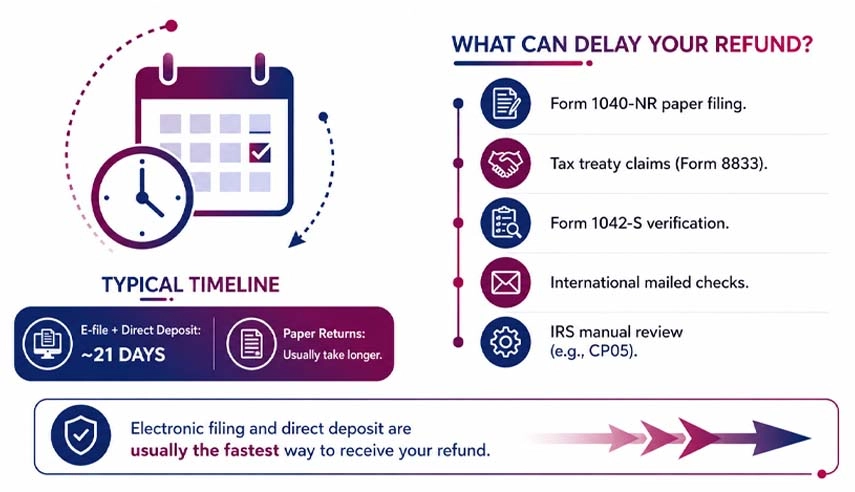
Well, here's a quick answer to that: most of the electronically filed U.S. tax returns with direct deposits are generally issued within the timeframe of 21 days. Whereas the paper-filed returns and the returns that require manual review, including the Form 1040-NR filing, can generally take longer.
The following factors commonly extend the IRS tax refund schedule for NRIs.
In case your US tax return requires any sort of additional verification, such as a CP05 hold, then the refund will not move to the "Approved" stage until and unless that specific review is done.
The following are some of the common reasons for an IRS refund to take longer than expected. Such as:
The following is a sequence to follow as an NRI if your US tax refund is delayed:
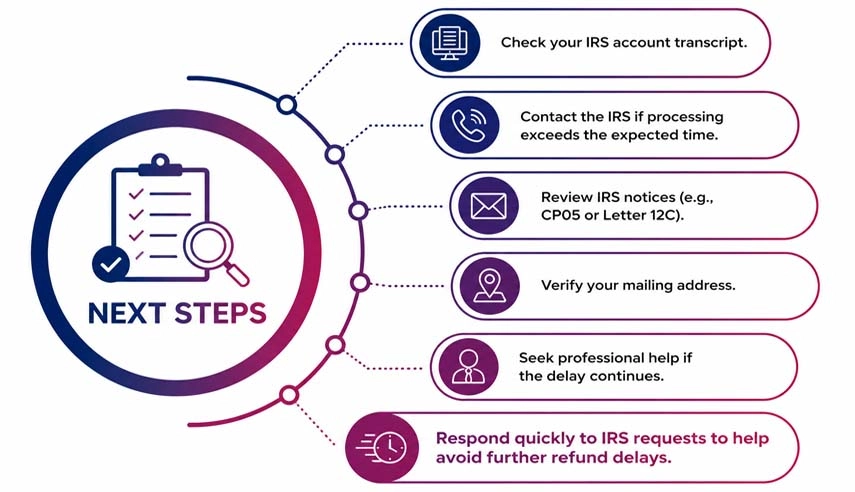
Check and validate your IRS account transcript. This generally demonstrates much more detail than the refund tracker, including any kind of specific hold codes.
After the expected processing period for the refund has passed and the refund tracker is still not providing any update, you must contact the IRS international taxpayer line to get information about your return status.
Ensure you review your mailbox for any IRS notices, such as the CP05 or Letter 12C, as these notices tell you exactly what is holding up the processing of the refund or if there's anything you need to send.
Once again, confirm whether the mailing address you have with the IRS is current, especially if you have relocated within India or elsewhere around the globe. This is because the refund check or notices sent to an outdated address can cause significant delays.
Contact a professional CPA if the tax refund delay is causing you a genuine financial hardship and the standard means have not resolved your problem; use Form 911 to request the assistance.
Rashi is an NRI who files Form 1040-NR every year for the rental income she earns from the property she owns in the United States. She filed her return by mail early in the filing season, and her tax preparer's e-filing options for the nonresident return were not accessible for her filings in that tax year. Ten weeks later, with no refunds being received, she tried to check her "Where's my refund" tool using her ITIN, filing status, and the exact refund amount. After doing so, the tool returned with no information at all, showing no record of her return.
Rashi got concerned and thought that her return might have gone missing; then Rashi called the IRS international taxpayer line, and the representative confirmed her return is received and still in the standard process for a nonresident paper-filed US tax return. The representative further adds that such returns typically take longer than the 21 days estimated in the e-filing workflow for e-filed returns. She was told to expect that her refund would take a few more weeks, and it arrived roughly four months after the date she originally filed.
This experience shows that paper-filed or manually reviewed returns may take longer to appear in the refund tracker; therefore, it is better to contact the IRS directly if no status is available after the normal processing period.
Savetaxs CPAs resolve your US tax refund status queries in minutes and ensure your refund is issued ASAP.
From abroad, tracking your U.S. tax refund can take longer for NRIs because their returns are often paper-filed or require additional IRS review, resulting in longer processing times. In case your IRS refund status is unavailable after the expected processing time, then contacting the IRS can help you get an update on your status.
If your US tax refund is taking noticeably longer than expected, or you have received a notice you are not sure about, then in such a case, taking the help of a professional CPA who has cross-border expertise and knows how to manage NRI taxation can help you confirm exactly where your refund stands, what you need to do, and what you need to do ahead. Savetaxs is one such name when it comes to trusting a professional with your taxes and finances in the United States and elsewhere around the globe.
Connect with us as we serve our clients 24/7 across all time zones.
This article is for general informational purposes only and does not constitute tax, legal, financial, or investment advice. Laws, regulations, rates, and procedures may change over time and may vary based on individual circumstances.
While SaveTaxs makes reasonable efforts to keep the information accurate and up to date, readers should verify applicable rules with official authorities or consult a qualified professional before making decisions based on this information.
Vipul Jain is the Co-Founder of SaveTaxs and a tax expert with experience in Indian and NRI taxation. He advises individuals, NRIs, and businesses on tax filing, tax planning, capital gains, DTAA, and compliance matters. He focuses on making complex tax concepts simple and helping taxpayers make informed, compliant decisions. See Full Bio

Want to read more? Explore Blogs