NRI Income Tax Compliance
Income Tax Forms Renamed in 2026: Old vs New Form NumbersIncome Tax Forms Renamed in 2026: Old vs New Form Numbers
Written by Vipul Jain

India’s income-tax law has changed from 1 April 2026, and if you live abroad, you may be wondering whether your NRI tax obligations have changed too. However, the new framework does not rewrite every NRI tax rule. In this guide, we’ll explain what actually changed, what stayed the same, and what NRIs should check for FY 2026–27.
The Income-tax Act, 2025 applies to tax years beginning on or after 1 April 2026, while earlier tax years continue under the Income-tax Act, 1961.
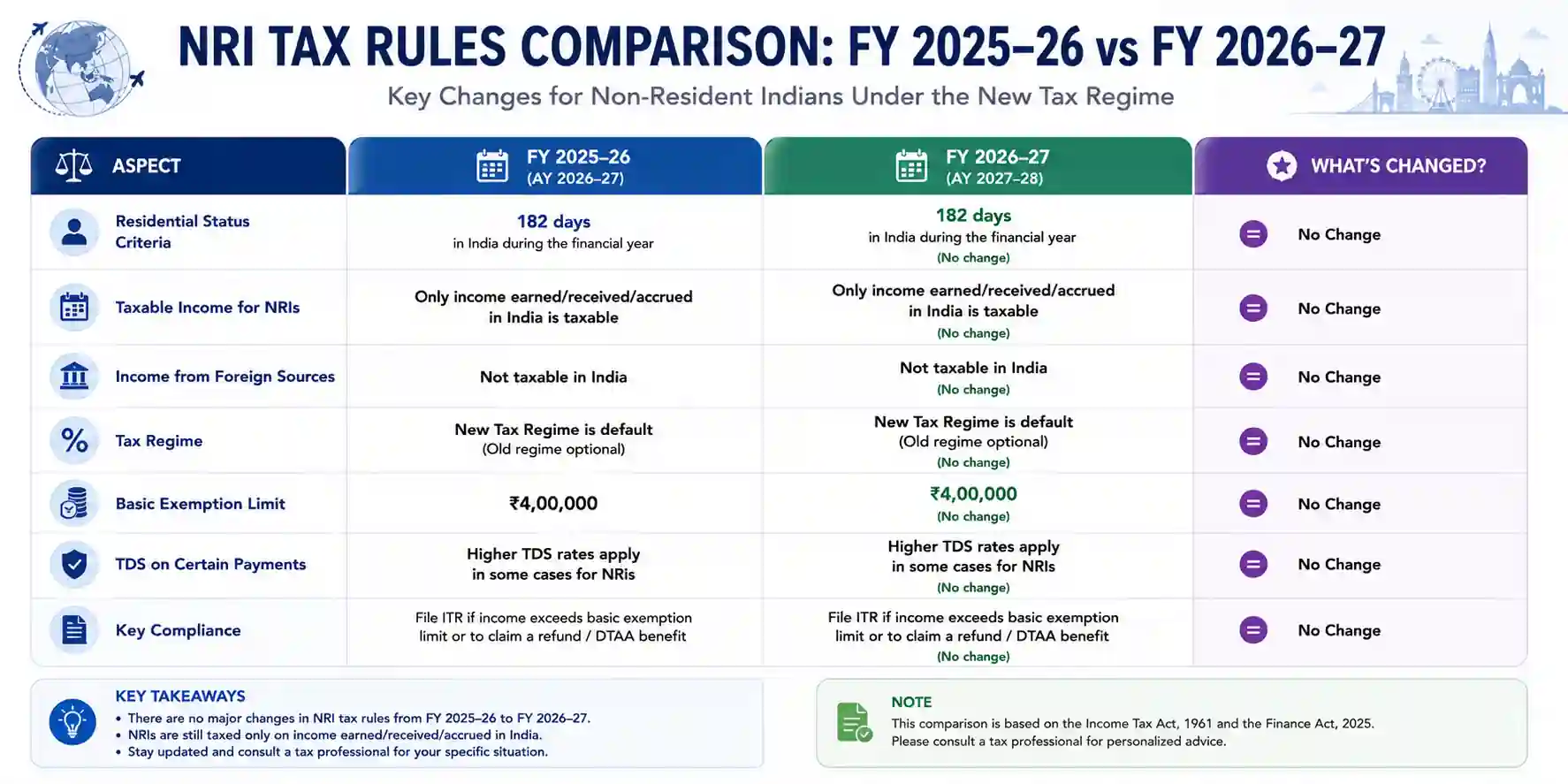
NRI residential-status tests have not materially changed; the core 182-day and 60-day-plus-365-day tests continue.
Special residency rules for certain Indian citizens and Persons of Indian Origin visiting India continue, including the 120-day rule for qualifying individuals with more than ₹15 lakh of specified Indian income.
NRE interest exemption continues under the new Act when the applicable FEMA and RBI conditions are satisfied.
Special NRI investment provisions have largely been carried forward under the new Act rather than removed.
New-regime tax slabs continue with rates ranging from 0% to 30%; however, NRIs cannot claim the Section 87A rebate available to eligible resident individuals.
NRI compliance still requires checking Indian-source income, residential status, TDS, capital gains and applicable return-filing requirements.
The new income-tax rules for NRIs are the provisions applicable to non-residents under the Income-tax Act, 2025 for tax years beginning on or after 1 April 2026. The major change is therefore the transition to the new legislation, while several substantive NRI provisions continue with similar rules.
First, the terminology also changes under the new framework. FY 2026–27 corresponds to the tax year beginning on 1 April 2026, so residential status for that period is determined under the Income-tax Act, 2025.
For example, an NRI whose relevant tax year begins on 1 April 2026 will determine residential status under the new Act, while FY 2025–26 remains governed by the 1961 Act.
The new NRI tax rules matter because using the wrong tax year or assuming that every provision has changed can lead to incorrect tax calculations and compliance decisions. The Income Tax Department confirms that the new Act applies prospectively to tax years beginning on or after 1 April 2026.
Moreover, the distinction is important when your stay in India crosses 31 March 2026. Residential status is assessed separately for each tax year, so FY 2025–26 and FY 2026–27 can fall under different Acts.
For example, if you spent substantial time in India during both years, your FY 2025–26 status is tested under the 1961 Act, while your FY 2026–27 status is tested under the 2025 Act.
The principal change for NRIs from 1 April 2026 is the replacement of the Income-tax Act, 1961 with the Income-tax Act, 2025 for new tax years. Several provisions have been reorganized and renumbered, but that does not automatically mean their underlying tax treatment has changed.
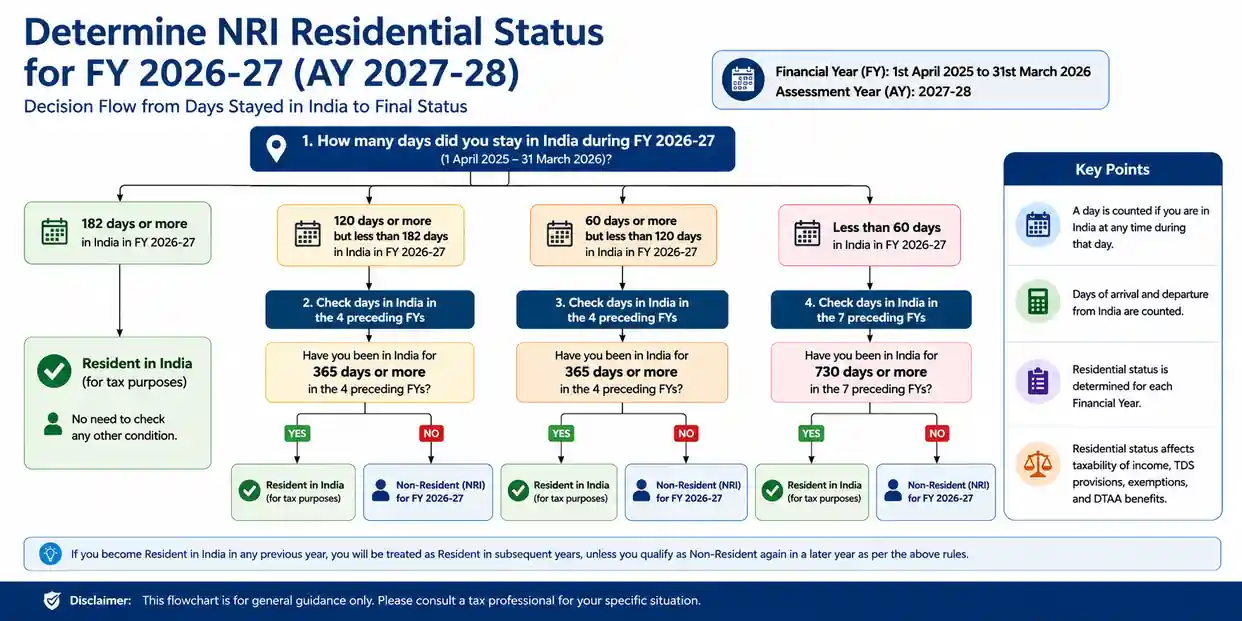
NRI residential-status rules have not materially changed under the Income-tax Act, 2025. An individual generally becomes resident if they stay in India for 182 days or more during the tax year, or meet the 60-day-plus-365-day test, subject to the statutory exceptions.
For example, a person staying in India for 190 days during the tax year would generally satisfy the 182-day condition, subject to the other provisions governing their circumstances.
The basic residential-status tests for individuals remain substantially the same under the Income-tax Act, 2025.
Special rules continue for certain Indian citizens and Persons of Indian Origin visiting India. Where such an individual has more than ₹15 lakh of income other than income from foreign sources, the alternate condition uses 120 days instead of 60 days, together with the preceding-four-year requirement.
Similarly, deemed-resident provisions continue for certain Indian citizens with more than ₹15 lakh of specified income who are not liable to tax in another country because of domicile, residence or similar criteria.
An NRI is generally taxed in India on income that is taxable in India under the applicable domestic provisions, with the exact treatment depending on the nature and source of income. Salary, rent, interest, dividends and capital gains can therefore require different tax treatment.
At the same time, the new tax regime remains relevant to individuals, including non-residents, and the tax rates under Section 202 of the Income-tax Act, 2025 are 0% to 30%. The published rates are:
| Taxable income | New-regime rate |
|---|---|
| Up to ₹4 lakh | Nil |
| ₹4 lakh–₹8 lakh | 5% |
| ₹8 lakh–₹12 lakh | 10% |
| ₹12 lakh–₹16 lakh | 15% |
| ₹16 lakh–₹20 lakh | 20% |
| ₹20 lakh–₹24 lakh | 25% |
| Above ₹24 lakh | 30% |
However, NRIs cannot claim the Section 87A rebate, because the Income Tax Department states that this rebate is available only to eligible resident individuals.
For example, an NRI with ₹10 lakh of taxable income should not assume that the resident Section 87A rebate will reduce their tax liability.
NRE-account interest exemption has been retained under the Income-tax Act, 2025, subject to the applicable FEMA and RBI conditions. The new Act places the exemption in Schedule IV rather than removing the underlying benefit.
For example, an eligible NRI maintaining an NRE account in accordance with applicable FEMA requirements can continue to receive the relevant income-tax exemption on qualifying interest.
Interest earned on an eligible NRE account continues to receive an income-tax exemption under the new Act, subject to the applicable FEMA and RBI conditions.
Moreover, the special NRI taxation framework has largely been retained. The provisions corresponding to the earlier Sections 115D, 115E and 115F continue the core treatment for qualifying investment income, concessional taxation and specified reinvestment exemptions.
NRI tax changes for 2026–27 also include practical compliance changes that can affect transactions involving Indian assets. One notable Budget 2026 change concerns TDS when a resident individual or HUF buys immovable property from a non-resident.
From 1 October 2026, a resident individual or HUF will not need to obtain TAN for TDS on consideration paid for an immovable property when the seller is a non-resident; the buyer can use the PAN-based process specified for reporting the deduction.
For example, an Indian resident purchasing qualifying property from an NRI after 1 October 2026 can follow the revised PAN-based TDS process rather than obtaining TAN solely for that transaction.
This change simplifies the buyer's compliance process but does not eliminate the underlying TDS obligation. The applicable rate and transaction conditions still need to be checked before completing the property transaction.
NRIs should first determine their residential status for FY 2026–27 under the Income-tax Act, 2025 before calculating their Indian tax liability. This should be based on the applicable stay conditions and special rules rather than simply relying on your NRI status with a bank.
Next, review your Indian income under these categories:
Salary or professional income connected with India
Rental income from Indian property
Interest and dividend income
Capital gains from Indian assets
Other taxable Indian-source income
In addition, check whether TDS has been correctly deducted and whether you need to file an Indian income-tax return. If you have capital gains or multiple income sources, review the applicable provisions before filing.
The new income-tax rules for NRIs represent a transition to the Income-tax Act, 2025 rather than a complete rewrite of NRI taxation. Core residential-status conditions, NRE interest exemption and special NRI taxation provisions have largely continued, while the legislative structure and selected compliance rules have changed.
Ultimately, the safest approach is to identify the correct tax year, determine your residential status, classify your Indian-source income and then apply the relevant tax and TDS provisions. By checking these points before filing, you can avoid treating a renumbered provision as a new tax rule - and focus on the changes that actually affect you.
This article is for general informational purposes only and does not constitute tax, legal, financial, or investment advice. Laws, regulations, rates, and procedures may change over time and may vary based on individual circumstances.
While SaveTaxs makes reasonable efforts to keep the information accurate and up to date, readers should verify applicable rules with official authorities or consult a qualified professional before making decisions based on this information.
Vipul Jain is the Co-Founder of SaveTaxs and a tax expert with experience in Indian and NRI taxation. He advises individuals, NRIs, and businesses on tax filing, tax planning, capital gains, DTAA, and compliance matters. He focuses on making complex tax concepts simple and helping taxpayers make informed, compliant decisions. See Full Bio
Want to read more? Explore Blogs