NRI Income Tax Compliance
Capital Gains Tax Planning for NRIs Living in the USCapital Gains Tax Planning for NRIs Living in the US
Written by Hatim Dudhiyawala


If you live in the United States but earn income, own property, or maintain investments in India, you may have tax obligations in both countries. Your US salary, Indian rental income, dividends, capital gains, and bank interest can be subject to different tax and reporting rules.
Cross-border tax planning for NRIs in the USA means understanding how Indian and US tax laws apply to your income and financial interests together. The aim is to determine where income may be taxable, identify eligible relief from double taxation, and meet the filing and reporting requirements of both countries. Relief may be limited and does not necessarily eliminate all double taxation.
The rules depend on your citizenship, tax residency, income source, and the type of asset involved. Being an NRI under Indian tax law does not automatically make you a nonresident for US tax purposes.
Cross-border tax planning helps you coordinate tax obligations when your income, investments, property, or financial accounts are connected to more than one country.
For NRIs living in the US, it commonly involves:
Example: Suppose you live and work in California and receive rent from an apartment in Bengaluru. India may tax the rental income because the property is located there. If you are a US citizen or US tax resident, the rental income will generally also need to be considered on your US tax return. India and the US may calculate taxable rental income differently, including the treatment of expenses and depreciation, so the income and any potential foreign tax credit should be calculated under each country's rules.
The correct approach is to assess both countries' rules rather than assume that paying tax in one country settles your obligations in the other.
Understand your cross-border tax obligations, DTAA benefits, and foreign tax credit options.
India and the US use different tests to determine tax residency and the scope of taxable income. Your status in one country does not automatically determine your status in the other.
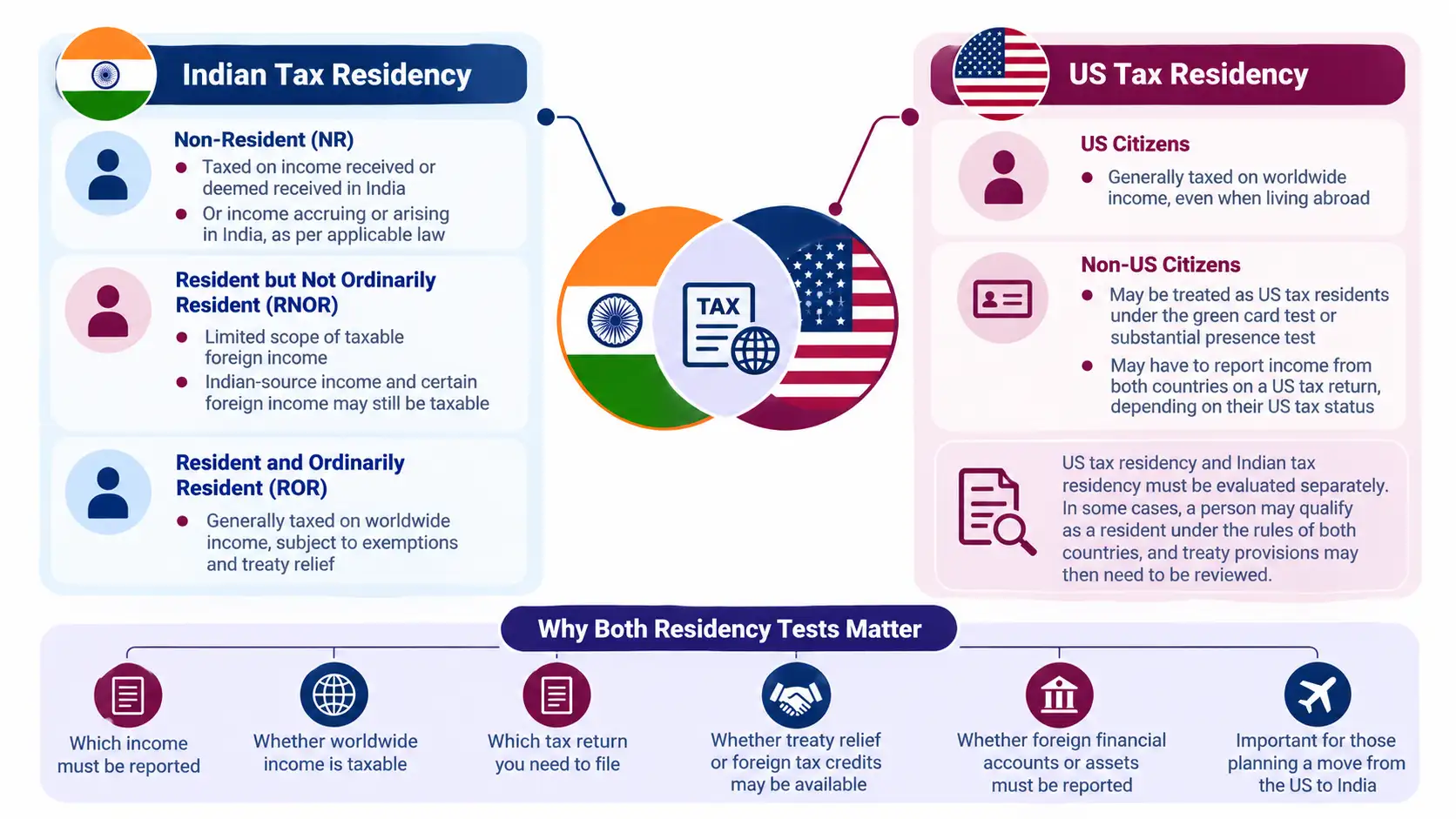
India determines your residential status separately for each relevant tax year under the law applicable to that year. The Income-tax Act, 2025 applies to tax years beginning on or after 1 April 2026, while earlier tax years continue to be governed by the Income-tax Act, 1961. The applicable residency tests and related provisions should therefore be checked for the specific tax year.
For Indian tax purposes, individuals may broadly be classified as:
Do not assume that you remain an NRI for Indian income-tax purposes simply because you hold an Indian passport or live abroad for most of the year. Check your status using the rules applicable to the specific tax year.
The US generally taxes US citizens on worldwide income, even when they live abroad. Non-US citizens may also be treated as US tax residents under rules such as the green card test or substantial presence test.
Consequently, an Indian citizen working in the US may have to report income from both countries on a US tax return, depending on their US tax status.
US tax residency and Indian tax residency must be evaluated separately. In some situations, a person may qualify as a resident under the domestic rules of both countries. Treaty provisions may then need to be reviewed.
Your residency status can affect:
If you are planning a move from the US to India, review your expected residency status and the timing of significant income or asset transactions before relocating.
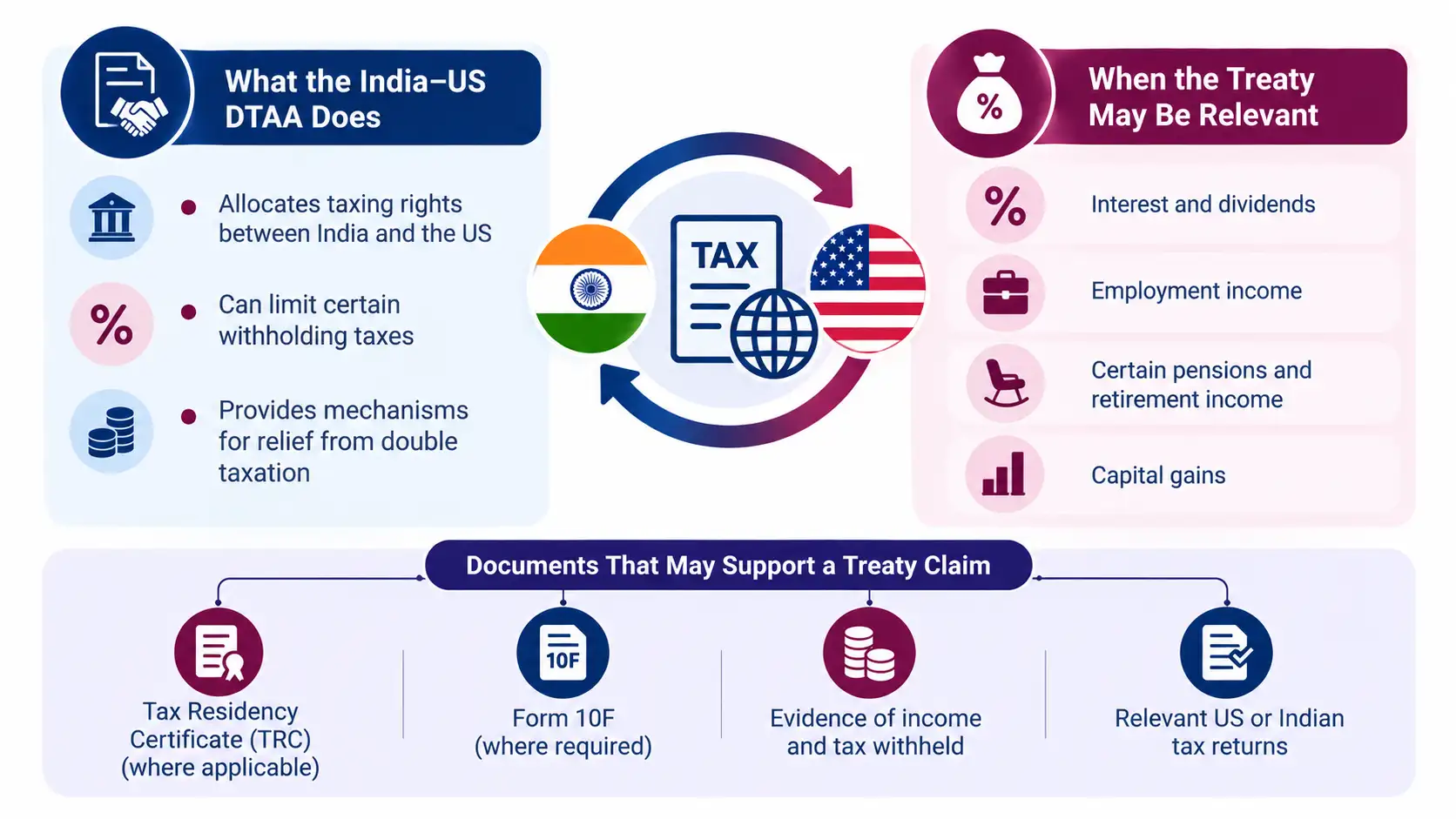
The India–US Double Taxation Avoidance Agreement (DTAA) is a tax treaty that addresses how certain types of income are treated when India and the US both have a potential right to tax them.
Depending on the relevant treaty article and your circumstances, the treaty may allocate taxing rights, limit certain withholding taxes, or provide mechanisms for relief from double taxation.
It does not mean that every NRI is exempt from tax in one country whenever tax has been paid in the other.
The India–US DTAA may need to be considered for income such as:
The applicable article depends on the income type, the taxpayer's residence, and the facts of the transaction. Special rules and exceptions may also apply.
Depending on the claim, you may need:
A treaty benefit should be assessed before relying on a reduced tax rate or exemption. US citizens and residents should also consider US domestic law and the treaty's saving-clause provisions. The saving clause generally preserves the United States' ability to tax its citizens under US law, subject to specified treaty exceptions. Treaty benefits must therefore be assessed against the relevant article, any applicable exception, and the taxpayer's circumstances.
For the official treaty text, refer to the IRS India tax treaty documents.
A foreign tax credit may help reduce double taxation when the same income is taxable in two countries and the tax paid to one country qualifies for credit in the other.
However, the rules are different in India and the US. A credit claimed in one country does not automatically create an equal credit in the other.
Eligible US taxpayers may be able to claim a credit for qualifying foreign income taxes paid or accrued, subject to IRS requirements and limitations.
For example, if you live in the US and receive taxable rental income from India, you may pay Indian income tax on the rental income. If the income is also taxable in the US, assess whether the Indian tax qualifies for a US foreign tax credit. The credit may be limited by the applicable rules for foreign-source income, income category, and treaty treatment, so it may not equal the full amount of Indian tax paid.
Form 1116 is generally used to calculate the credit for individuals when required. Certain taxpayers may qualify for an exception from filing the form, depending on the applicable conditions.
The credit is not necessarily equal to the entire amount of foreign tax paid. Eligibility, the source and category of income, and the applicable limitations matter.
See the IRS guidance on the Foreign Tax Credit and Publication 514.
If you qualify as an Indian tax resident and pay eligible foreign income tax on income that is also taxable in India, you may be able to claim Indian foreign tax credit under the applicable law and treaty. Form 67 has been used for eligible claims under the Income-tax Act, 1961 and the related rules. For tax years beginning on or after 1 April 2026, verify the applicable provisions, prescribed form, deadline, and procedure under the Income-tax Act, 2025 and the rules in force for that year.
Before claiming a foreign tax credit, check:
Keep tax payment receipts, withholding statements, income calculations, and copies of both countries' tax returns. These records can help support your claim if either tax authority requests evidence.
Paying tax is not the same as completing every filing and disclosure requirement. You may have to report income or financial accounts even when no additional tax is due.
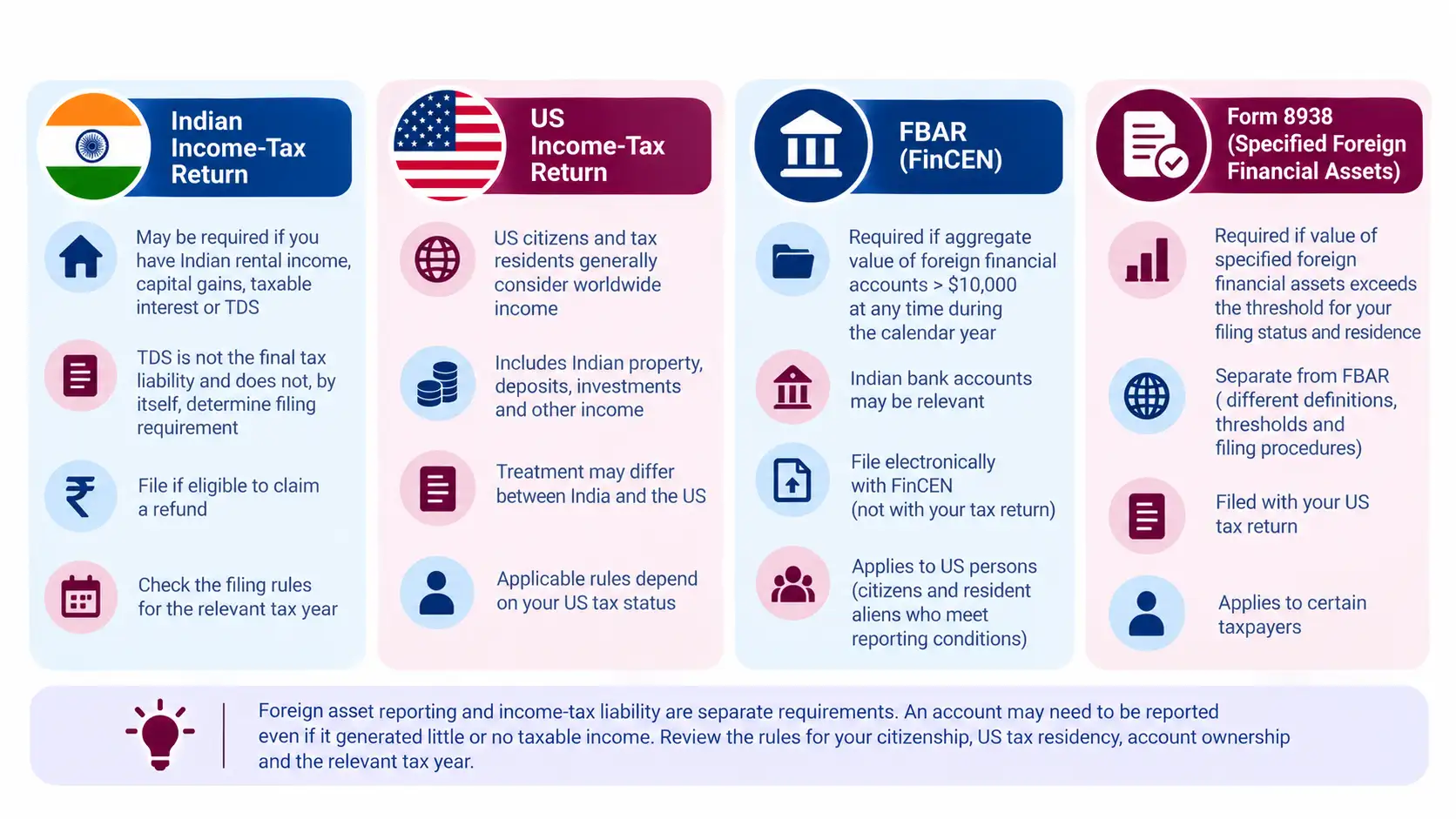
You may need to file an Indian income-tax return if your circumstances meet the applicable filing conditions. For an NRI, relevant factors can include Indian rental income, capital gains, taxable interest, tax deducted at source (TDS), and eligibility to claim a refund. TDS is not necessarily the final tax liability and does not, by itself, establish whether a return is required.
Check the return-filing requirements for the relevant tax year rather than assuming that non-resident status removes the need to file.
US citizens and US tax residents generally need to consider worldwide income when determining their US filing and reporting obligations. This can include income from Indian property, deposits, investments, and other sources.
The treatment of a particular income item may differ between India and the US. For example, the countries may apply different rules for recognizing income, calculating gains, or determining deductible expenses.
US persons, including US citizens and resident aliens who meet the applicable reporting conditions, generally must file a Report of Foreign Bank and Financial Accounts (FBAR) if they have a financial interest in or signature or other authority over qualifying foreign financial accounts and the aggregate value of those accounts exceeded $10,000 at any time during the calendar year. US tax status and FBAR status should be assessed under the applicable rules.
Indian bank accounts may be relevant to this test. The threshold is based on the aggregate value of qualifying foreign financial accounts, not the balance of each account considered separately.
FBAR is filed electronically through the Financial Crimes Enforcement Network (FinCEN), not as an attachment to the federal income-tax return.
Check the IRS FBAR guidance to determine whether the requirement applies to you.
Some taxpayers must also file Form 8938 with their US tax return if the value of their specified foreign financial assets exceeds the threshold applicable to their filing status and residence.
Form 8938 and FBAR are separate reporting regimes. Filing one does not automatically satisfy the other, and their definitions, thresholds, and filing procedures differ.
For details, review the IRS guidance for US citizens and residents abroad.
Foreign asset reporting and income-tax liability are not identical questions. An account may need to be reported even if it generated little or no taxable income. Missing a required disclosure can create a separate compliance problem.
Review the requirements for your citizenship, US tax residency, account ownership, and the relevant tax year.
Get guidance on tax residency, foreign income, and filing requirements as an NRI.
Before filing returns or making a significant financial decision, use this checklist to identify the main India–US issues.
This checklist is a starting point, not a substitute for assessing the rules that apply to your specific income and residency circumstances.
Cross-border tax planning is most effective when you review Indian and US tax obligations together. Understanding residency, checking treaty eligibility, documenting foreign taxes, and meeting reporting requirements can help you avoid preventable compliance problems.
If you have Indian income or assets while living in the US, consider reviewing your tax position before a major transaction or filing deadline. You can explore Savetaxs India–US tax planning services for guidance on your circumstances.
This article is for general informational purposes only and does not constitute tax, legal, financial, or investment advice. Laws, regulations, rates, and procedures may change over time and may vary based on individual circumstances.
While SaveTaxs makes reasonable efforts to keep the information accurate and up to date, readers should verify applicable rules with official authorities or consult a qualified professional before making decisions based on this information.
Vipul Jain is the Co-Founder of SaveTaxs and a tax expert with experience in Indian and NRI taxation. He advises individuals, NRIs, and businesses on tax filing, tax planning, capital gains, DTAA, and compliance matters. He focuses on making complex tax concepts simple and helping taxpayers make informed, compliant decisions. See Full Bio

Want to read more? Explore Blogs