NRI Income Tax Compliance
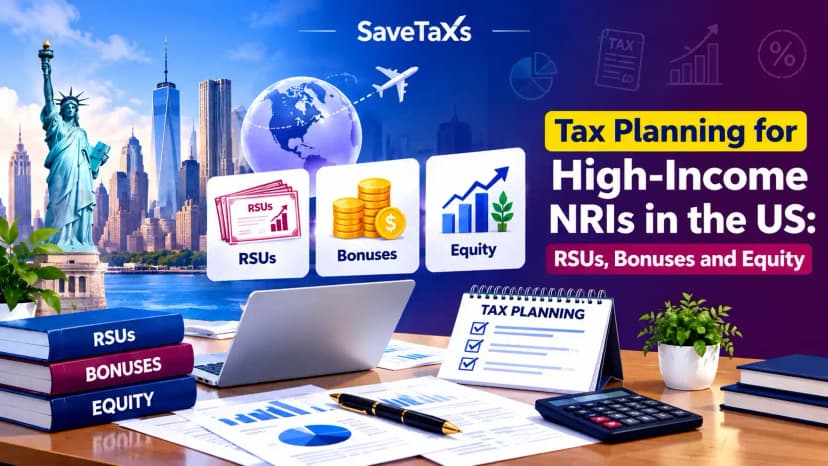
Tax Planning for High-Income NRIs in the US: RSUs, Bonuses and EquityTax Planning for High-Income NRIs in the US: RSUs, Bonuses and Equity
Written by Vipul Jain
An S Corporation election allows an eligible corporation to pass its income, losses, deductions, and credits through to its shareholders under federal tax rules. However, this tax status does not continue automatically if the corporation stops meeting the applicable requirements. Certain events can cause its S Corporation election to terminate, sometimes without the business owners intending to change the company's tax status.
For business owners, an unexpected termination can affect federal tax treatment, shareholder reporting, and the corporation's tax-filing responsibilities. The effective date is particularly important because it determines when the corporation stops being treated as an S Corporation and generally begins being treated as a C Corporation.
This guide explains the reasons an S Corporation election can terminate, when termination takes effect, whether an inadvertent termination can be corrected, and what happens to the corporation's tax obligations afterward.
S Corporation termination means that a corporation's federal S Corporation election is no longer effective. Once termination takes effect, the corporation generally stops receiving S Corporation pass-through tax treatment and becomes subject to the federal income-tax rules applicable to a C Corporation.
Termination does not necessarily mean that the business has closed, dissolved, or stopped operating. The legal entity may continue its business activities under state law. The change concerns its federal tax treatment.
Under Section 1362(d) of the Internal Revenue Code, an S Corporation election can terminate through voluntary revocation, loss of small business corporation eligibility, or the passive investment income rule.
Understand your new tax obligations, short-year filings, and C Corporation compliance requirements.
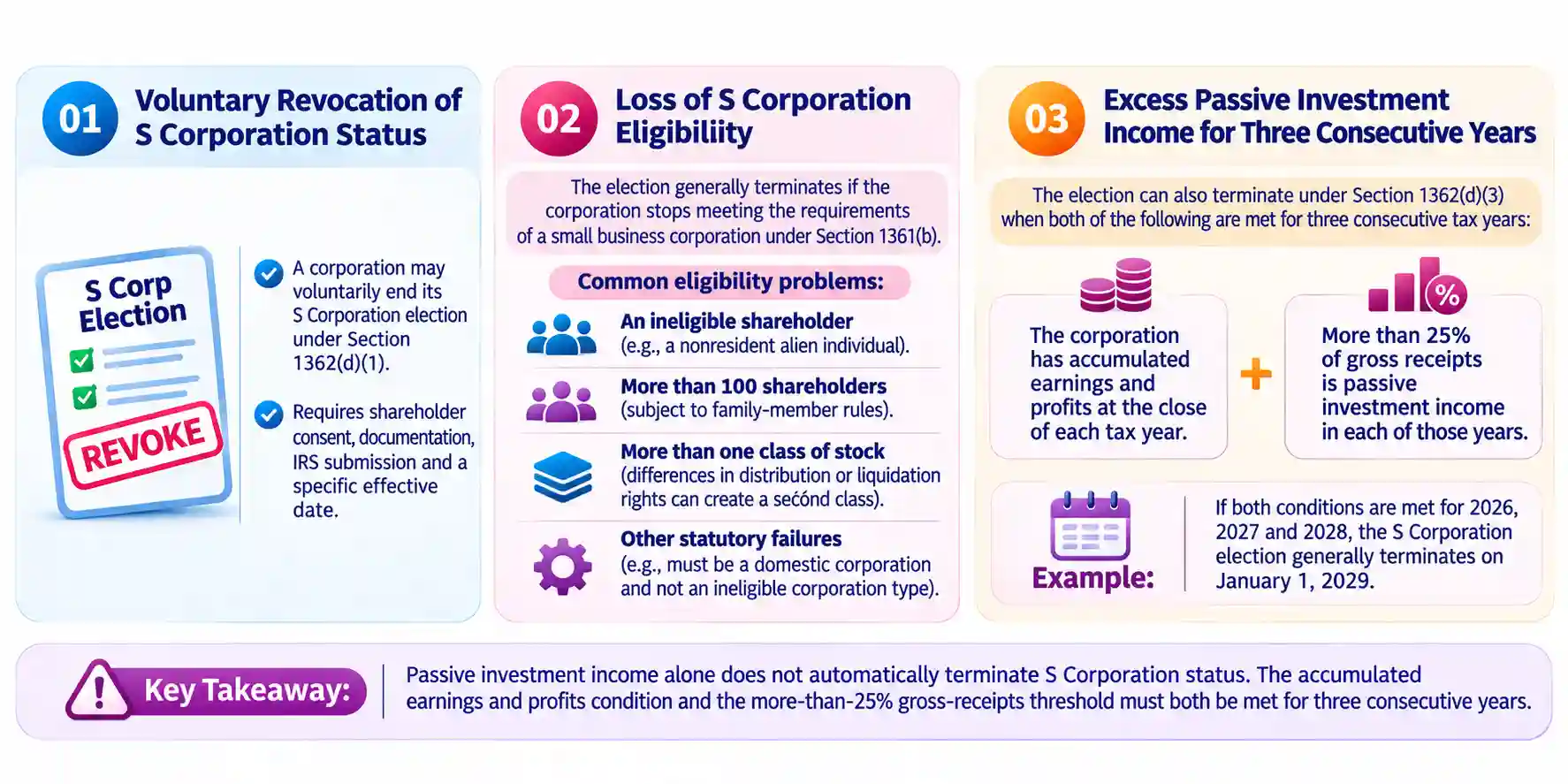
An S Corporation election can end for different reasons. The applicable rules and effective date depend on the event that causes termination.
A corporation may voluntarily end its S Corporation election under Section 1362(d)(1). This is a deliberate decision rather than an automatic consequence of losing eligibility or meeting the passive investment income termination conditions.
Voluntary revocation has specific shareholder-consent, documentation, submission, and effective-date requirements. These procedures are different from automatic termination.
For the detailed process, including shareholder approval and IRS submission, read our guide on how to revoke an S Corporation election.
An S Corporation must continue meeting the requirements of a small business corporation under Section 1361(b). If it stops qualifying after its election becomes effective, its S Corporation election generally terminates on the date it ceases to meet those requirements.
Common eligibility problems include:
Example: Suppose an S Corporation transfers shares to an individual who is a nonresident alien for U.S. tax purposes. If the individual is not within a permitted shareholder category, the transfer may cause the corporation to stop qualifying as a small business corporation. The S Corporation election generally terminates on the date the disqualifying event occurs, unless applicable relief is available.
The result depends on the ownership facts, applicable exceptions, and the date the corporation stops meeting the requirements. For a broader explanation of these requirements, see our guide to S Corporation eligibility requirements.
An S Corporation can also lose its status under the passive investment income rule in Section 1362(d)(3).
This rule generally applies when both of the following conditions are met for each of three consecutive tax years:
Passive investment income generally includes gross receipts from royalties, rents, dividends, interest, and annuities. The law also provides specific exceptions and special rules for certain types of income and businesses.
Example: Suppose a calendar-year S Corporation has accumulated earnings and profits at the close of 2026, 2027, and 2028. If passive investment income exceeds 25% of its gross receipts in each of those three years, its S Corporation election generally terminates on January 1, 2029.
Important: Passive investment income alone does not automatically terminate S Corporation status. The accumulated earnings and profits condition and the more-than-25% gross-receipts threshold must both be met for three consecutive tax years. The calculation also follows specific statutory rules, including special treatment for certain asset sales. A corporation should not rely only on how income is labelled in its accounting records.
The effective date depends on the reason for termination. An eligibility failure and the passive investment income rule do not follow the same timing.
| Reason for termination | General effective date |
|---|---|
| Corporation ceases to qualify as a small business corporation | The date it stops meeting the eligibility requirements |
| Passive investment income exceeds 25% of gross receipts for three consecutive tax years, with accumulated earnings and profits at the close of each year | The first day of the first tax year after the third consecutive year |
| Voluntary revocation | Governed by the separate revocation timing rules under Section 1362(d)(1) |
For example, if an eligibility failure occurs on August 10, the termination generally takes effect on that date, assuming the event causes the corporation to cease qualifying and no relief applies.
The passive investment income rule works differently. If a calendar-year corporation meets both statutory conditions for 2026, 2027, and 2028, termination generally takes effect on January 1, 2029.
The effective date determines when the corporation's S Corporation tax period ends and its C Corporation tax period begins. It also affects how income, deductions, credits, and other tax items are reported. The corporation should identify the event and its effective date rather than assuming that every termination occurs at the end of the tax year.
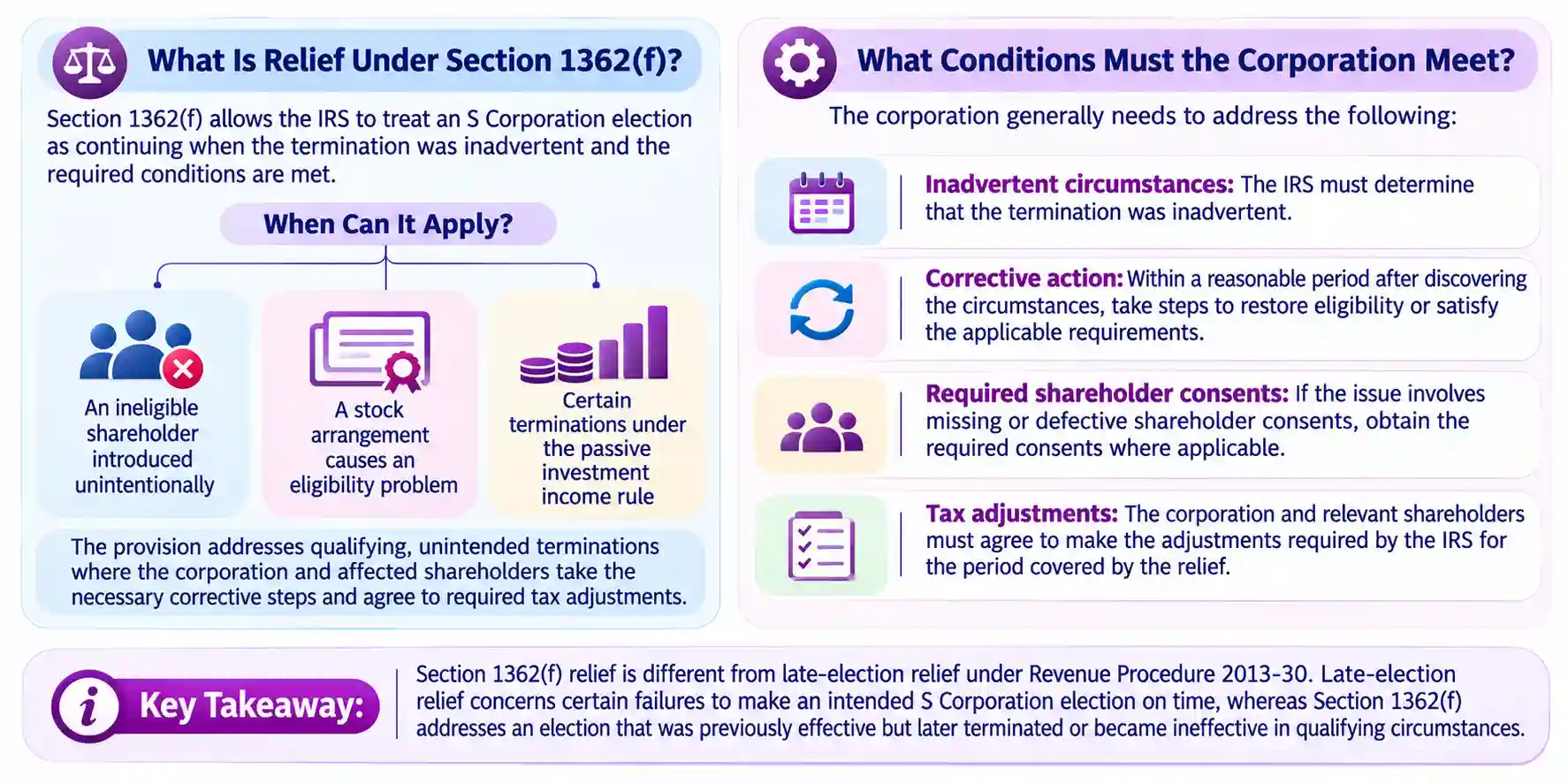
An S Corporation may qualify for relief when its election terminates unintentionally because of an eligibility failure or the passive investment income rule. Section 1362(f) gives the IRS authority to treat an inadvertent termination as continuing if the statutory conditions are satisfied.
However, relief is not automatic. The corporation must establish that the termination was inadvertent and take the required corrective steps within a reasonable period after discovering the problem.
Section 1362(f) allows the IRS to treat an S Corporation election as continuing when the IRS determines that the circumstances resulting in the termination were inadvertent and the required conditions are met.
This relief may be relevant when an ownership change unintentionally introduces an ineligible shareholder, a stock arrangement causes an eligibility problem, or another qualifying event terminates the election. It may also apply to certain terminations under the passive investment income rule.
The provision is intended to address qualifying unintended terminations where the corporation and affected shareholders take the necessary corrective steps and agree to the required tax adjustments.
The corporation generally needs to address the following matters:
For example, if an ownership change unintentionally causes an S Corporation to have an ineligible shareholder, the corporation may need to correct the ownership issue promptly after discovering it. The IRS will consider the circumstances and whether the requirements for relief have been met.
Correcting the ownership record does not, by itself, guarantee that S Corporation status has been restored. The corporation should review whether IRS relief is necessary and what conditions apply.
Section 1362(f) relief is different from late-election relief under Revenue Procedure 2013-30. Late-election relief concerns certain failures to make an intended S Corporation election on time. Section 1362(f) addresses an election that was previously effective but later terminated or became ineffective in qualifying circumstances.
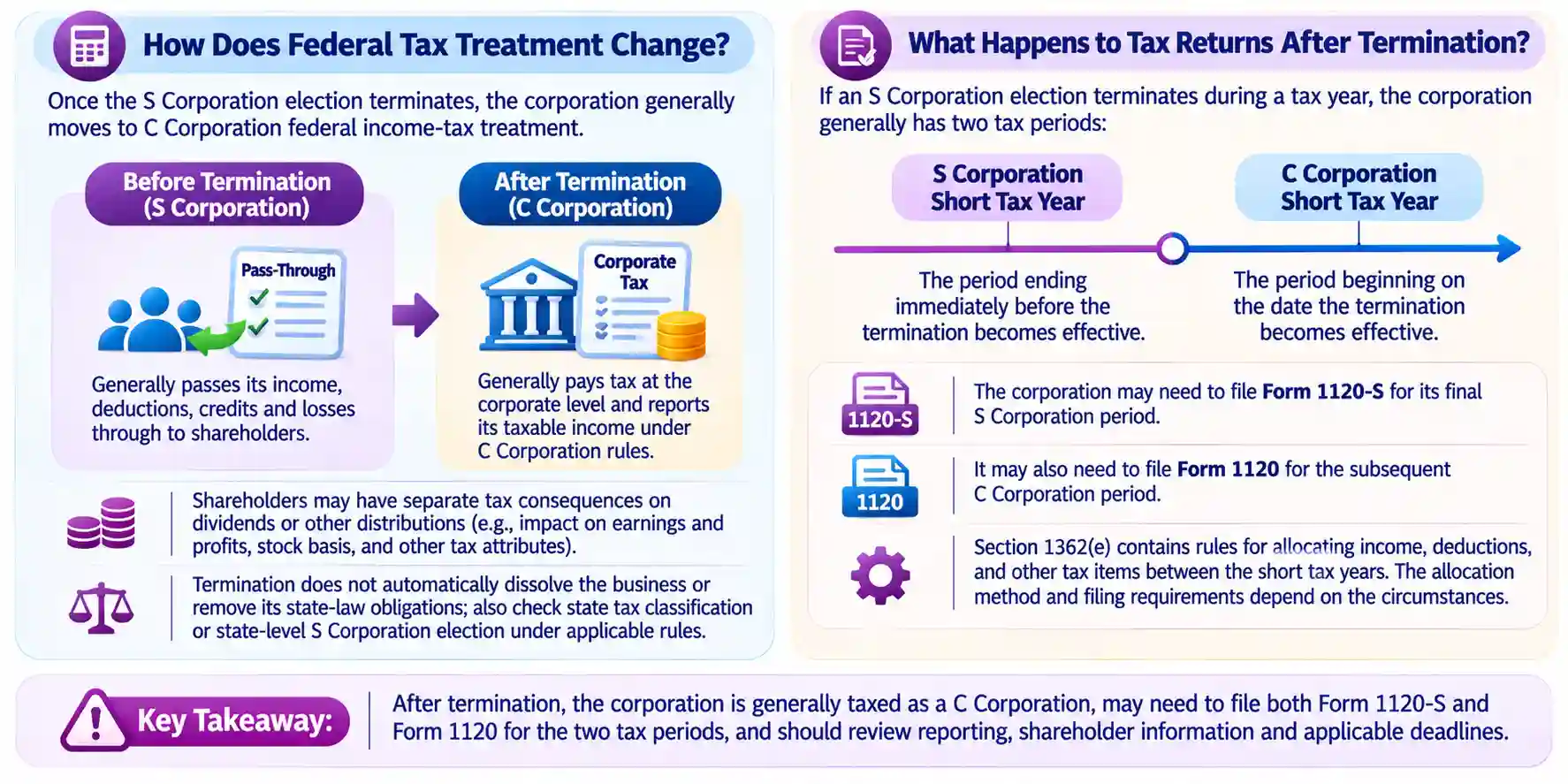
Once termination becomes effective, the corporation generally moves to C Corporation federal income-tax treatment. The reporting requirements depend on the termination date and the corporation's tax year.
Before termination, an S Corporation generally passes its applicable income, deductions, credits, and losses through to its shareholders. Shareholders report their allocated tax items under the applicable rules.
After termination, the corporation generally becomes subject to federal income-tax rules applicable to a C Corporation. It generally reports its taxable income at the corporate level rather than passing its operating income through under Subchapter S.
Shareholders may have separate tax consequences when they receive dividends or other distributions. The treatment of distributions, accumulated earnings and profits, shareholder stock basis, and other tax attributes should be reviewed based on the corporation's circumstances.
Termination does not automatically dissolve the business or remove its state-law obligations. The corporation should also check whether its state tax classification or state-level S Corporation election changes under applicable state rules.
If an S Corporation election terminates during a tax year, the corporation generally has two tax periods:
The corporation may therefore need to file Form 1120-S for its final S Corporation period and Form 1120 for the subsequent C Corporation period. Section 1362(e) contains rules for allocating income, deductions, and other tax items between the short tax years. The allocation method and filing requirements depend on the circumstances.
The corporation should review its accounting records, shareholder reporting, final Schedule K-1 information, tax payments, and applicable return deadlines. For detailed annual S Corporation return guidance, see our article on Form 1120-S filing requirements.
A corporation whose S Corporation election has terminated generally cannot make another S Corporation election effective for a tax year beginning before the fifth tax year after the first tax year in which the termination took effect, unless the IRS consents to an earlier election.
This is commonly called the five-tax-year waiting period. It can apply after termination caused by an eligibility failure or the passive investment income rule.
The corporation should consider this restriction before planning to return to S Corporation taxation. It must also meet the applicable eligibility requirements when making a new election.
The restriction is not necessarily a permanent prohibition. An earlier election may be possible with IRS consent under the applicable rules.
Get expert guidance on termination relief, eligibility issues, and corrective tax compliance.
S Corporation termination can create more than a change in tax classification. An eligibility failure or passive investment income issue can affect the termination date, shareholder reporting, tax-return periods, and the corporation's future ability to elect S Corporation status again.
If your business is facing an unexpected termination, it is important to identify what caused it, establish the correct effective date, review whether relief under Section 1362(f) may apply, and determine the required S Corporation and C Corporation filings.
Savetaxs can help business owners review S Corporation tax and compliance issues, understand the implications of a change in tax status, and assess the filing requirements that follow. Explore our S Corporation tax services for support with your corporation's tax compliance and next steps.
This article is for general informational purposes only and does not constitute tax, legal, financial, or investment advice. Laws, regulations, rates, and procedures may change over time and may vary based on individual circumstances.
While SaveTaxs makes reasonable efforts to keep the information accurate and up to date, readers should verify applicable rules with official authorities or consult a qualified professional before making decisions based on this information.
Shubham Jain is the Founder of SaveTaxs and has extensive experience in Indian and NRI taxation. He advises individuals, NRIs, and businesses on tax filing, tax planning, capital gains, DTAA benefits, fund repatriation, and compliance matters. He regularly writes about taxation and related financial topics. His focus is on making complex tax concepts easy to understand. Through his articles, he helps taxpayers stay informed, avoid common mistakes, and stay compliant with Indian tax laws. See Full Bio

Want to read more? Explore Blogs