UAE NRI Taxation
NRE Account Repatriation to UAENRE Account Repatriation to UAE
Written by Hatim Dudhiyawala
Many Indians living and working in the UAE are unaware that while their UAE income is generally not taxable in India as non-residents, income earned from Indian sources may still be taxable in India. Since the UAE does not impose a personal income tax, NRIs avoid double taxation. However, they are still liable to pay tax in India on Indian sources, such as rent or interest from NRO fixed deposits. In this, the Double Tax Avoidance Agreement (DTAA) between India and the UAE ensures that persons are not taxed twice on the same income. Most UAE-based NRIs are unaware of this tax advantage. Considering this, the DTAA between India and the UAE provides several tax reliefs and deductions and covers income sources such as interest, salaries, royalties, and dividends.
Want to know more about this? This blog explains how the DTAA between India and the UAE works, what it covers, and how UAE-based NRIs benefit from it. So read on and gather all the information.
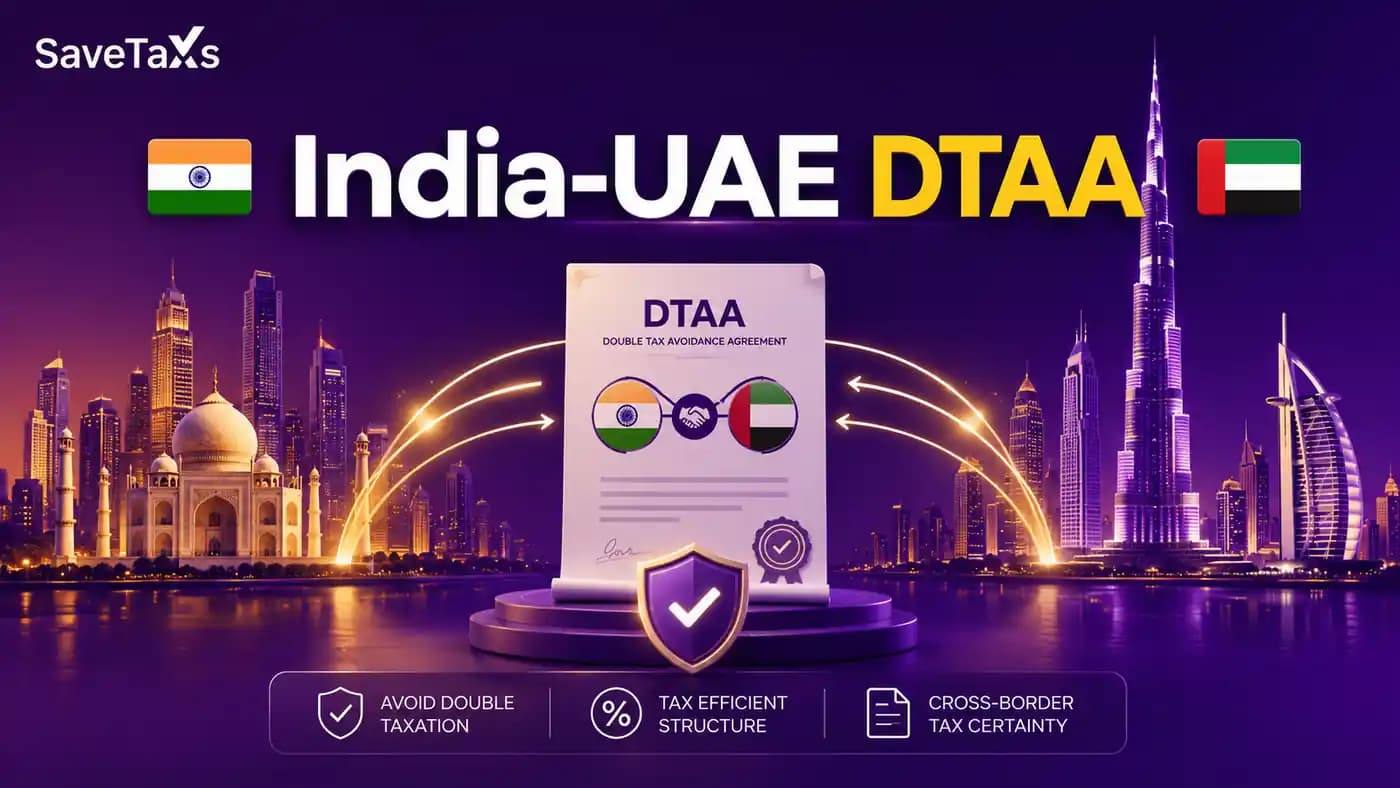
The Double Taxation Avoidance Agreement between India and the UAE was signed in 1993 and has been revised several times since. As the name states, this agreement ensures that individuals and companies with the same income do not pay tax twice. It helps taxpayers to avoid confusion about income tax and tax burden across borders.
Since the UAE does not impose personal income tax, Indians earning in Abu Dhabi or Dubai get the benefit from lower tax rates through the DTAA agreement. The agreement determines which country has the primary right to tax specific categories of income and provides relief where overlapping taxation may arise.
Apart from promoting fair taxation, the DTAA between India and the UAE also encourages investment and commerce between the countries.
This was all about the taxation treaty between India and the UAE. Moving ahead, let's know how this DTAA agreement is different from other DTAAs.
The India-UAE Double Tax Avoidance Agreement is different from other DTAA because it follows the unique tax system of the UAE. As mentioned earlier, the UAE does not impose any personal income tax and has broader definitions for setting a business presence and specific rules for capital gains, which makes it different from other DTAA agreements.
In simple words, you can say that The UAE's tax system can offer tax advantages to many NRIs because the country generally does not impose personal income tax on individuals. However, India still has the right to impose tax on certain India-sourced income types regardless of the treaty.
Confused? Let's understand the India-UAE Double Taxation Avoidance Agreement with an example.
Mr. A is an NRI living in the UAE. From an Indian NRO savings account, he earns INR 5,00,000 interest income. Without the DTAA between India and the UAE, the Indian bank deducts up to 31.2% TDS at the standard rate, resulting in INR 1,56,000 in taxes. Under DTAA, the TDS rate is capped at just 12.5%, reducing the tax outflow to INR 62,500.
So this is how the DTAA between India and the UAE is different from other DTAA agreements. Moving further, let's know who qualifies as a UAE tax resident for DTAA.
Connect with Savetaxs and simply manage your tax obligations from start to finish.
Holding a UAE-residency visa does not qualify you for the India-UAE tax treaty benefits. Considering this, to qualify, you should:
Furthermore, a company is stated as a UAE tax resident if it is incorporated within the UAE and is controlled and managed within the country. Now, moving forward, let's know the taxes covered under the agreement between the two countries.
Although the UAE does not impose any personal income tax on individuals. However, there are other taxes that individuals are liable to pay in the country. For instance, corporations need to pay corporate taxes. Article 2 of the DTAA between India and the UAE mentions the taxes covered under this agreement.
Considering this, all taxes imposed on total income, capital, and taxes on gains from selling immovable and movable property are considered capital and income tax. Here is the list of taxes covered in the agreement between both countries:
The DTAA agreement is only applicable to identical income and capital taxes imposed at the Federal or State level, either in the tax place or in the contracting state.
Now, moving ahead, let's know about the India-UAE DTAA tax rates.
The table below showcases the India-UAE DTAA tax rates on different incomes:
| Income Type | Income Earned in | Income Taxed in | Exception |
|---|---|---|---|
| Interest | The country where the resident is a receiver | Resident country of the receiver | Interest is taxable in the state where it arises, and the tax on such interest should not be more than the following:
|
| Royalties | The country where the resident is a receiver | Resident country of the receiver | Taxed at a rate not more than 10% of the gross royalty amount in the contracting state where they occur. |
| Dividends | The country where the resident is a receiver | Resident country of the receiver | Tax imposed on dividends should not be more than 10% in the contracting state where the firm paying dividends is located. |
Apart from this, on interest income, TDS is imposed at 12.5% in the UAE. Additionally, the DTAA between India and the UAE also states that income generated from the immovable property should be taxed in the country where it is located.
Now, moving further, let's know taxation on capital gains under the DTAA between India and the UAE.
Article 13 of the India-UAE DTAA focuses on the tax policies associated with capital gains. Here are some rules that you need to follow in case of capital gains:
However, if the taxpayers receive capital gains from selling any other property type that is not covered above, they are liable to be taxed in the state where they live. Moving ahead, let's know how DTAA eliminates double taxation.
Article 22 of the India-UAE DTAA addresses the measures for reducing double taxes on foreign income. Some provisions are:
This is how the DTAA agreement eliminates double taxation. Moving further, let's know how to obtain a tax residency certificate (TRC) from the UAE Federal Tax Authority.
Follow the steps below to obtain a tax residency certificate (TRC) from the UAE Federal Tax Authority:
Once you get the TRC certificate, submit it along with Form 10F to every Indian entity paying you income, i.e., mutual fund house, bank, or tenant, to ensure TDS is deducted at a lower DTAA treaty rate.
Now, moving ahead, UAE-specific mistakes NRIs should avoid when claiming DTAA benefits.
Resolve tax notices, file ITR on time, fix refund delays, and avoid tax penalties with expert support.
Here are some of the UAE-Specific Mistakes NRIs should avoid:
| Mistakes | What to do Instead |
|---|---|
| Assuming a residency visa is equal to tax residency | Instead, from the UAE Federal Tax Authority, you need to Apply for TRC. |
| Not renewing the TRC every year | For each financial year, you need to apply for a new TRC. |
| Not filing Indian ITR and assuming the UAE has no tax. | File ITR and claim DTAA benefits formally. |
| Wondering all Indian income is tax-free. | Rental income and capital gains are taxable in India. |
| For a tax refund, use an NRE account. | On the income tax portal, pre-validate your NRO account. |
| Before interest is credited, do not submit your TRC to the Indian bank. | It is vital to submit the TRC and Form 10F at the beginning of every financial year. |
These are some of the key mistakes UAE-based NRIs should avoid.
Lastly, as an NRI, understanding the DTAA between India and the UAE is important for knowing your tax obligations. It helps in avoiding double taxation, clarifies your tax obligations, and ensures that income earned in the UAE is handled transparently and fairly.
If you are facing issues in the India-UAE DTAA, connect with Savetaxs. We have a team of professionals who provide you with personalized guidance as per your tax situation. With our convenient online tax consultation, you can contact us from anywhere in the world.
This article is for general informational purposes only and does not constitute tax, legal, financial, or investment advice. Laws, regulations, rates, and procedures may change over time and may vary based on individual circumstances.
While SaveTaxs makes reasonable efforts to keep the information accurate and up to date, readers should verify applicable rules with official authorities or consult a qualified professional before making decisions based on this information.
Vipul Jain is the Co-Founder of SaveTaxs and a tax expert with experience in Indian and NRI taxation. He advises individuals, NRIs, and businesses on tax filing, tax planning, capital gains, DTAA, and compliance matters. He focuses on making complex tax concepts simple and helping taxpayers make informed, compliant decisions. See Full Bio
Want to read more? Explore Blogs