
_1784547039242.webp&w=828&q=75)
The Double Taxation Avoidance Agreement (DTAA) between India and Malaysia is an agreement for the avoidance of double taxation. It is an important bilateral treaty introduced to prevent the same income being taxed twice in two countries. Considering this, the India-Malaysia DTAA is specifically important for Non-Resident Indians (NRIs), investors, and businesses operating in both nations. This agreement provides clear tax rules, foster stronger economic ties, and offers tax relief from double taxation.
Want to know more about the DTAA agreement between India and Malaysia? Then you are on the right page. Read the blog and gather all the information about it.
Key Takeaways
- India-Malaysia DTAA eliminates the double taxation risk for cross-border earners. It allows foreign investments and bilateral trade to flourish.
- The DTAA agreement between India and Malaysia is available for residents and corporations of India and Malaysia.
- The primary objective of the DTAA agreement is to develop a fair and predictable tax environment that boosts economic cooperation between the two countries.
- The income types covered in the DTAA agreement include salary, capital gains, business profits, interest, dividends, royalties, etc.
- The common TDS rate is 10% for royalties, interest, and fees for technical services.
What is DTAA Between India and Malaysia?
The first DTAA agreement between India and Malaysia was signed on May 14, 1970. However, with changing economic geography and new forms of business strategies and competition, the agreement was revised on May 9, 2012, which became operative on April 1, 2013. It covers income from capital gains, salaries, royalties, interest, and dividends. Additionally, the DTAA agreement simplifies compliance, reduces TDS rates, and provides tax credits.
This new DTAA agreement showcases the shifting of international taxation practices and is based on rules set by global organizations, including the Organization for Economic Cooperation and Development (OECD). The agreement also deals with contemporary commerce and some elements, such as digital services and e-commerce, which were not present in the old DTAA.
The proposed changes in the India-Malaysia DTAA are intended to improve tax efficiency and clarity of the tax systems for those carrying out their operations in the stated countries. It means that it shows how different income types should be taxed. Therefore, reducing the difficulties that arise between the taxpayers and tax authorities.
This was all about the India-Malaysia DTAA. Moving ahead, let's know the significance of this agreement.
Significance of India-Malaysia DTAA
The significance of the India-Malaysia DTAA is beyond individual taxpayers. It plays a vital role in improving the broader economic relationship between the two countries.
- Elimination of Double Taxation: The key objective of DTAA is to avoid double taxation on the same income earned in one country by a resident of the other country. The agreement clearly specifies which country has the right to tax different types of income, thereby reducing potential disputes and ambiguity.
- Reduce Tax Evasion: To prevent tax evasion and ensure compliance, the DTAA treaty includes provisions for the disclosure of income in both countries. This makes it easier to detect and prevent tax evasion cases, ensuring that every taxpayer and business fulfills their tax obligations in both countries.
- Promotion of Foreign Investment: The DTAA clarifies tax obligations and reduces the risk of double taxation. This further helps simplify cross-border investments. Additionally, companies from India and Malaysia feel safer investing in each other, as they know they will get fair taxation.
- Clarity on Tax Liabilities: The clear rules stated in the DTAA reduce the scope of tax conflicts. For both individuals and companies, long-term financial planning is vital. Additionally, understanding these tax rules is an essential part of their tax rules.
- Enhancement of Bilateral Trade Relations: The DTAA agreement improves the environment of trade relations between Malaysia and India, and makes them favorable states. It reduces tax obligations and allows corporations to be more flexible. With the introduction of DTAA, a company can easily take part in import-export business, set up subsidiaries, or partner with a partner state.
So, this was all about the significance of the India-Malaysia DTAA. Moving further, let's know the taxes covered under DTAA.
What Are the Taxes Covered Under DTAA?

The DTAA agreement between India and Malaysia applies to taxes on income imposed by each nation. To understand the scope of the treaty, it is vital to know which specific taxes are included in it.
- In Malaysia, the DTAA covers:
- Income Tax
- Petroleum Income Tax
- In India, the DTAA covers:
- Income Tax
- Surcharge on Income Tax
These taxes ensure that the DTAA agreement covers all income-earning activities between the two nations. However, this agreement does not include local taxes or levies. Now, moving further, let's know the India-Malaysia DTAA tax rates.
India Malaysia DTAA Tax Rates
The DTAA agreement between India and Malaysia provides competitive tax rates that offer meaningful savings options across different income streams.
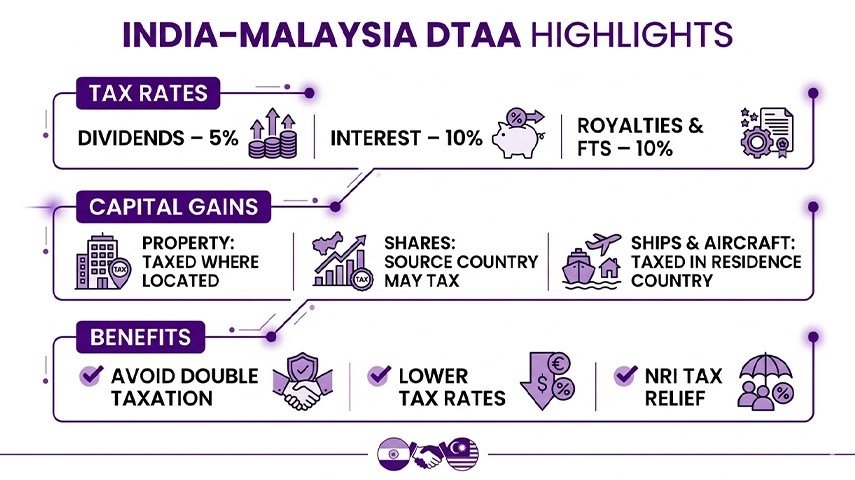
- Dividends: Under DTAA, the dividend is taxed at 5% for the individual living in one state and receiving dividends from a company located in another state.
- Royalties: Royalties are charged for using or making suitable use of any patent, design, copyright, trademark, process, or more. Under the DTAA agreement, they are subject to a maximum tax rate of 10% of the total amount.
- Interest: Income from interest is taxed at a rate of 10% of the total amount of received interest. This applies to any interest received from bonds, debentures, or government securities.
- Fees for Technical Services: Like royalties, under DTAA, fees for technical services are taxed at 10% of the gross amount. This category consists of payments for technicians, managers, or consultants.
This was all about India-Malaysia DTAA tax rates. Moving forward, how capital gain is taxed under DTAA.
Capital Gain Taxation Under DTAA
The DTAA agreement provides specific taxation rules for capital gains arising from the sale of assets and investments. Considering this, let's know about DTAA on NRI property income in India and Malaysia:
- Immovable Property: Profits arising from the sale or removal of any form of fixed income, for instance, buildings or land, are liable to be taxed in the country where it is located. This provision states the rights of the source country to levy taxes on the capital gains arising from immovable property in that country. It is an important point for NRIs planning to purchase property in India.
- Movable Property: Capital gains arising from the sale of movable property, which is a part of "permanent establishment," are taxed in the country where it is located.
- Shares: Under the DTAA agreement, the taxation on capital gains arising from the sale of shares depends on the nature of the company. Considering this:
- If the shares obtain 50% more than their value from immovable property, capital gains from is liable to be taxed in the country where the property is located.
- For other shares, the source country has the right to impose tax.
- Ships and Aircraft: Capital gains arising from the sale of ships or aircraft working in international traffic are taxable in the residence country where the enterprise is located.
These are some of the key DTAA benefits on capital gains that individuals and companies received under the agreement. Now, moving ahead, let's know the employment income taxation under the DTAA agreement.
Employment Income Taxation Under DTAA
The India-Malaysia DTAA also contains detailed tax provisions regarding employment income taxation, which is vital for today's cross-border work environment. Considering this, let's know which country can tax the employment income and under what circumstances.
- General Rule: Any remuneration received in the form of wages, salary, and similar items by a resident of one country from employment is liable to be taxed in the first-mentioned country. If the employment is performed in another country, the payments arising from that are liable to be taxed in that country. For instance, if a resident in India operates a business in Malaysia, then Malaysia is liable to impose tax on that income.
- Short-term Assignments: For short-term business assignments, the DTAA agreement between India and Malaysia has made an exception. Considering this, remuneration derived by a resident of one country for employment performed in another region is taxable in the first country only if:
- The individual, during a financial year, stayed in the other country for a period not exceeding 183 days in any 12 months.
- The salary is paid by an employer who is not a resident of the other nation.
- The salary is paid for services not associated with a fixed base or permanent establishment that the employer has in another nation.
- Directors' Fees: Remuneration paid to a member of the board of directors of a company is taxable in the country where the company is located.
- Entertainers and Sportspersons: Income earned by entertainment, such as motion pictures, theatre, radio, or more, for their activities performed in another country is liable to be taxed in that country, irrespective of the time they stayed there.
- Government Service: Salary or wages paid by the government of one country to an individual for services rendered to that government are liable to be taxed in that country.
This was all about the employment income taxation under the India-Malaysia DTAA agreement.
Final Thoughts
Lastly, the India-Malaysia DTAA agreement is an amazing tax optimization option for wealth creation in Asia. The agreement contains provisions on capital gains, business profits, royalties, employment income, etc. Additionally, it also offers lower tax rates for some income types and clarifies tax jurisdiction, which reduces the tax burden to individuals and companies working in both countries.
Furthermore, for NRIs, managing property and tax compliance in India can be difficult. To help you out, Savetaxs offers services for NRIs designed to simplify these difficulties. From tax planning to property management and tax compliance associated with the DTAA between India and Malaysia, we provide comprehensive solutions. So connect with us and simplify your taxation journey.
- Capital Gain: Capital Gains, Profits on the Financial Assets at the Time of Selling.
- Double Taxation Avoidance Agreement (DTAA): DTAA, an Agreement Signed Between the Countries to Avoid Double Taxation.
- Tax Planning: Tax Planning, Minimizes the Tax Liabilities, Maximizes the Claimed Benefits.
- Surcharge: Surcharge, an additional charge on income tax, added if you cross the thresholds.
- Permanent Establishment: Permanent Establishment helps in setting the limit for taxation, applied to businesses operating in foreign countries.
- How NRIs can Claim Benefits Under DTAA?
- What is the Double Tax Avoidance Agreement (DTAA) Between India and Singapore?
- Tax Residency Certificate (TRC) in India
- Form 67 & Claim Of Foreign Tax Credit For NRIs
- DTAA Benefits On Capital Gains For NRIs
- Timeline to Claim Foreign Tax Credit
- How Can NRIs Avoid Double Taxation - An Easy Guide
- DTAA Between India and Thailand
Note: This guide is for information purposes only. The views expressed in this guide are personal and do not constitute the views of Savetaxs. Savetaxs or the author will not be responsible for any direct or indirect loss incurred by the reader for taking any decision based on the information or the contents. It is advisable to consult either a CA, CS, CPA or a professional tax expert from the Savetaxs team, as they are familiar with the current regulations and help you make accurate decisions and maintain accuracy throughout the whole process.
Hatim Dudhiyawala is a Certified Public Accountant (CPA) with SaveTaxs and specializes in Indian and NRI taxation. He advises individuals, NRIs, and businesses on income tax filing, capital gains taxation, DTAA benefits, fund repatriation, and tax compliance. With experience in cross-border tax matters, Hatim helps taxpayers understand complex regulations and make informed decisions. Through his articles, he shares practical insights to help readers stay compliant and manage their tax obligations with confidence. See Full Bio
Want to read more? Explore Blogs

_1784547039242.webp&w=828&q=75)
_1784546974133.webp&w=828&q=75)
_1784376356528.webp&w=828&q=75)
_1784375756402.webp&w=828&q=75)