US Tax Filing and Compliance
How to Report Multiple 1099 Forms on a U.S. Tax Return: A Guide for NRIsHow to Report Multiple 1099 Forms on a U.S. Tax Return: A Guide for NRIs
Written by Hatim Dudhiyawala

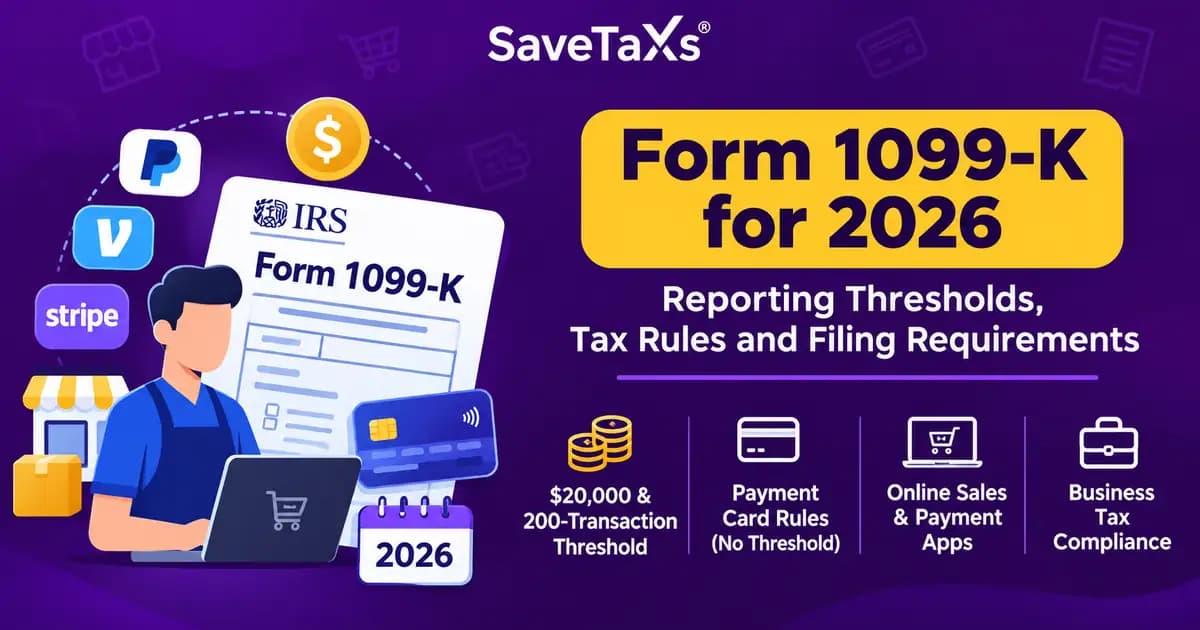
Form 1099-K is an IRS information return used to report certain payments received through payment cards and third-party payment networks. It is particularly relevant to online sellers, freelancers, independent contractors, gig workers and businesses accepting payments through platforms such as PayPal, Venmo, Stripe and online marketplaces. For calendar year 2026, the federal reporting threshold for third-party network transactions is generally more than $20,000 and more than 200 transactions. Payment card transactions follow a different rule and have no minimum reporting threshold. Understanding these requirements is important because the amount reported on Form 1099-K is not necessarily your taxable income or business profit.
Form 1099-K reports qualifying payments received through payment cards and third-party settlement networks.
For third-party network transactions, the general federal reporting threshold is more than $20,000 AND more than 200 transactions during the calendar year.
Payment card transactions, including qualifying credit and debit card payments, have no minimum federal reporting threshold.
The One Big Beautiful Bill Act restored the $20,000 and 200-transaction threshold retroactively for tax years 2025 and beyond.
A payment reported on Form 1099-K is not automatically taxable income. Tax treatment depends on the underlying transaction.
Businesses should reconcile gross payments with refunds, processing fees, business expenses and their accounting records.
Income may still need to be reported even when a taxpayer does not receive Form 1099-K.
Form 1099-K, Payment Card and Third Party Network Transactions, is an IRS information return used by payment settlement entities to report qualifying payments made to participating payees.
It helps the IRS match payment information with income reported on federal tax returns.
Form 1099-K may relate to payments received through:
Credit and debit cards.
Stored-value cards, including qualifying gift cards.
Payment apps used for business transactions.
Online marketplaces and e-commerce platforms.
Freelance and gig-work platforms.
Other qualifying third-party payment networks.
For example, an online seller accepting customer payments through a marketplace may receive Form 1099-K showing the gross payment transactions processed for the year.
The form reports payment information. It does not independently determine whether the money represents business revenue, a personal asset sale, a reimbursement or another type of transaction.
Official reference: IRS – About Form 1099-K.
The federal reporting threshold depends on the payment method.
| Payment type | General federal reporting threshold for 2026 |
|---|---|
| Payment card transactions | No minimum dollar or transaction-count threshold |
| Third-party network transactions | More than $20,000 AND more than 200 reportable transactions |
There is no minimum federal reporting threshold for qualifying payment card transactions.
This means a merchant may receive Form 1099-K for payment card transactions even when the total is below $20,000 or the number of transactions is below 200.
Payment cards include qualifying credit cards, debit cards and stored-value cards.
For payments processed through a qualifying third-party settlement organization (TPSO), the general federal reporting requirement applies when both conditions are met:
The gross amount of reportable payments exceeds $20,000 during the calendar year.
The total number of reportable transactions exceeds 200.
Both conditions must be satisfied.
| Annual payments | Transaction count | Meets general federal TPSO threshold? |
|---|---|---|
| $25,000 | 250 | Yes |
| $25,000 | 200 | No |
| $20,000 | 250 | No |
| $18,000 | 300 | No |
| $30,000 | 180 | No |
The test is more than 200 transactions, not 200 or more.
The American Rescue Plan Act of 2021 had planned to lower the third-party network reporting threshold. However, the One Big Beautiful Bill Act, enacted in July 2025, restored the previous federal threshold.
The change applies retroactively to tax years beginning in 2025 and continues for 2026.
Therefore, the general federal third-party network threshold for both 2025 and 2026 is more than $20,000 in reportable payments and more than 200 transactions.
Yes. A payment settlement entity may issue Form 1099-K below the federal third-party network threshold. Some states also impose lower reporting thresholds, which can result in a form being issued even when the federal threshold is not met.
Businesses and individuals should check the reporting requirements applicable to their state and payment platform.
Official reference: IRS – Form 1099-K FAQs.
Form 1099-K is generally filed by a payment settlement entity (PSE) responsible for transferring funds to a participating payee.
The two main types of payment settlement entities are:
Merchant acquiring entities: Banks or other organizations with the contractual obligation to make payments to merchants for qualifying payment card transactions.
Third-party settlement organizations (TPSOs): Central organizations that facilitate payments between buyers and participating sellers or service providers through qualifying third-party networks.
Potential recipients include:
| Recipient | Example |
|---|---|
| Online sellers | Individuals selling products through marketplaces |
| Freelancers | Professionals receiving client payments through payment platforms |
| Gig workers | Drivers, delivery workers and service providers |
| Small businesses | Retailers accepting credit or debit cards |
| E-commerce businesses | Online stores using payment processors |
| Independent contractors | Individuals receiving qualifying business payments |
| Hobby sellers | Individuals selling goods through online marketplaces |
Receiving Form 1099-K does not mean the recipient operates a business. The tax treatment depends on what the payments represent and the circumstances of the underlying transactions.
Form 1099-K and Form 1099-NEC report different types of payment arrangements.
Form 1099-K generally covers qualifying payments processed through payment cards and third-party settlement networks. Form 1099-NEC generally reports nonemployee compensation paid directly by a business to freelancers, independent contractors and other nonemployees.
The payment method and reporting rules determine which form applies. A freelancer may receive Form 1099-NEC for direct compensation and Form 1099-K for qualifying payments processed through a payment platform.
Similarly, understanding the difference between Form 1099 and Form W-2 can help workers understand how employee wages and nonemployee payments are reported.
No. Form 1099-K generally reports gross payment amounts, not net income or profit.
Box 1a generally reflects gross reportable payment transactions before adjustments for items such as processing fees, credits, refunds, shipping amounts and discounts.
The taxpayer must reconcile the form with transaction records and determine the correct tax treatment.
Suppose an online seller receives the following payments during 2026:
| Particulars | Amount |
|---|---|
| Gross payments processed | $30,000 |
| Refunds | $2,000 |
| Payment processing fees | $900 |
| Cost of goods sold | $15,000 |
| Illustrative business profit before other expenses | $12,100 |
The $30,000 shown as gross payments is not automatically the seller's taxable profit.
The seller must account for refunds, allowable processing expenses, cost of goods sold and other qualifying business deductions. The final taxable amount depends on the business's accounting records and applicable tax rules.
A personal item is property that an individual previously owned for personal use, such as furniture, electronics, household appliances or jewellery.
The tax treatment generally depends on whether the item was sold at a gain or loss.
Personal item sold at a loss: A loss on personal-use property is generally not deductible. However, the taxpayer may need to report or reconcile the Form 1099-K amount so the gross payment is not incorrectly treated as taxable income.
Personal item sold at a gain: The gain is generally taxable and reported as a capital gain.
Suppose someone purchases a refrigerator for $1,000 and later sells it online for $700.
| Particulars | Amount |
|---|---|
| Original purchase price | $1,000 |
| Online selling price | $700 |
| Personal loss | $300 |
The $700 payment may appear on Form 1099-K, but the taxpayer did not make a profit.
The $300 personal loss is generally not deductible. The taxpayer should follow the current IRS reporting instructions to offset the reported proceeds so the full $700 is not incorrectly treated as taxable income.
Suppose someone purchases a collectible for $500 and sells it for $800.
The resulting $300 gain is generally taxable. A gain on a personal-use capital asset is generally reported using Form 8949 and Schedule D (Form 1040), subject to the applicable rules.
Official reference: IRS – What to Do With Form 1099-K.
Form 1099-K provides payment information that recipients can use when preparing their tax returns.
Important fields generally include:
| Form field | Information reported |
|---|---|
| Box 1a | Gross payment card and third-party network transactions |
| Box 1b | Gross payments for card-not-present transactions |
| Box 2 | Merchant category code, where applicable |
| Box 3 | Number of payment transactions |
| Box 4 | Federal income tax withheld, if applicable |
| Boxes 5a–5l | Gross payment amounts for individual months |
| Boxes 6–8 | State and local withholding and identification information, if applicable |
The form may also include payment settlement entity details, account information and recipient taxpayer identification information.
Box 4 reports federal income tax withheld from payments, if applicable.
Backup withholding may apply when a payee fails to provide a required taxpayer identification number or provides incorrect taxpayer information under applicable rules. The general backup withholding rate is 24%.
Recipients should verify their taxpayer identification information with the payment platform to reduce the risk of incorrect reporting and withholding.
Businesses and independent contractors may be asked to provide Form W-9 to certify their taxpayer identification number and other required information.
You generally do not attach Form 1099-K itself to your federal income tax return. Instead, use it with your accounting records and other tax documents to report the underlying transactions correctly.
The appropriate reporting depends on the activity and business structure.
Sole proprietors and self-employed individuals: Business income is generally reported on Schedule C (Form 1040). The schedule is used to report business income and expenses and calculate net profit or loss.
Partnerships: The partnership generally reports business income and expenses on Form 1065. Partners receive Schedule K-1 and report their allocated income according to the applicable individual tax-return instructions.
C corporations: Business income is generally reported on Form 1120.
S corporations: Business income is generally reported on Form 1120-S, with shareholders receiving Schedule K-1.
Personal asset sales: Taxable gains are generally reported on Form 8949 and Schedule D. Personal losses generally are not deductible, although the reported proceeds may need to be offset under IRS instructions.
The correct treatment depends on the nature of the transaction, the taxpayer's entity classification and applicable tax rules.
These IRS information returns serve different reporting purposes.
| Tax form | What it generally reports |
|---|---|
| Form 1099-K | Qualifying payment card and third-party network transactions |
| Form 1099-NEC | Nonemployee compensation paid directly by a business |
| Form 1099-DA | Proceeds from qualifying digital asset broker transactions |
A business should not assume these forms are interchangeable. The payment method and nature of the transaction determine which reporting rules apply.
For more information about digital asset transaction reporting, read our guide to Form 1099-DA and IRS cryptocurrency reporting rules.
Businesses should reconcile Form 1099-K with their accounting records before preparing their federal income tax returns.
A practical reconciliation process includes:
Download Form 1099-K from each payment processor or marketplace.
Verify the recipient's name, taxpayer identification number and reported gross payments.
Compare the reported amounts with payment platform statements and accounting records.
Identify refunds, chargebacks, credits and cancelled transactions.
Reconcile payment processing fees and other allowable expenses.
Separate business receipts from personal reimbursements or transfers.
Check whether payments were reported more than once by different parties.
Record the correct income and expenses using the appropriate tax forms and schedules.
Businesses should maintain supporting records such as transaction reports, sales invoices, refund confirmations, processor statements and bank deposits.
The objective is to report the underlying income accurately rather than simply treating the Form 1099-K gross amount as taxable profit.
A Form 1099-K may contain incorrect gross payment amounts, duplicate transactions or personal payments that do not belong on the form.
Common examples include:
Personal gifts or reimbursements reported as business payments.
Payments belonging to another person or business.
Duplicate reporting.
Incorrect recipient name or taxpayer identification number.
Payment totals that do not match the platform's transaction history.
If you receive an incorrect form:
Contact the payment settlement entity or issuer shown on the form.
Request a detailed transaction statement.
Ask for a corrected Form 1099-K where necessary.
Keep the original form, correspondence and supporting documents.
Follow the IRS instructions for reporting the amounts if a corrected form is not available before filing.
Do not simply ignore an incorrect Form 1099-K. The IRS does not generally correct the form on behalf of the issuing payment settlement entity.
Form 1099-K statements for calendar year 2026 are generally due to recipients by January 31 of 2027, subject to the applicable weekend and holiday rules.
Payment platforms may provide the form electronically through an account dashboard or furnish a paper statement.
Businesses should retain their transaction records throughout the year rather than waiting for the form to arrive before starting their tax reconciliation.
Form 1099-K may also be relevant to NRIs, foreign business owners and individuals receiving payments connected with US commercial activities.
However, receiving the form does not by itself determine whether the payments are taxable in the United States.
The tax treatment depends on factors such as:
Whether the individual is a US citizen, resident alien or nonresident alien.
Whether the income is connected with a US trade or business.
The source and nature of the income.
Whether payments belong to an individual or a separate business entity.
The entity's US tax classification and applicable filing requirements.
Any relevant income tax treaty provisions.
For example, an Indian citizen who operates a US business through an eligible entity may have separate US business income-tax and information-reporting obligations. The Form 1099-K recipient name and taxpayer identification number should be checked against the entity's actual tax classification.
US citizens and resident aliens generally have worldwide income reporting responsibilities. Nonresident aliens may have different obligations based on US-source income, effectively connected income and other applicable rules.
NRIs and foreign business owners should therefore distinguish payment reporting from the separate question of US income tax liability.
For taxpayers earning business or freelance income without regular employer withholding, self-employment tax rules may also apply. Depending on their income and withholding, they may need to make estimated tax payments during the year.
Assuming payments below $20,000 are tax-free: The federal reporting threshold does not determine whether income is taxable.
Applying the TPSO threshold to payment cards: Qualifying payment card transactions have no minimum federal reporting threshold.
Treating gross payments as net profit: Refunds, processing fees and allowable expenses must be reconciled.
Ignoring state reporting rules: Some states have lower Form 1099-K reporting thresholds.
Mixing personal and business transactions: Gifts and genuine personal reimbursements should not be treated as business revenue merely because money was transferred through a payment app.
Ignoring personal asset sales: The tax treatment depends on whether the property was sold at a gain or loss.
Overlooking duplicate reporting: Payments reported by multiple parties must be reconciled to avoid double-counting income.
Failing to maintain transaction records: Businesses should retain platform statements, invoices, refunds and supporting accounting records.
Form 1099-K reporting in 2026 requires businesses, freelancers, online sellers and payment app users to understand the difference between payment reporting thresholds and actual income tax obligations.
The federal third-party network threshold is generally more than $20,000 and more than 200 transactions, while qualifying payment card transactions have no minimum reporting threshold.
However, receiving Form 1099-K does not automatically mean that the gross amount is taxable profit. Businesses and individuals should reconcile payment statements with their accounting records, separate personal and business transactions, account for refunds and allowable expenses, and report income according to its actual tax treatment.
Maintaining accurate records throughout the year can help reduce reporting errors, prevent double-counting and support accurate federal and state tax filing.
For businesses and taxpayers with more complex US filing requirements, Savetaxs US tax compliance services can provide relevant tax compliance support.
This article is for general informational purposes only and does not constitute tax, legal, financial, or investment advice. Laws, regulations, rates, and procedures may change over time and may vary based on individual circumstances.
While SaveTaxs makes reasonable efforts to keep the information accurate and up to date, readers should verify applicable rules with official authorities or consult a qualified professional before making decisions based on this information.
Hatim Dudhiyawala is a Certified Public Accountant (CPA) with SaveTaxs and specializes in Indian and NRI taxation. He advises individuals, NRIs, and businesses on income tax filing, capital gains taxation, DTAA benefits, fund repatriation, and tax compliance. With experience in cross-border tax matters, Hatim helps taxpayers understand complex regulations and make informed decisions. Through his articles, he shares practical insights to help readers stay compliant and manage their tax obligations with confidence. See Full Bio

Want to read more? Explore Blogs