US Tax Forms
IRS Form 2350: Extension to File U.S. Tax Return for FEIEIRS Form 2350: Extension to File U.S. Tax Return for FEIE
Written by Hatim Dudhiyawala
While living overseas, U.S. taxpayers come across different filing extension options. However, the most common mistake is assuming they're all the same. Filing taxes as a U.S. taxpayer abroad often creates unique timing challenges, specifically when claiming the foreign earned income exclusion (FEIE). You need to know the difference between Form 4868 and Form 2350.
Form 4868 is the standard extension form that gives you six additional months to file your tax return, i.e., October 15 for most calendar-year Form 1040 filers. In contrast, Form 2350 is for eligible U.S. taxpayers who need additional time to meet the residence or presence test to claim the FEIE or qualifying foreign housing benefits.
Confused and want to know which IRS form applies to you according to your situation? Then you are on the right page. This blog answers all your questions. So scroll down and gather all the information.
While both Form 2350 and Form 4868 extend your time to file your federal tax return, they target different situations. If you need extra time to file your tax return, complete Form 4868. However, if you need additional time to meet the foreign residence or presence period, fill out Form 2350.
Here's a quick overview of Form 2350 vs. Form 4868 in the table below.
| Basis | Form 4868 | Form 2350 |
|---|---|---|
| Main Purpose | General extension to file an individual income tax return | Extra time to meet an FEIE qualifying test or qualifying foreign housing test |
| Typical Taxpayer | U.S. taxpayers who need more time to prepare and file their tax return | Eligible U.S. citizens and resident aliens living overseas |
| Form 2555 Required | No | The applicant generally expects to file Form 2555 to claim the applicable exclusion or deduction |
| Foreign Tax Home Required | No | Yes, for the relevant qualifying period |
| Relevant Qualification Test | No | Physical presence or bona fide residence test |
| Extension Period | Generally, six months from the applicable original filing deadline | Generally, 30 days after the expected date when you meet the test requirements, subject to IRS approval |
| Approval | Generally automatic if you file the form correctly and on time | Approval is not automatic; the IRS reviews the application |
| Payment Extension | No general extension of the tax-payment deadline | No general extension of the tax-payment deadline |
| Best Suited for | Missing documents, additional preparation, or calculation | Waiting to complete an FEIE qualifying period |
So, this was a quick overview of the difference between Form 2350 and Form 4868. Moving ahead, let's look at when an NRI should file Form 4868.
At Savetaxs, we provide you with complete guidance about US taxes and help you meet your tax obligations on time.
An NRI should file Form 4868 when they have U.S. tax obligations and need extra time to file their federal tax return. Common scenarios include:
This form generally extends the applicable filing deadline by six months. For most calendar-year Form 1040, Form 1040-SR, and Form 1040-SS filers, the extended deadline is October 15. For Form 1040-NR filers, the extended deadline depends on the original due date applicable to their circumstances. However, it does not prevent interest and penalties on unpaid taxes.
For instance, Rohan is an Indian citizen living in the U.S. and has tax obligations there. His normal filing deadline depends on his U.S. tax status and the applicable filing rules. If his return is due on April 15, he can file Form 4868 by that date to request additional time. However, because he is waiting for information from his Indian partnership and other foreign income sources, he cannot file by the due date. So, he files Form 4868 by the applicable deadline to request additional time.
This is when an NRI living in the U.S. should file Form 4868. Now, moving further, let's look at when a U.S. citizen living as an NRI in India should file Form 2350.
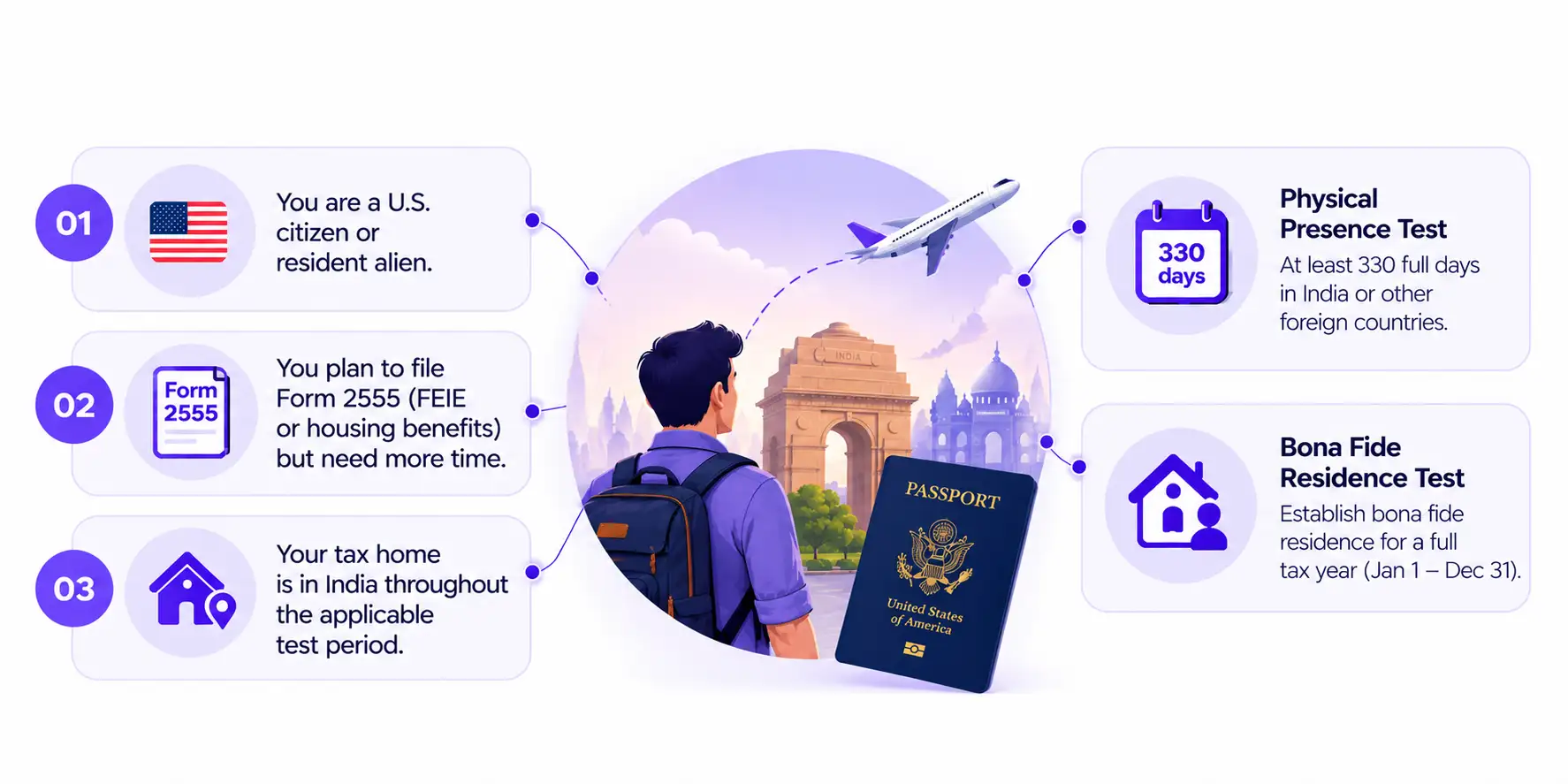
A U.S. citizen living as an NRI in India should file Form 2350 if they satisfy the three mentioned conditions:
Further, they also need to satisfy either of the residency tests:
Physical Presence Test: You must be physically present in India or one or more other foreign countries for at least 330 full days during any 12-month period.
Bona Fide Residence Test: This test generally requires a U.S. citizen to establish bona fide residence in a foreign country for an uninterrupted period that includes a complete tax year (January 1 to December 31). A resident alien may also qualify if they are a citizen or national of a country with which the U.S. has an income tax treaty in effect. The test depends on the taxpayer's facts and circumstances, not simply the number of days spent in the foreign country.
For instance, Tia is a U.S. citizen who moved to India in September. By the following federal tax return deadline, she may not yet have completed the 330-day physical presence test required for the FEIE. She decided to file Form 2350 because she met the form-filing requirements.
So, this is when a U.S. citizen living as an NRI in India should file Form 2350. Moving forward, let's look at the deadlines and extension period for both forms.
The filing deadlines and extension periods of both Form 4868 and Form 2350 are as follows:
For most calendar-year individual returns, the regular filing deadline is April 15. If you are a U.S. citizen or resident alien living abroad and meet the automatic two-month extension requirements, your filing deadline is generally June 15.
The form provides a six-month extension period, until October 15, from April 15 for most calendar-year Form 1040 filers. So, if you qualify for the two-month automatic tax extension and still file the form, the extension deadline remains the same. You do not receive an additional six-month extension after June 15.
You must file Form 2350 by the applicable due date for your federal tax return. If you qualify for the automatic two-month extension because you are out of the country under IRS rules, you can generally file Form 2350 by June 15 for a calendar-year return.
The extended deadline for Form 2350 is generally 30 days after the date you expect to meet the physical presence or bona fide residence test requirements, subject to IRS approval. Also, do not wait until your filing deadline to submit Form 2350; if your request is rejected, you can still file your return on time and avoid penalties.
Additionally, interest on unpaid taxes starts from your original filing date, i.e., April 15. So, if possible, try to meet your tax obligations by that date to avoid unnecessary interest. Unlike Form 4868, the extension deadline for Form 2350 does not stay the same for every applicant; it depends entirely on their qualifying period.
This was all about the filing deadline and extension period of both forms. Now, moving ahead, let's see whether these forms also extend the tax-payment deadline.
Neither Form 4868 nor Form 2350 generally extends the tax-payment deadline. However, qualifying U.S. citizens and resident aliens abroad may receive an automatic two-month extension to file and pay. Interest still accrues on tax unpaid after the original due date, generally April 15. With that in mind, calculate your amount due and pay it by the applicable payment deadline.
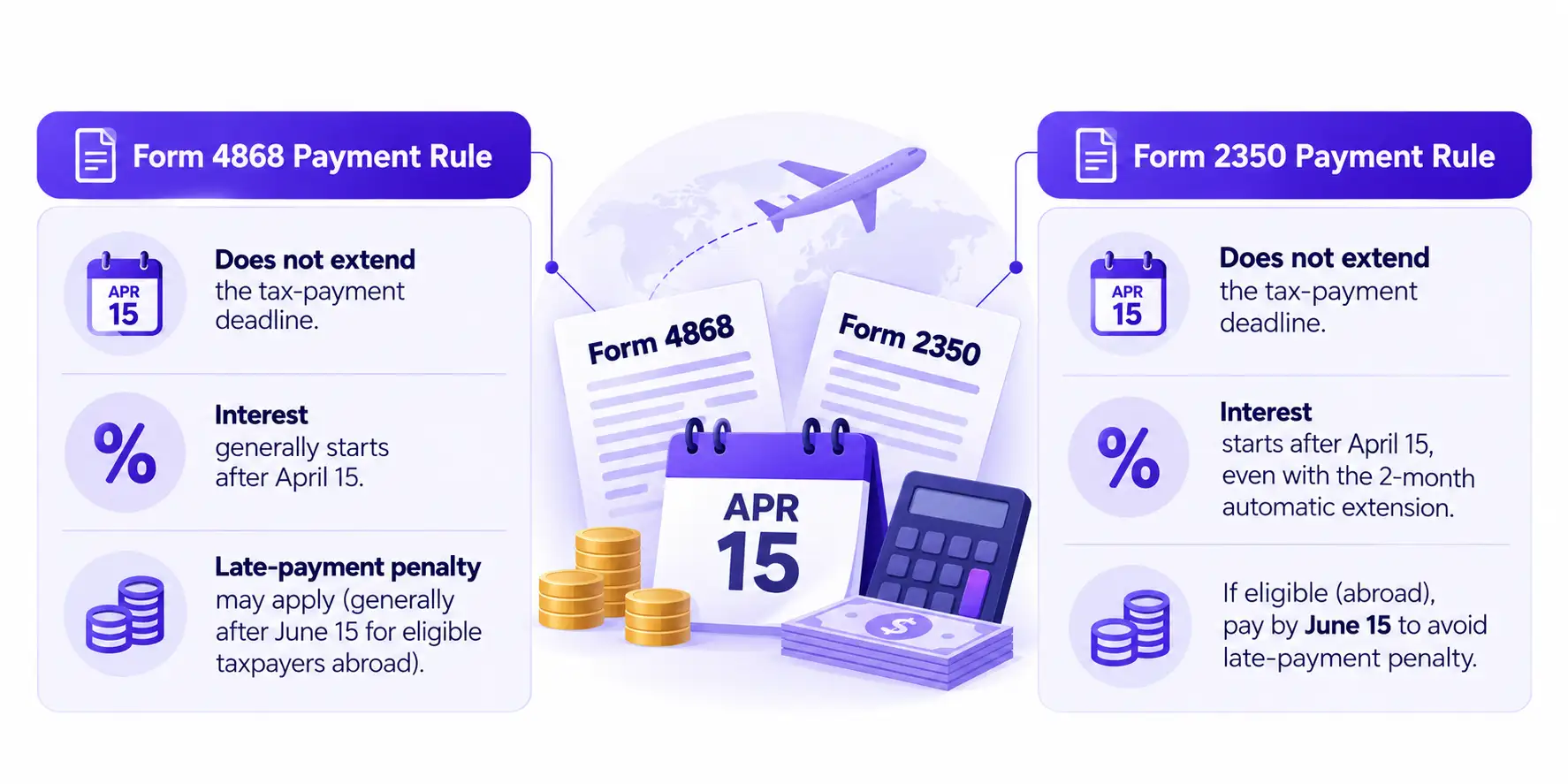
As mentioned earlier, Form 4868 generally extends your filing deadline, not your tax-payment deadline. If you do not pay your unpaid taxes by April 15 (the regular tax filing deadline), you face the following circumstances:
Rather than waiting until your extended filing deadline to pay, you should pay as much tax as possible by April 15. It helps you avoid unnecessary interest and penalties on your unpaid taxes.
Also, you don't need to pay all your taxes to get a Form 4868 extension. However, you need to properly estimate your tax liability using the information available to you and report the relevant figures on Form 4868.
IRS Form 2350 also only extends your tax filing date, not your payment date. Additionally, interest on your unpaid taxes starts accruing after the April 15 deadline, even if you get a two-month automatic extension to file.
If you qualify for the automatic two-month extension because you are out of the country under IRS rules, you can generally pay your unpaid taxes by June 15 without the standard late-payment penalty. However, interest on unpaid tax generally accrues from April 15.
Also, don't assume the FEIE removes your entire U.S. tax obligation. You may still need to pay tax on U.S.-source income, investment income, self-employment income, and income above the applicable exclusion amount, depending on the relevant tax rules and your circumstances.
So, based on the information above, it is clear that neither form generally extends the tax-payment deadline for unpaid taxes. Moving forward, let's identify the common form-selection mistakes you should avoid when choosing between Form 4868 and Form 2350.
Connect with Savetaxs to understand both tax forms and choose the one that fits your situation.
Here are the mistakes you should avoid when choosing Form 2350 vs. Form 4868:
These are the common mistakes to avoid when choosing between Form 2350 and Form 4868.
Lastly, doing a comparison of Form 2350 vs. Form 4868 helps you choose the right form according to your situation. If you only need additional time to gather the required documents for your federal tax return, Form 4868 is appropriate. However, if you are an eligible U.S. citizen or resident alien living abroad, expect to file Form 2555, and need more time to meet the residence requirements, choose Form 2350. Although both forms extend your filing deadline, they serve different purposes.
If you are confused between Form 2350 and Form 4868 and need help, connect with SaveTaxs. Our team of cross-border experts helps you choose the right form for your tax situation and stay compliant with U.S. tax laws.
This article is for general informational purposes only and does not constitute tax, legal, financial, or investment advice. Laws, regulations, rates, and procedures may change over time and may vary based on individual circumstances.
While SaveTaxs makes reasonable efforts to keep the information accurate and up to date, readers should verify applicable rules with official authorities or consult a qualified professional before making decisions based on this information.
Shubham Jain is the Founder of SaveTaxs and has extensive experience in Indian and NRI taxation. He advises individuals, NRIs, and businesses on tax filing, tax planning, capital gains, DTAA benefits, fund repatriation, and compliance matters. He regularly writes about taxation and related financial topics. His focus is on making complex tax concepts easy to understand. Through his articles, he helps taxpayers stay informed, avoid common mistakes, and stay compliant with Indian tax laws. See Full Bio

Want to read more? Explore Blogs