


US Tax Forms
IRS Form 8962 for NRIs: Premium Tax Credit and APTCIRS Form 8962 for NRIs: Premium Tax Credit and APTC
Written by Shubham Jain
Suppose you have US tax obligations and need to file a US tax return, but while filing, you realize that you cannot get a Social Security number (SSN). In such a situation, applying for an Individual Taxpayer Identification Number (ITIN) becomes necessary. It is a number issued by the IRS that allows individuals to file returns, claim benefits under a treaty, and satisfy other federal tax reporting requirements.
You can apply for an ITIN by filling out Form W-7, which is not too lengthy. However, even a minor mistake while filing can lead to delays or rejection of your application. Common mistakes include providing incorrect personal information or not submitting the required supporting documents. If you have a US tax obligation and want to learn more about an ITIN, this blog is for you. We will cover everything regarding Form W-7, including the required documents, filing process, mistakes to avoid, and much more.
To apply for an ITIN, you can only use Form W-7, which is officially known as "Application for IRS Individual Taxpayer Identification Number". An ITIN is a nine-digit number that always starts with 0. It is issued strictly for federal tax purposes to individuals who have US filing obligations but cannot apply for a Social Security number.
This is what an ITIN does, but you must also stay clear about what the ITIN does not do. So, an ITIN doesn't:
In short, the only purpose of an ITIN is to help you fulfill your tax obligations. The main question here is: Does everybody without an SSN need an ITIN, or do you need to file IRS Form W-7? Let's see that.
You will be required to file Form W7 if you:
If you are eligible, you should apply for an SSN instead of an ITIN. Remember that if you qualify for a Social Security number but you fill out an ITIN application form, it will be rejected by the IRS. Now that we know who needs to file, let's learn about the documents you need to gather before you file Form W-7.
Ensure accurate US tax filing with reliable support from Savetaxs.
Before you proceed further with filing Form W-7, you must gather a few documents, which are as follows:
**Quick Tip: Ensure that the name, birth date, and document number reflected on your W-7 match your ID, tax return, and the form itself. Your application may face delays or rejections even due to a small mistake, so ensuring accuracy is crucial.
Now comes the main part: filling out Form W-7. Let's see how you can do it.
You might think that this is the stressful part, but it isn't. The form has two pages, and you can complete them easily once you understand what you need to provide in each section. Here is how you can fill out Form W-7:
With that, filling out Form W-7 is clear.
*Note: Remember that there is no separate form required to apply for ITIN renewal. It means you can file Form W-7 for both first-time applications and renewals. If your ITIN has expired for any reason, like not using it on a federal tax return for 3 consecutive tax years. In such a situation, you need to submit the same IRS Form W-7, check the "Renewal Box," and provide your existing ITIN.
Next comes the key step: submitting the form. You have three options to submit Form W-7: by mail, via an IRS acceptance agent, or at an IRS taxpayer assistance center. Let's learn each option in detail.
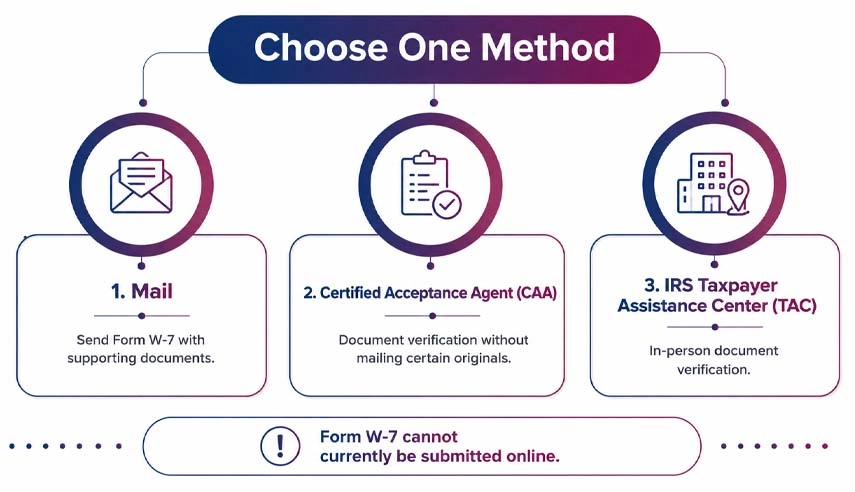
To submit the completed Form W-7, you have three official routes. Based on how your original documents are handled, each route may vary. Here are three official submission routes through which you can submit your Form W-7:
Mailing is the most commonly used method. Under this option, you can mail the completed Form W-7, supporting documents, and the tax return to the IRS ITIN operation address in Austin, Texas. Check the exact address in the instructions section on your current Form W-7.
However, there is one drawback, which is that you will have to send your original documents by mail, such as your passport. The IRS generally returns original documents within approximately 60 days, although longer processing times may occur during peak filing periods.
Nevertheless, there is one key point to keep in mind. If you think that you might need your passport for any reason during this 60-day window, then mailing your original document is a bad idea.
As discussed above, if you want to keep your passport with yourself throughout the process, this option will be convenient for you. So, the IRS authorizes Certified Acceptance Agents (CAAs) to review your original identity documents and certify them under IRS procedures, allowing you to avoid mailing certain original documents.
Since this is not a free channel offered by the IRS, you may have to pay a service fee to the CAAs to take this option.
The last option is to apply in person at a taxpayer assistance center (TAC). These centers offer ITIN document verification, but you will have to book an appointment before visiting them.
Although you have to submit your original documents for this process, they return them immediately after verifying them. It means there is no stress of not having your original documents when required.
After reading these options, you may be wondering: can I not file my Form W-7 online? Well, as of now, you cannot. Let's learn about this in detail.
The IRS does not currently offer a direct online filing option for Form W-7. Applications must generally be submitted by mail or through a Certified Acceptance Agent (CAA) or IRS Taxpayer Assistance Center (TAC).
While filing, you must stay cautious of third-party websites that claim to offer "instant" or fully online ITIN filing. The IRS strictly warns individuals against paying for any service that guarantees results. So, always keep in mind that the IRS will not ask for any money if you file by mail with them directly.
Further, let's look at the common mistakes that individuals face while filing Form W-7.
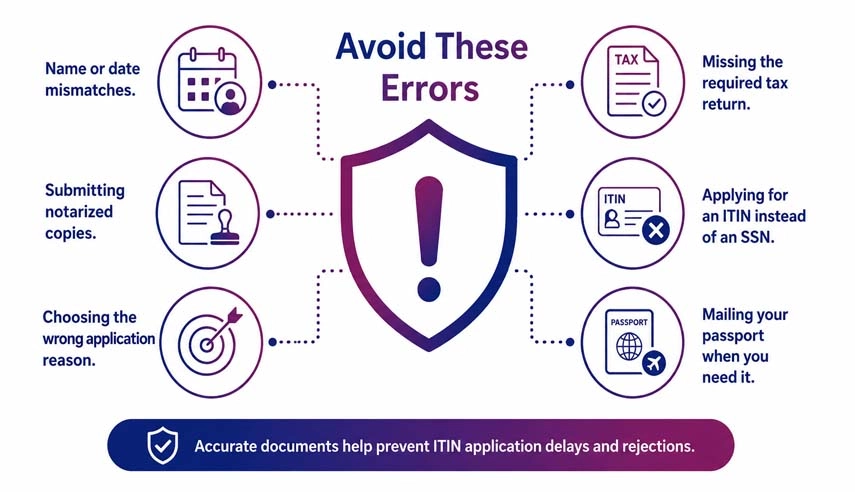
Here are some common mistakes faced by individuals while filing Form W-7 that you should avoid:
Lastly, let's consider an example of an NRI to clear up everything.
To claim the reduced treaty withholding rate on dividends from a US brokerage account, Meera wanted to file Form 1040-NR. But she never held a US taxpayer ID before, so this was her first time applying for an ITIN.
To start with, she carefully filled out Form W-7 and attached her signed paper Form 1040-NR. After that, she chose to have her supporting identity documents reviewed by a Certified Acceptance Agent (CAA), allowing her to avoid mailing her original passport. But she faced delays, and her ITIN took around 10 weeks to arrive because she applied during the peak filing season in March.
The good thing that happened to her was that she didn't have to send her original passport overseas since she chose to work with a CAA. This one step made the process a little less stressful for her.
For anyone who is not eligible to get an SSN, Form W-7 becomes mandatory, which helps obtain or renew an ITIN. While filing out the form, you must ensure that you only fill in the accurate details, submit the correct documents, and choose the relevant filing method. Ensuring these steps can help you avoid any unnecessary delays and IRS correspondence.
The easiest way to enjoy a smooth application process is to complete your Form W-7 carefully and accurately. Moreover, contact an expert at Savetaxs for assistance if your tax situation involves treaty claims, international claims, or other tax matters. We have an entire team of experts familiar with all the cross-border rules, procedures, and requirements. Our team can help you prepare and review your Form W-7 carefully to reduce the risk of errors and unnecessary delays throughout the application process. Contact us right away, as we are actively working 24/7 across all time zones.
This article is for general informational purposes only and does not constitute tax, legal, financial, or investment advice. Laws, regulations, rates, and procedures may change over time and may vary based on individual circumstances.
While SaveTaxs makes reasonable efforts to keep the information accurate and up to date, readers should verify applicable rules with official authorities or consult a qualified professional before making decisions based on this information.
Shubham Jain is the Founder of SaveTaxs and has extensive experience in Indian and NRI taxation. He advises individuals, NRIs, and businesses on tax filing, tax planning, capital gains, DTAA benefits, fund repatriation, and compliance matters. He regularly writes about taxation and related financial topics. His focus is on making complex tax concepts easy to understand. Through his articles, he helps taxpayers stay informed, avoid common mistakes, and stay compliant with Indian tax laws. See Full Bio

Want to read more? Explore Blogs
_1786539671275.webp&w=828&q=75)