

US Tax Forms
IRS Form 8962 for NRIs: Premium Tax Credit and APTCIRS Form 8962 for NRIs: Premium Tax Credit and APTC
Written by Shubham Jain

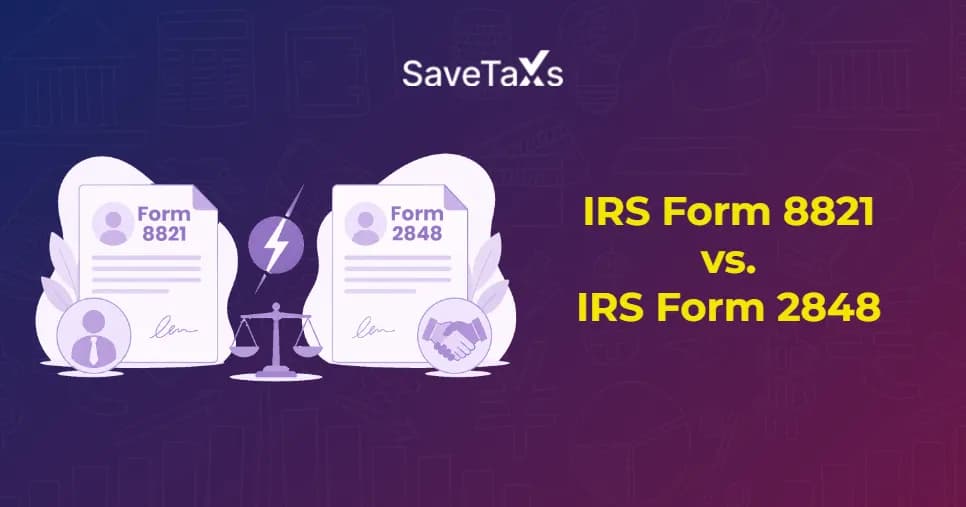
Filling out the wrong IRS authorization form can lead to avoidable delays, extra administrative work, and rejected requests. This is where many taxpayers face issues when comparing Form 8821 vs. Form 2848. Although both forms include authorization and client signatures, they serve different purposes. Considering this, selecting between Form 8821 (Tax Information Authorization) and Form 2848 (Power of Attorney) can be confusing.
Form 8821 allows a third person to inspect or review your confidential tax information for specific tax matters and periods. In contrast, Form 2848 gives a qualified individual, such as a CPA or EA, the authority to act on behalf of the taxpayer before the IRS for specific tax matters and periods.
Confused and want to know which IRS authorization form you should fill out as per your tax situation? Read the blog to understand what each form does, how they differ, and how to select the right one.
As mentioned earlier, IRS Form 2848 provides authority to a qualified person to act on your behalf before the IRS for specific tax matters and periods. This means they can respond to notices, access your confidential tax information, and negotiate resolutions for the specific matters and financial year you list.
Considering this, your appointed authority can attend your IRS calls, sign specific agreements, and handle a matter without needing you at every stage. Further, you can only appoint specific categories of tax professionals on IRS Form 2848:
Only individuals authorized to practice before the IRS under Circular 230 or applicable IRS rules may be appointed using Form 2848. This was all about Form 2848. Moving ahead, let's know about IRS Form 8821.
IRS Form 8821 is a tax information authorization and a lightweight version of Form 2848. The form gives authority to a third party to inspect or receive your specific tax periods or matters. However, it does not allow that third party to represent you before the IRS.
In simple terms, Form 8821 is used when you grant someone permission to review or receive tax information for specific tax matters and periods. This can include giving authority to obtain transcript-associated tax information such as wage and income information, when those details are required for reconciliation, underwriting, internal validation, or compliance reviews.
As this form is limited only to information access, it supports a controlled authorization model. Considering this, you only need to share what is needed without providing broader authority to act on their behalf. You may generally authorize any individual or organization to receive your tax information through Form 8821, subject to IRS requirements.
Form 8821 is often used by family members and bookkeepers helping them with documentation, or professionals who just need to check your account to know whether formal representation is needed or not.
This is what IRS Form 8821 is. Moving further, let's know the difference between Form 8821 and Form 2848.
With Savetaxs, fulfill your US tax obligations accurately and stay compliant with the IRS requirements.
The table below showcases the key difference between Form 8821 and Form 2848:
| Particulars | Form 2848 (Power of Attorney) | Form 8821 (Tax Information Authorization) |
|---|---|---|
| What it grants | Complete representation- speaking, signing, negotiating | Only provide information access |
| Who can be appointed | CPAs, EAs, attorneys, enrolled actuaries, enrolled retirement plan agents | You can appoint anyone without any license requirement |
| Authority Level | Broader representation authority | Limited information access |
| Can they speak to the IRS for you? | Yes | No |
| Can they represent you in an appeal or audit? | Yes | No |
| Can they sign waivers or agreements? | Yes, within the scope of authorization | No |
| Best used for | Active IRS tax notices, collection cases, audits and appeals | Account data, transcripts, verification and information access |
Further, the key difference between the forms is: Form 2848 acts for you, while Form 8821 is only for reviewing your information. Getting confused between them is one of the most avoidable mistakes that taxpayers make. Moving forward, let's know when shoud NRIs should use Form 2848.
Generally, Form 2848 is useful when you are looking for someone to handle your IRS matter actively without your involvement at every step. This is helpful in different time zones, i.e., connecting with the IRS from India during U.S. business hours. Considering this, common situations where NRIs can fill out IRS Form 2848 include:
These are some of the key situations where NRIs should fill out Form 2848. Moving ahead, let's know when NRIs should use Form 8821.
NRIs should fill out IRS Form 8821 when they only need visibility, not active representation. Considering this:
If you are not sure whether your tax situation needs full representation or just a closer look at your account, opting for Form 8821 is often a lower-commitment and conservative choice. Moving further, let's know how to fill out Forms 2848 and 8821.
Both tax forms need the same four filing routes, though the speed varies enormously between them. Considering this, here is how you can file Forms 2848 and 8821:
This is how you can file Form 2848 and 8821. Further, let's know a few procedures before filing out the forms.
These are a few things that you should know before filing out Forms 2848 and 8821. Moving forward, let's know the common mistakes to avoid when filing out these forms.
Here are some common mistakes you should avoid when filing Form 2848 and Form 8821:
Further, let's better understand this with an example.
Mr. A is a US-based NRI living in Bengaluru. While living in India, he was going through an active CP2000 dispute over dividend income and wanted his brother, who is living in the US, to periodically check on his tax refund status. For the CP2000 dispute, Mr. A signed Form 2848 and worked with a CPA, giving him authority to respond to his IRS tax notice, submit supporting documents, and negotiate directly with the IRS on the matter for that specific tax year.
Additionally, he also filed Form 8821 for his brother, allowing him to view his account transcript and refund status. However, he did not give his brother any authority to speak to the IRS or make decisions. Later, when Suresh's brother tried to call the IRS to ask a question about the case, he was informed that he had only authority to review the information, not to discuss or resolve the issue.
This is a clear example of where the limits of the Form 8821 are set.
Connect with Savetaxs and let our tax experts take care of choosing the correct IRS form as per your situation.
Lastly, understanding Form 8821 vs. Form 2848 makes a significant difference in how you handle your tax situation. Considering this, Form 8821 is used for accessing tax information, whereas Form 2848 is used for IRS representation. Selecting the correct form depends on the authority level your situation requires. If your need is limited to tax data or transcripts, Form 8821 is a better fit. However, when you want someone to interact with the IRS, choosing IRS Form 2848 becomes vital.
Furthermore, if you are unsure what form you should use for your tax optimization requirements, connect with Savetaxs. We have a team of qualified tax experts who help you choose the correct form as per your situation and assist you in planning your US taxes correctly.
This article is for general informational purposes only and does not constitute tax, legal, financial, or investment advice. Laws, regulations, rates, and procedures may change over time and may vary based on individual circumstances.
While SaveTaxs makes reasonable efforts to keep the information accurate and up to date, readers should verify applicable rules with official authorities or consult a qualified professional before making decisions based on this information.
Vipul Jain is the Co-Founder of SaveTaxs and a tax expert with experience in Indian and NRI taxation. He advises individuals, NRIs, and businesses on tax filing, tax planning, capital gains, DTAA, and compliance matters. He focuses on making complex tax concepts simple and helping taxpayers make informed, compliant decisions. See Full Bio

Want to read more? Explore Blogs

_1786539671275.webp&w=828&q=75)