

US Tax Filing and Compliance
How U.S. Citizens Living in India Report Indian Income to the IRSHow U.S. Citizens Living in India Report Indian Income to the IRS
Written by Hatim Dudhiyawala

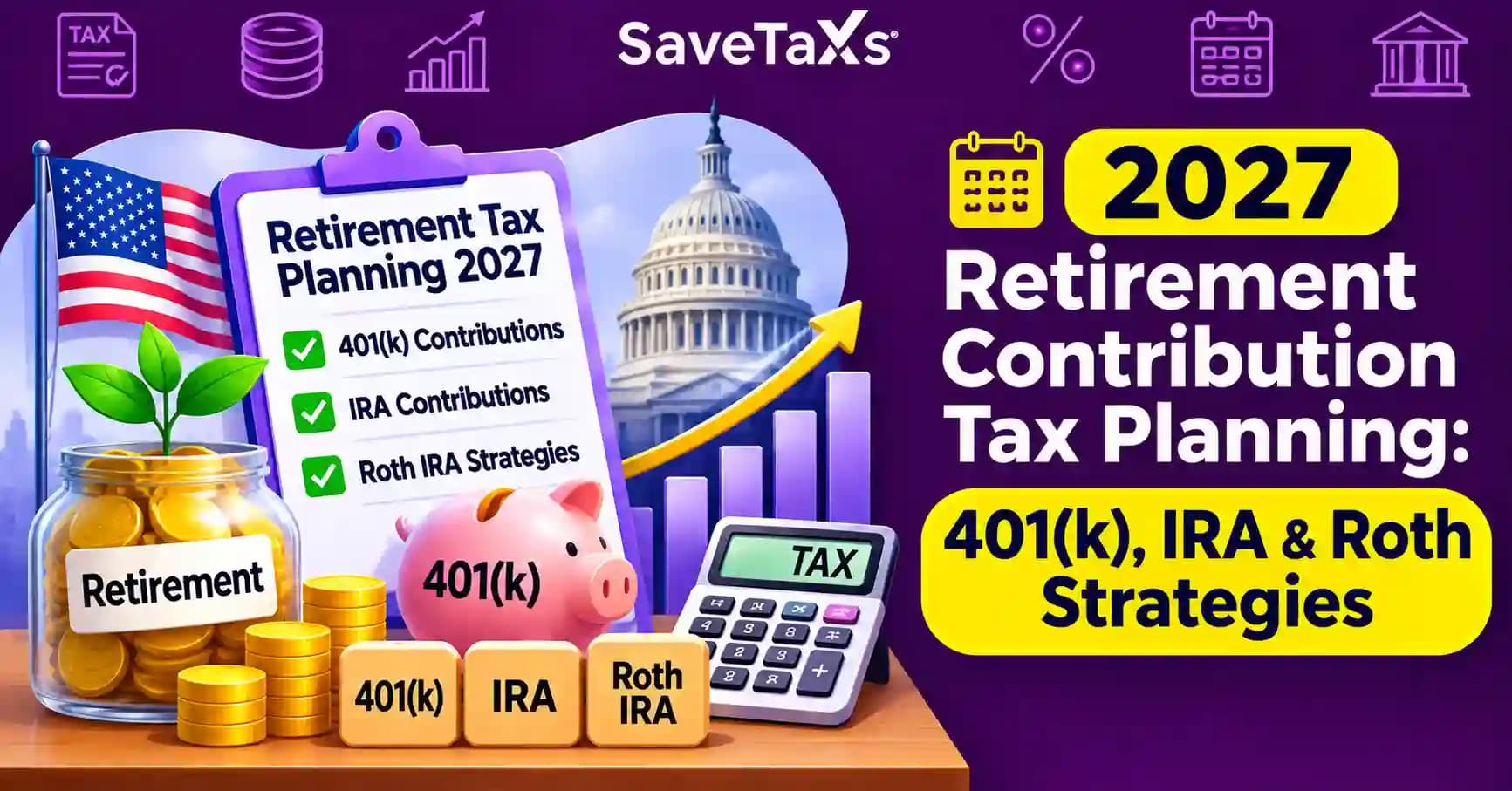
Retirement contribution planning for 2027 starts with understanding the new IRS contribution limits. However, the right strategy is not simply to contribute the maximum to every account. Your employer-sponsored retirement plan, income, age, tax bracket, eligibility for IRA deductions or Roth contributions, and expected future tax residency all influence your contribution decisions.
For 2027, the IRS has increased the regular 401(k) employee elective deferral limit to $25,500, while the traditional and Roth IRA contribution limit remains $7,500. Eligible workers aged 50 and older can make additional catch-up contributions, including a higher catch-up limit for participants aged 60 through 63.
This guide explains the 2027 retirement contribution limits and how U.S. taxpayers and NRIs working in the United States can prioritize their retirement savings. It focuses on contribution planning rather than repeating the detailed account mechanics covered in SaveTaxs' existing 401(k), IRA, and Mega Backdoor Roth guides.
The IRS announced the 2027 retirement contribution limits on November 12, 2026. The following table summarizes the primary limits relevant to individual retirement contribution planning.
| Retirement Contribution Category | 2027 Contribution Limit |
|---|---|
| 401(k), 403(b), most governmental 457(b), and TSP employee deferral | $25,500 |
| General catch-up for eligible participants aged 50+ | Additional $8,500 |
| Higher catch-up for participants aged 60–63 | Additional $11,750 instead of general catch-up |
| Maximum regular deferral plus general catch-up | Generally $34,000 |
| Maximum regular deferral plus age 60–63 catch-up | Generally $37,250 |
| Traditional and Roth IRA combined contribution limit | $7,500 |
| IRA catch-up for eligible individuals aged 50+ | Additional $1,100 |
| Defined-contribution annual additions limit under Section 415(c) | $75,000, generally excluding catch-up contributions |
The 401(k) employee elective deferral limit is generally shared across applicable employer-sponsored plans. If you contribute to more than one employer plan during the year, you may need to coordinate your contributions to avoid exceeding the applicable limit.
Special rules may apply to governmental 457(b) plans and certain other retirement arrangements.
For eligible participants, the additional catch-up contribution increases the amount they can defer beyond the regular employee contribution limit.
Get help reviewing contribution options and tax implications
The $75,000 defined-contribution annual additions limit under Section 415(c) is different from the employee elective deferral limit.
It generally includes:
Catch-up contributions are generally treated separately from this annual additions limit.
Your compensation, employer contributions, and specific plan provisions may reduce the amount you can actually contribute.
Eligibility to contribute directly to a Roth IRA depends on your modified adjusted gross income (MAGI) and federal income tax filing status.
The 2027 Roth IRA income phase-out ranges are:
| Filing Status | 2027 Roth IRA MAGI Phase-Out Range |
|---|---|
| Single or Head of Household | 158,000–173,000 |
| Married Filing Jointly | 250,000–260,000 |
| Married Filing Separately (if applicable) | Generally 0–10,000 |
If your MAGI falls within the applicable phase-out range, the amount you can contribute directly to a Roth IRA may be reduced. If your income exceeds the upper threshold, you generally cannot make a direct Roth IRA contribution.
Traditional IRA deductibility has separate income phase-out rules depending on whether you or your spouse are covered by an employer-sponsored retirement plan.
Review the applicable IRS guidance and your filing status before assuming that a traditional IRA contribution is fully deductible.
One of the most important retirement planning decisions is choosing between traditional pre-tax and Roth contributions.
A traditional pre-tax contribution generally reduces your current taxable income when deductible or excluded under the applicable retirement plan rules. However, withdrawals are generally taxable when distributed.
In contrast, designated Roth contributions are made with after-tax dollars. Qualified distributions may be tax-free under U.S. tax rules.
| Comparison Factor | Traditional Pre-Tax Contribution | Roth Contribution |
|---|---|---|
| Current-year tax treatment | May reduce current taxable income | Generally no current deduction |
| Future qualified distributions | Generally taxable | Generally tax-free under U.S. rules |
| Often considered when | Current marginal tax rate is relatively high and the expected future rate may be lower | Current tax rate is manageable and future tax-free qualified withdrawals are valuable |
| Main planning question | Is the current tax deduction worth more than future tax-free treatment? | Is paying tax now preferable to paying tax later? |
There is no universal winner between traditional and Roth contributions. The appropriate choice depends on your financial situation and long-term retirement objectives.
Before deciding, consider:
An employer match should also influence your contribution strategy. Review the plan's matching formula and vesting schedule before prioritizing an IRA over your employer-sponsored retirement plan. Employer matching contributions can materially change the overall value of your retirement savings.
A structured contribution strategy can help you use available retirement limits without overlooking eligibility requirements or employer plan restrictions.
Consider the following contribution sequence when planning your 2027 retirement savings.
Start by checking whether your employer offers matching contributions.
If your cash flow allows, consider contributing enough to receive the full employer match, subject to the plan's matching formula and vesting requirements.
Employer matching contributions can increase your retirement savings without requiring an equivalent increase in your personal contributions.
Once you understand the employer match, determine how much you want to contribute to your 401(k).
Decide whether traditional pre-tax contributions, Roth contributions, or a combination of both better aligns with your current tax bracket and expected future tax position.
Also, review your employer plan's contribution options and applicable annual limits.
After setting your workplace retirement contribution target, evaluate whether you can also contribute to a traditional or Roth IRA.
Before making a contribution, check:
Remember that the traditional and Roth IRA limits are combined. You cannot contribute the full annual limit separately to both accounts.
A Health Savings Account (HSA) is not a retirement account, but eligible taxpayers with qualifying health coverage may consider its tax advantages as part of their broader financial planning.
Review the applicable HSA eligibility requirements and contribution limits before including it in your savings strategy.
If you have already reviewed your regular retirement contribution options, you may consider advanced strategies such as:
These strategies have separate eligibility, aggregation, tax, and employer plan requirements.
For example, a Backdoor Roth IRA strategy may involve the pro-rata rule, while a Mega Backdoor Roth strategy depends on whether your employer's plan permits voluntary after-tax contributions and the required conversion or distribution features.
Do not assume these strategies are automatically available simply because you have reached the standard contribution limit.
If you changed jobs during 2027 or contributed to multiple employer-sponsored retirement plans, track your year-to-date employee deferrals.
Review your contribution records to identify any excess deferrals and understand which limits apply to your specific plans.
For a basic account comparison, use the Savetaxs IRA vs. 401(k) guide. For the after-tax 401(k) strategy, use the separate Mega Backdoor Roth guide for NRIs.
Retirement contribution planning can become more complicated when you have financial connections to both the United States and India.
For NRIs working in the United States, contribution eligibility, account ownership, future withdrawals, and cross-border tax treatment all deserve attention.
Your ability to contribute to a U.S. retirement account depends on the relevant account rules, eligible compensation, employer plan eligibility, and applicable U.S. tax requirements.
Immigration status alone does not determine eligibility for every retirement account.
For example, an individual who earns only investment income generally cannot make a regular IRA contribution without the required eligible compensation.
If you are an NRI working in the United States, review your retirement contribution strategy in light of your current income and future financial plans.
If you expect to relocate to India after working in the United States, your retirement planning should consider the potential tax implications in both countries.
Before contributing substantial amounts to a U.S. retirement account, evaluate the following:
A U.S. Roth account may provide tax-free qualified distributions under U.S. rules. However, you should not assume that the same tax treatment will automatically apply in India.
The outcome can depend on the account's legal character, timing of income or distributions, Indian residential status, and the applicable tax law at that time.
Business owners need to distinguish employee elective deferrals from employer contributions when selecting a retirement plan and calculating contribution limits.
The rules can vary depending on the business structure.
For example, S corporation shareholder-employees generally calculate retirement plan contributions based on eligible W-2 compensation rather than shareholder distributions.
Business owners should review their compensation structure, business income, employer contribution rules, and applicable retirement plan requirements before determining their contribution limits.
For more information, read the SaveTaxs S Corporation Retirement Plans Guide.
Use the following checklist before finalizing your retirement contribution elections for 2027.
Discuss how U.S. retirement accounts may fit into your cross-border tax plan.
The increased retirement contribution limits for 2027 provide U.S. taxpayers with more opportunities to build long-term retirement savings. However, choosing the right contribution strategy involves more than simply maximizing every available account.
Your employer match, income, age, tax bracket, IRA eligibility, investment horizon, and expected future tax residency all influence how you should allocate your retirement contributions.
For NRIs working in the United States, the decision requires additional attention to the potential tax implications of retaining U.S. retirement accounts after returning to India.
SaveTaxs can help U.S. taxpayers and NRIs evaluate retirement contributions alongside their broader tax position, including the implications of a future move between the United States and India.
Review your employer plan documents and applicable IRS contribution limits before finalizing your 2027 payroll elections.
This article is for general informational purposes only and does not constitute tax, legal, financial, or investment advice. Laws, regulations, rates, and procedures may change over time and may vary based on individual circumstances.
While SaveTaxs makes reasonable efforts to keep the information accurate and up to date, readers should verify applicable rules with official authorities or consult a qualified professional before making decisions based on this information.
Shubham Jain is the Founder of SaveTaxs and has extensive experience in Indian and NRI taxation. He advises individuals, NRIs, and businesses on tax filing, tax planning, capital gains, DTAA benefits, fund repatriation, and compliance matters. He regularly writes about taxation and related financial topics. His focus is on making complex tax concepts easy to understand. Through his articles, he helps taxpayers stay informed, avoid common mistakes, and stay compliant with Indian tax laws. See Full Bio

Want to read more? Explore Blogs

The regular 401(k) employee elective deferral limit for 2027 is $25,500.
Eligible participants aged 50 or older may generally contribute an additional $8,500 as a catch-up contribution. Participants aged 60–63 may qualify for a higher catch-up contribution of $11,750 instead of the general catch-up amount.
The combined traditional and Roth IRA contribution limit for 2027 is $7,500.
Eligible individuals aged 50 or older may contribute an additional $1,100 as a catch-up contribution, subject to eligible compensation and other applicable IRA rules.
Generally, yes. You can contribute to both a 401(k) and an IRA if you satisfy the eligibility requirements for each account.
However, employer-sponsored retirement plan coverage and your income can affect whether your traditional IRA contribution is deductible and whether you qualify for a direct Roth IRA contribution.
Not necessarily. The better option depends on your current tax bracket, expected retirement income, and long-term financial goals.
Traditional 401(k) contributions may provide a current tax benefit, while Roth 401(k) contributions are made with after-tax dollars and may allow tax-free qualified withdrawals under U.S. tax rules.
Compare your current and expected future tax positions before deciding.
An NRI working in the United States may be eligible to contribute to a U.S. 401(k) or IRA if the relevant employer plan, compensation, and account eligibility requirements are satisfied.
NRI status alone does not establish eligibility. For example, investment or rental income alone generally does not provide the eligible compensation required for a regular IRA contribution.