

US Tax Forms
IRS Form 8962 for NRIs: Premium Tax Credit and APTCIRS Form 8962 for NRIs: Premium Tax Credit and APTC
Written by Shubham Jain

Have you often heard people saying, "I accidentally filed Form 1040 instead of 1040-NR"? Well, it is one of the most common mistakes for non-residents, especially international students and workers. It can impact your tax obligation in the US, but no worries; this is generally correctable if you act promptly.
Considering this, if you filed Form 1040 instead of 1040-NR, file an amended tax return as soon as you figure it out. Additionally, you can avoid this mistake further by knowing your correct tax residency in the US.
Want to know why it matters to fill out the correct form and how you can fix the mistake of filing the wrong one without facing heavy penalties? Read the blog and gather all the information.
Form 1040 and Form 1040-NR are not interchangeable versions of US tax returns. They are used for completely different tax treatments in the US.
Further, if you are a non-resident alien and mistakenly file Form 1040, then you are facing tax rules that were never meant to impose on you. Additionally, claiming benefits like the standard tax deduction or certain credits that are generally not available for non-resident aliens.
So, this is why filing the correct US tax form matters. Now, moving ahead, let's know what happens if a non-resident files 1040 instead of 1040-NR.
Well, in most cases, nothing happens immediately if you accidentally file Form 1040 instead of Form 1040-NR. Tax returns are generally processed and refunds issued without manual review during filing.
The problem creates issues later when the IRS cross-verifies US tax filings against visa and immigration records. Considering this, if your visa status shows you are a non-resident alien for the specific year but your US tax returns state otherwise, this mismatch can result in an IRS notice. Sometimes it may take months or even a year or two before you receive an IRS notice for this.
*Quick Tip: If you find out the form mistake yourself before the IRS, you are in a good state. Correcting the form mistake voluntarily is generally considered than waiting for an IRS notice to force the issue.
This is what happens if you file Form 1040 instead of Form 1040-NR. Moving further, let's know who is most likely to make this mistake.
Connect with Savetaxs and get expert guidance from tax professionals and fulfill your US tax obligations without any issue.
The US form mistake often shows among:
For instance, Rohan is an Indian student living in the USA on an F-1 visa. After completing his master's degree, he is on OPT (Optional Practical Training). He filed the US tax returns using a popular consumer tax app suggested by his roommate. When filing the tax returns, the app did not ask him about his visa status or residency days, and defaulted to Form 1040. After filing his returns, he claimed the standard deduction and got a refund that was meant for resident taxpayers.
Now, after a year, he received a notice from the IRS questioning his tax filing status based on his immigration record. He amended his filed US tax return, refiled it as a non-resident using Form 1040-NR, and, along with accrued interest, repaid the refund. A stressful process that was avoidable from the start by filing the correct IRS form.
So, this was all about who is most likely to make the mistake of filing the wrong US tax return form. Moving forward, let's know how to correct a Form 1040 filed by mistake.
Follow the steps below to correct a Form 1040 filed by mistake:
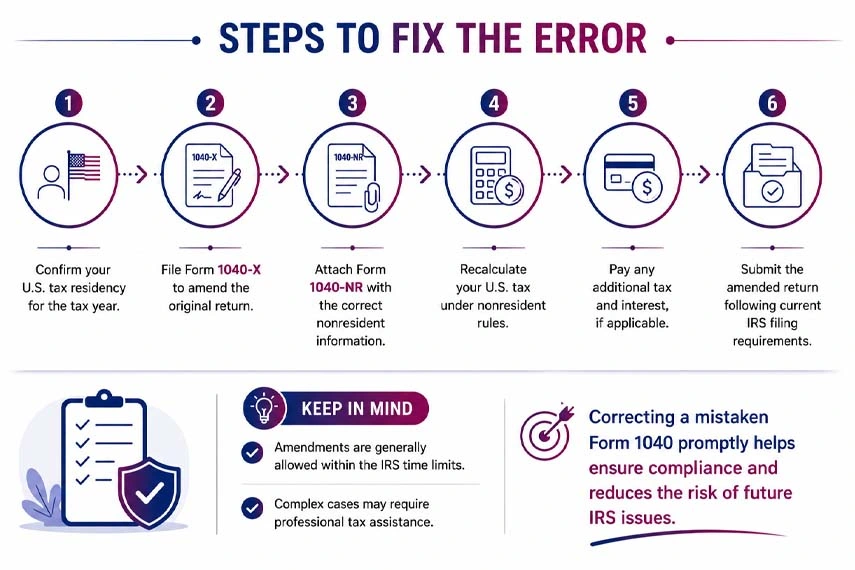
Further, generally the IRS allows amended returns within three years of the original tax filing date or two years from when you paid tax, whichever is later. If you are outside this time window, it is advisable to seek help from a tax professional since, in your situation, the standard amendment process may not apply.
This is how you can correct a Form 1040 filed by mistake. Now, moving ahead, let's know what happens after you correct the US return.
A few things generally happen once your amended US return is processed. These are:
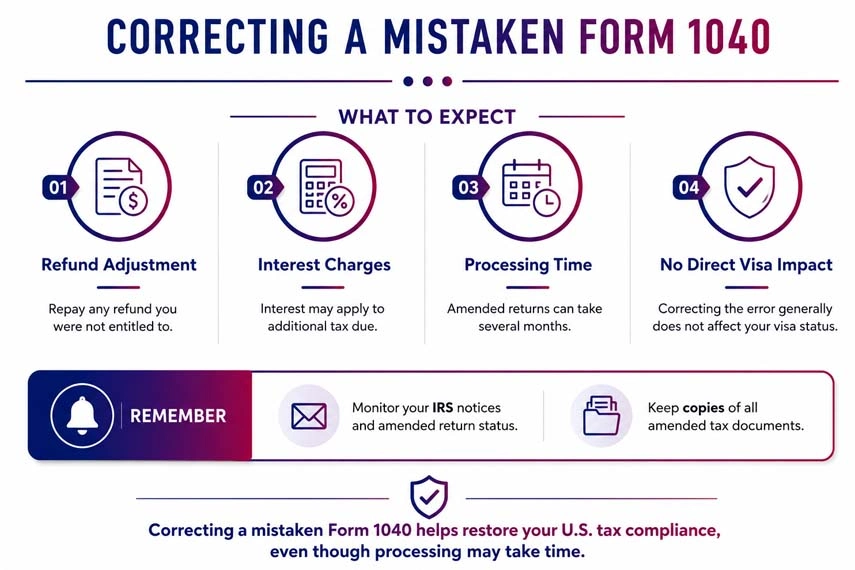
So, this is what happens after you correct your US return Form 1040 mistake. Moving further, let's know the common mistakes that non-resident aliens should avoid when filing tax returns in the US.
Here is a list of some common mistakes that non-resident aliens should avoid when filing a US tax return in the future:
These are some of the common mistakes that non-resident aliens should avoid when filing US tax returns in the future.
Savetaxs helps non-resident aliens and international students to get through complex US IRS tax laws.
Lastly, for non-resident aliens or first-time US taxpayers, accidentally filing Form 1040 instead of Form 1040-NR is a common mistake. It can be resolved by filing an amended return with the IRS. Additionally, it is vital to take correct action as soon as possible after discovering the form mistake. It ensures your accurate tax records reflect your residency status and reduces additional IRS penalties.
Further, if you are not sure whether you qualified as a resident or non-resident alien for the tax year or need assistance in preparing Form 1040-X and Form 1040-NR, connect with Savetaxs. We have a team of tax experts with years of experience in US taxes who make the US amendment process smooth for you and help you remain fully compliant with tax laws.
This article is for general informational purposes only and does not constitute tax, legal, financial, or investment advice. Laws, regulations, rates, and procedures may change over time and may vary based on individual circumstances.
While SaveTaxs makes reasonable efforts to keep the information accurate and up to date, readers should verify applicable rules with official authorities or consult a qualified professional before making decisions based on this information.
Vipul Jain is the Co-Founder of SaveTaxs and a tax expert with experience in Indian and NRI taxation. He advises individuals, NRIs, and businesses on tax filing, tax planning, capital gains, DTAA, and compliance matters. He focuses on making complex tax concepts simple and helping taxpayers make informed, compliant decisions. See Full Bio

Want to read more? Explore Blogs
_1786539671275.webp&w=828&q=75)