


Investment & Financial Planning
NRI Property Sale: How to Calculate Capital Gains TaxNRI Property Sale: How to Calculate Capital Gains Tax
Written by Shubham Jain

_1767339016.png&w=3840&q=75)
Investing in Indian mutual funds can help Non-Resident Indians (NRIs) participate in India's financial markets while managing investments from abroad. However, starting an investment involves more than selecting a fund. NRIs need to consider their bank account, Know Your Customer (KYC) status, country of residence, the mutual fund house's onboarding rules, and how they may access their money later.
The process can differ depending on whether you are starting a new investment, continuing a Systematic Investment Plan (SIP) opened while you lived in India, or updating your details after moving overseas.
This guide explains the main steps involved in mutual fund investment for NRIs, the documents generally required, how NRE and NRO accounts are used, and the practical checks to complete before investing. It also explains why NRIs living in the United States or Canada may need to check additional requirements.

Yes. Eligible Non-Resident Indians can invest in Indian mutual funds, subject to the applicable regulatory framework and the terms of the relevant scheme. The Ministry of External Affairs confirms that NRIs and eligible persons of Indian origin can invest in mutual fund units in India. The scheme's offer documents and the fund house's onboarding requirements should be checked before applying.
NRIs may invest in different categories of mutual funds, including equity, debt, hybrid and other schemes, depending on the scheme's eligibility conditions and their own investment objectives.
However, eligibility to invest does not mean every mutual fund is available to every NRI. The investor's country of residence, documentation, KYC status and the fund house's compliance arrangements can affect whether an application is accepted.
Before starting, distinguish between three questions:
All three should be considered before investing.
The exact documents and checks depend on the fund house and the investor's circumstances. The following are common requirements to prepare for.
A Permanent Account Number (PAN) is generally required for mutual fund investment and related tax compliance, subject to applicable exceptions. Ensure your PAN details match the information supplied in your application.
KYC is used to verify an investor's identity and other required details. Depending on your circumstances and the fund house's process, you may be asked for documents such as:
A completed KYC record does not necessarily mean every account or investment application will be approved automatically. The fund house may require additional verification or updated information.
For official KYC guidance and links to relevant processes, refer to the AMFI KYC resource.
NRIs generally use an eligible NRE or NRO account to route Indian mutual fund investments. The appropriate account depends on the source of the money, the investment arrangement and the intended treatment of the proceeds.
Before making a payment, confirm that the bank account is accepted by the mutual fund house and correctly registered in the investor's folio.
Provide your current overseas address, country of residence and other requested declarations accurately. If you move countries or your residential status changes, check whether your existing records need to be updated.
This is particularly important for investors whose country of residence has additional financial-account reporting or investment compliance requirements.
Understand eligibility, KYC and NRE/NRO account requirements before investing in Indian mutual funds.
An NRE and an NRO account serve different purposes. The right option depends on where your funds originate and the applicable repatriation rules.
| Feature | NRE account | NRO account |
|---|---|---|
| Typical purpose | Holding eligible overseas earnings in India | Managing income received in India and other permitted funds |
| Mutual fund funding | May be used for eligible investments through accepted banking channels | May be used for eligible investments through accepted banking channels |
| Repatriation considerations | Generally offers repatriation of eligible balances, subject to applicable rules | Repatriation is subject to applicable limits and compliance requirements |
| Main point to check | Source of funds and repatriation eligibility | Source of funds, tax compliance and applicable repatriation procedure |
Do not assume that every redemption follows identical rules simply because an NRE or NRO account was used. The source of the investment, its repatriation basis, applicable regulations and the fund house's procedures can all matter.
Before investing, confirm the account details and intended repatriation basis with your bank and mutual fund provider. The Ministry of External Affairs' overseas Indian FAQs provide background on accounts and investments for overseas Indians.
The following steps provide a practical starting point. The exact process may differ by fund house and platform.
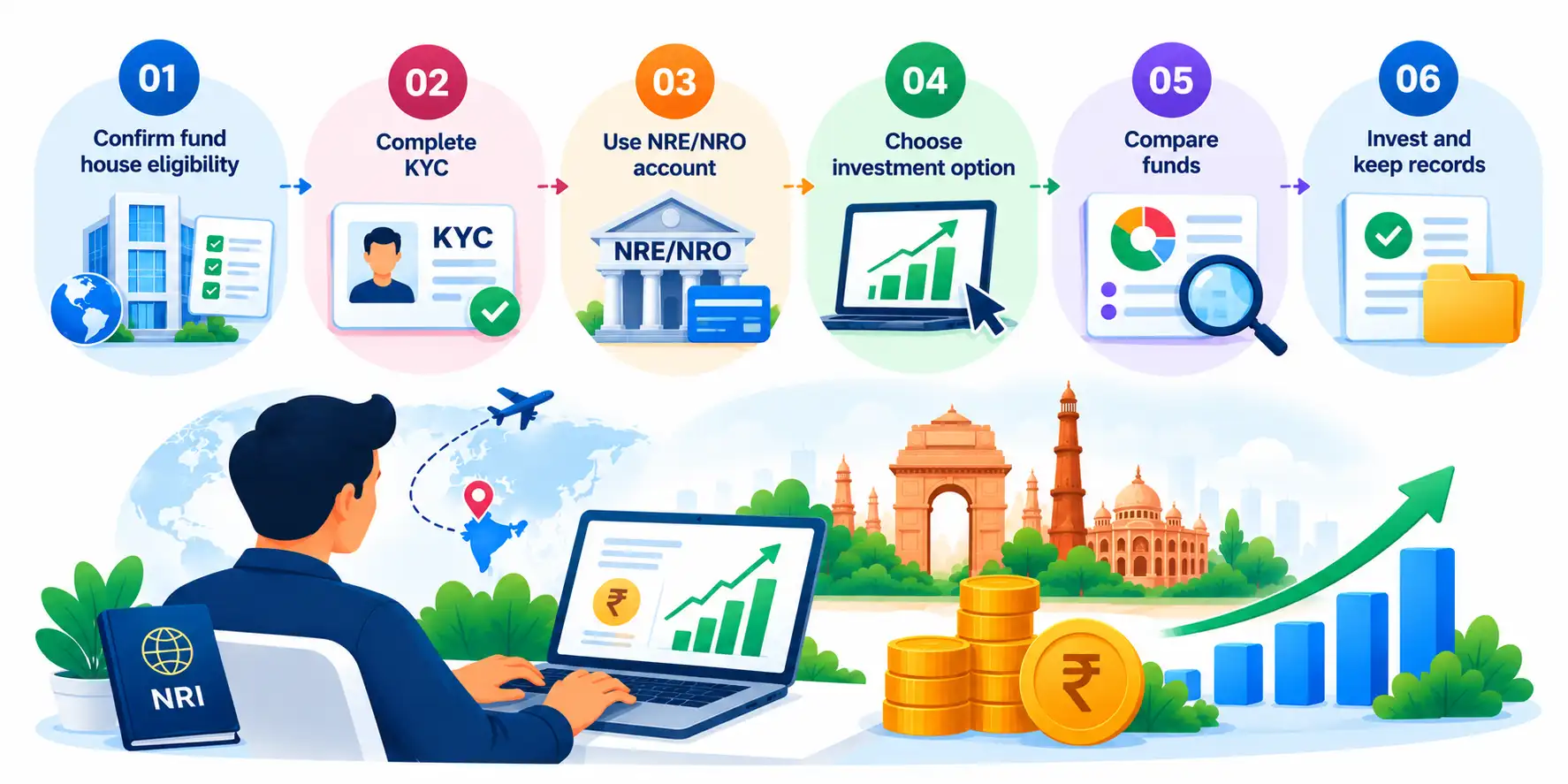
Start by confirming that the mutual fund provider accepts investors with your country of residence and residential status.
Ask whether there are any restrictions for your country, whether digital onboarding is available, and which documents or declarations are required.
Do this before transferring money or choosing a particular scheme.
Check your existing KYC status and determine whether you need fresh verification or an update. Ensure your PAN, overseas address, bank details and declarations are consistent.
If you previously invested as a resident Indian, do not assume that your old records automatically reflect your current non-resident status.
Choose the appropriate NRE or NRO account for the investment and confirm that the mutual fund provider accepts it. Complete any bank verification or account-mandate process required.
The first holder of the mutual fund folio generally needs to satisfy the fund house's bank-account validation requirements.
Depending on the provider, you may be able to invest directly with the asset management company (AMC), use an eligible investment platform or distributor, or arrange for an authorised representative to act under a valid Power of Attorney (PoA).
The available options depend on the provider's rules, verification requirements and the authority granted to any representative. A PoA should not be assumed to override country-specific or regulatory restrictions.
Before selecting a scheme, review its investment objective, underlying assets, risk level, costs, liquidity, exit load where applicable and offer documents.
Consider whether you may need the money in India or abroad, when you may need it, and whether currency movements could affect the value of your investment when measured in your country of residence.
Past performance does not guarantee future returns.
Follow the provider's instructions for submitting the application and transferring funds. Check the confirmation, folio details, registered bank account and transaction record after the investment is processed.
Keep copies of your investment confirmations and relevant statements. These can be useful for future redemptions, tax reporting and resolving discrepancies.
NRIs residing in the United States or Canada may encounter additional restrictions when investing in Indian mutual funds. Some fund houses limit or do not accept applications from residents of these countries because of applicable compliance, reporting and operational requirements.
This is not a universal rule for every mutual fund provider. Availability can differ between AMCs, schemes and onboarding channels, and policies may change.
Before investing, confirm:
Do not rely solely on a general online statement that all NRIs from a particular country can—or cannot—invest. Check the fund house's current application instructions and scheme documents.
Choosing a mutual fund should begin with your financial needs, not a list of recent top performers.

Consider whether you are investing for a long-term goal, a future expense in India, retirement or another purpose. Your time horizon can influence how much market volatility you may be able to tolerate.
Equity funds, debt funds and hybrid funds have different risk characteristics. Diversification can help spread exposure, but it cannot eliminate market risk or guarantee a positive return.
Understand what a fund holds and how it may behave under different market conditions before investing.
Review the expense ratio, exit load, applicable transaction conditions and redemption procedures. Check whether any restrictions could affect access to your money when you need it.
Your investment may be denominated in Indian rupees while your income or future spending is in another currency. Changes in the exchange rate can affect the value of your investment when converted into your overseas currency.
Indian mutual fund taxation depends on factors such as the type of fund, the date and nature of the transaction, the holding period and the rules applicable to the investor. TDS may apply to payments made to non-resident investors.
Tax withheld at source is not necessarily the same as the final tax liability. Your return-filing position and any available treaty relief depend on the relevant facts and rules.
For a detailed discussion, read Savetaxs' separate guide, NRI Taxation on Mutual Fund Gains in India. This investment guide intentionally does not reproduce a full tax-rate table, as the tax article should remain the primary resource for detailed calculations and tax updates.
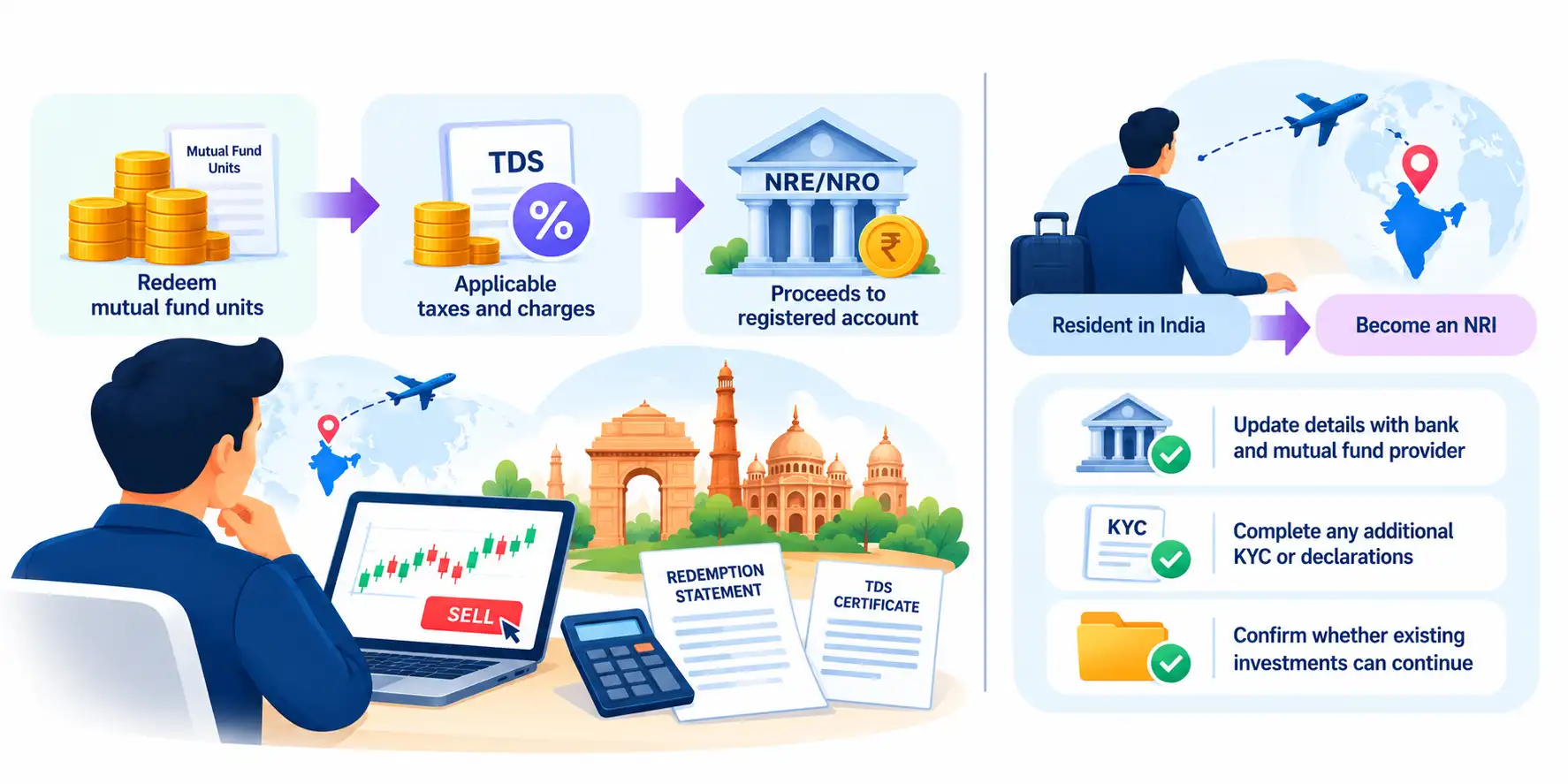
Redemption is the process of selling mutual fund units back to the scheme in accordance with its terms. The applicable procedure and timing depend on the scheme, transaction type, cut-off rules, settlement process and any relevant restrictions.
For an NRI, the amount credited after redemption may be affected by applicable taxes, TDS, charges or other adjustments. The proceeds are generally paid to the registered bank account in accordance with the fund house's rules.
Before redeeming, check:
Keep the redemption statement and tax-deduction documents. If TDS exceeds the final tax payable, a refund may be available through the applicable tax-return process, depending on eligibility and compliance with filing requirements.
If you move abroad and your residential status changes, contact your bank and mutual fund provider to update the relevant details. Confirm whether your existing investments can continue under the updated status and whether any additional KYC, bank mandate, or tax declarations are required.
Do not assume that your old resident account or investment profile can continue unchanged. Updating records promptly can help avoid transaction delays and compliance problems.
Get clarity on investment eligibility, tax implications and repatriation requirements.
Mutual fund investment for NRIs involves understanding eligibility, completing KYC, choosing an appropriate bank account and confirming that the fund house accepts investors from your country of residence. These steps are important whether you are making a first investment or updating an existing portfolio after moving overseas.
Before investing, review the scheme documents, consider your goals and risk tolerance, and confirm the applicable account, tax and repatriation requirements. Because rules and provider policies can change, verify the current position with the relevant fund house and official sources.
This article is for general informational purposes only and does not constitute tax, legal, financial, or investment advice. Laws, regulations, rates, and procedures may change over time and may vary based on individual circumstances.
While SaveTaxs makes reasonable efforts to keep the information accurate and up to date, readers should verify applicable rules with official authorities or consult a qualified professional before making decisions based on this information.
Vipul Jain is the Co-Founder of SaveTaxs and a tax expert with experience in Indian and NRI taxation. He advises individuals, NRIs, and businesses on tax filing, tax planning, capital gains, DTAA, and compliance matters. He focuses on making complex tax concepts simple and helping taxpayers make informed, compliant decisions. See Full Bio

Want to read more? Explore Blogs
_1781845771869.webp&w=828&q=75)
_1778936280179.webp&w=828&q=75)