

Investment & Financial Planning
FCNR Deposit Interest Rates in 2026FCNR Deposit Interest Rates in 2026
Written by Vipul Jain

_1766742512.webp&w=3840&q=75)
Changing your residential status from an Indian resident to a non-resident indian is overwhelming but lowkey exciting. Overwhelming because changes in residential status affect one's finances, lifestyle, banking, investments, and a lot more.
Talking specifically about investments, understanding this one change is essential to successfully continue your financial journey, even after moving abroad. In this guide, we will discuss what happens to your regular demat account when you become an NRI.
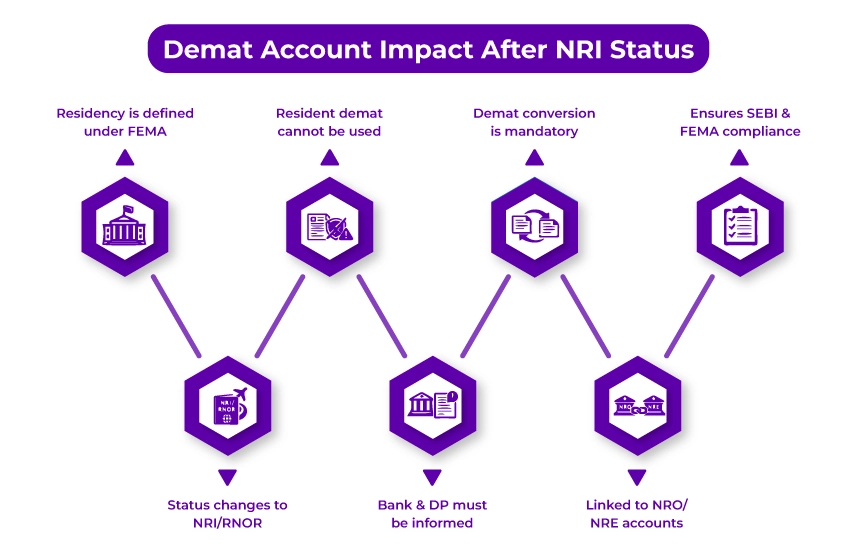
For investment and regulatory purposes, an individual's residency is defined under the FEMA Act. Here, the residency is not defined just by where you live, but also by your intentions and how long you have stayed in or outside India.
With regard to FEMA, the individuals are classified either as Non-Resident Indians, Resident Indians, or Resident but not Ordinarily Resident (RNOR). This classification of residential status directly affects your ability to operate your bank and demat accounts in India.
When an individual becomes an NRI, they are no longer allowed to use their resident savings or demat account for any purpose. If they consent to do so, it's flagged as non-compliant with FEMA. Hence, to remain compliant, investors must inform the bank and the bank's depositary participant (DP) or broker of any change in residency status.
Upon being notified, you must restructure your entire investment setup to be NRI-compliant. This includes converting your resident Demat and trading account into an NRI Demat account linked with NRE and NRO bank accounts, with or without the Portfolio Investment Scheme, which depends on your investment rate.
Timely reporting of your residential status change and conversion ensures compliance with SEBI and FEMA, and that your investments will be managed smoothly even after your residential status changes.
The following are the steps to convert your Demat account to an NRI Demat account.
Step 1: Close Your Resident Demat Account
Visit your bank, the financial institution that holds your demat account, and request closure of the resident demat account. Please ensure that upon becoming a resident, this step is mandatory as per the FEMA guidelines.
Step 2: Open an NRO or NRE Demat Account.
The following are the effects on your existing shares and investment.
No automatic sale or cancellation.
The existing shares in yur resident account are neither cancelled nor sold when you become an NRI.
Transfer of Shares To NRI Demat Is Mandatory
All holdings must be transferred or converted into an NRI demat account to remain FEMA-compliant.
Sale Proceeds Follow RBI Rules
Post the transfer of shares and securities, the sale proceeds will be credited to an NRI account. NRE account credit is allowed only when repatriation is permitted under the RBI guidelines.
Corporate actions will continue smoothly.
Dividend shares, stock splits, or rights issues will continue even after a change in your residential status. All the benefits will be credited to your NRI demat account.
NRI Taxation and TDS Applicability.
Income and capital gains are taxed under the NRI tax provisions. Additionally, the TDS will be deducted at source on the dividends and capital gains as applicable.
Fresh Investment Restrictions
Upon becoming an NRI, you must know that the new overseas cases of investment must be routed through an NRI-linked trading account. The tractions must comply with either the PIS or non-PIS norma, repartition limits, and the sectoral caps for NRI investors.
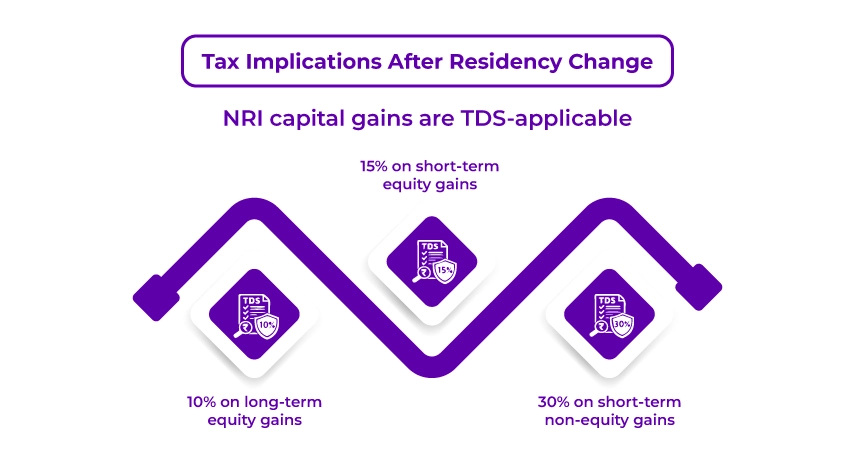
Upon becoming an NRI, the tax deduction at source is applicable on the capital gains that arise from the sale of securities in India. However, the TDS rates vary based on he type of investment.
NRI file your income tax confidently in India under Savetax's Expert Guidance.
The following are the consequences of failing to update residency status.
When transitioning into an NRI life, a lot of changes are required to ensure everything remains in compliance. With respect to the demat accounts, you must immediately convert our normal demat account into an NRI or NRE demat account. Additionally, understanding the tax implications will help you strategize your investments more effectively.
However, as an NRI, if you need expert-backed professional advice on managing your cross-border investments, Savetaxs is here to serve you with the finest cross-border investment strategy.
Our experts bring 30+ years of experience handling NRI investment accounts and portfolios.
Connect with us as we serve our clients 24/7 across all time zones.
This article is for general informational purposes only and does not constitute tax, legal, financial, or investment advice. Laws, regulations, rates, and procedures may change over time and may vary based on individual circumstances.
While SaveTaxs makes reasonable efforts to keep the information accurate and up to date, readers should verify applicable rules with official authorities or consult a qualified professional before making decisions based on this information.
Shubham Jain is the Founder of SaveTaxs and has extensive experience in Indian and NRI taxation. He advises individuals, NRIs, and businesses on tax filing, tax planning, capital gains, DTAA benefits, fund repatriation, and compliance matters. He regularly writes about taxation and related financial topics. His focus is on making complex tax concepts easy to understand. Through his articles, he helps taxpayers stay informed, avoid common mistakes, and stay compliant with Indian tax laws. See Full Bio

Want to read more? Explore Blogs
_1781845771869.webp&w=828&q=75)
_1778936280179.webp&w=828&q=75)
_1778936089630.webp&w=828&q=75)