

NRI Income Tax Compliance
How to Claim Excess TDS Refund After Selling Property in India as an NRIHow to Claim Excess TDS Refund After Selling Property in India as an NRI
Written by Shubham Jain

If you are an NRI or earn income in India and abroad, you have probably wondered which income you must include in your Indian tax calculation. The important gap is that taxability does not depend only on where money is received; residential status, source and the nature of income matter. In this guide, you’ll learn how taxable income differs for NRIs, Residents and RNORs for FY 2026-27 and what NRI status means for your Indian tax liability.
Residential status determines the broad scope of income taxable in India for FY 2026-27.
NRIs generally have Indian tax exposure on income falling within the Indian tax scope.
Residents generally face a wider tax scope that can include foreign-source income.
RNOR status can provide different treatment of foreign income from an ordinarily resident taxpayer.
Indian-source income such as qualifying rent, interest and capital gains can remain taxable for an NRI.
Taxable income is income chargeable to Indian tax after applicable exclusions, exemptions, deductions and other provisions. For FY 2026-27, the period is called Tax Year 2026-27 under the Income Tax Act, 2025, which applies from 1 April 2026.
— Source: Income Tax Department, 2026.
First, residential status is the starting point for determining the scope of taxable income. For example, a person abroad may still have taxable Indian rent or interest.
Residential status matters because Indian tax law applies different income-scope rules to Residents, RNORs and Non-Residents. For example, a Resident generally has a wider tax scope than an NRI, particularly regarding foreign-source income.
Moreover, FY 2026-27 is the first tax year governed by the Income Tax Act, 2025. The Income Tax Department confirms that the basic residency tests remain unchanged.
An NRI is generally taxed in India on income that falls within the Indian tax scope, while a Resident generally has a wider scope that can include foreign-source income. For example, Indian rent may be taxable for an NRI, while a Resident may also need to consider qualifying foreign salary or investment income under the applicable provisions.
The key difference is the scope of taxable income in India.
| Income type | NRI | Resident |
|---|---|---|
| Indian-source income | Generally taxable if chargeable | Generally taxable if chargeable |
| Income received in India | Subject to applicable rules | Subject to applicable rules |
| Foreign-source income | Depends on applicable rules | Generally within wider tax scope |
| Indian rent, interest and gains | Generally taxable if chargeable | Generally taxable if chargeable |
At the same time, foreign income is not automatically taxable merely because an NRI transfers money to an Indian bank account. For example, an NRI earning salary abroad should assess the underlying income, not a later remittance.
Residential status is determined mainly from your physical stay in India and the statutory conditions applicable to you. For example, the basic test treats an individual as resident if they stay in India for 182 days or more during the tax year, or satisfy the applicable 60-day-plus-365-day test.
— Source: Income Tax Department, 2026.
Moreover, special rules apply to certain Indian citizens and persons of Indian origin visiting India and to citizens leaving India for employment abroad or as crew members. For some visiting citizens or PIOs with income other than foreign-source income above ₹15 lakh, the relevant threshold can be 120 days.
— Source: Income Tax Department, 2026
RNOR is a separate residential category for individuals who meet the applicable residence conditions but also satisfy the statutory RNOR conditions. Under the Income Tax Act, 2025, these include being non-resident in 9 out of the 10 preceding tax years or staying in India for 729 days or less during the 7 preceding tax years.
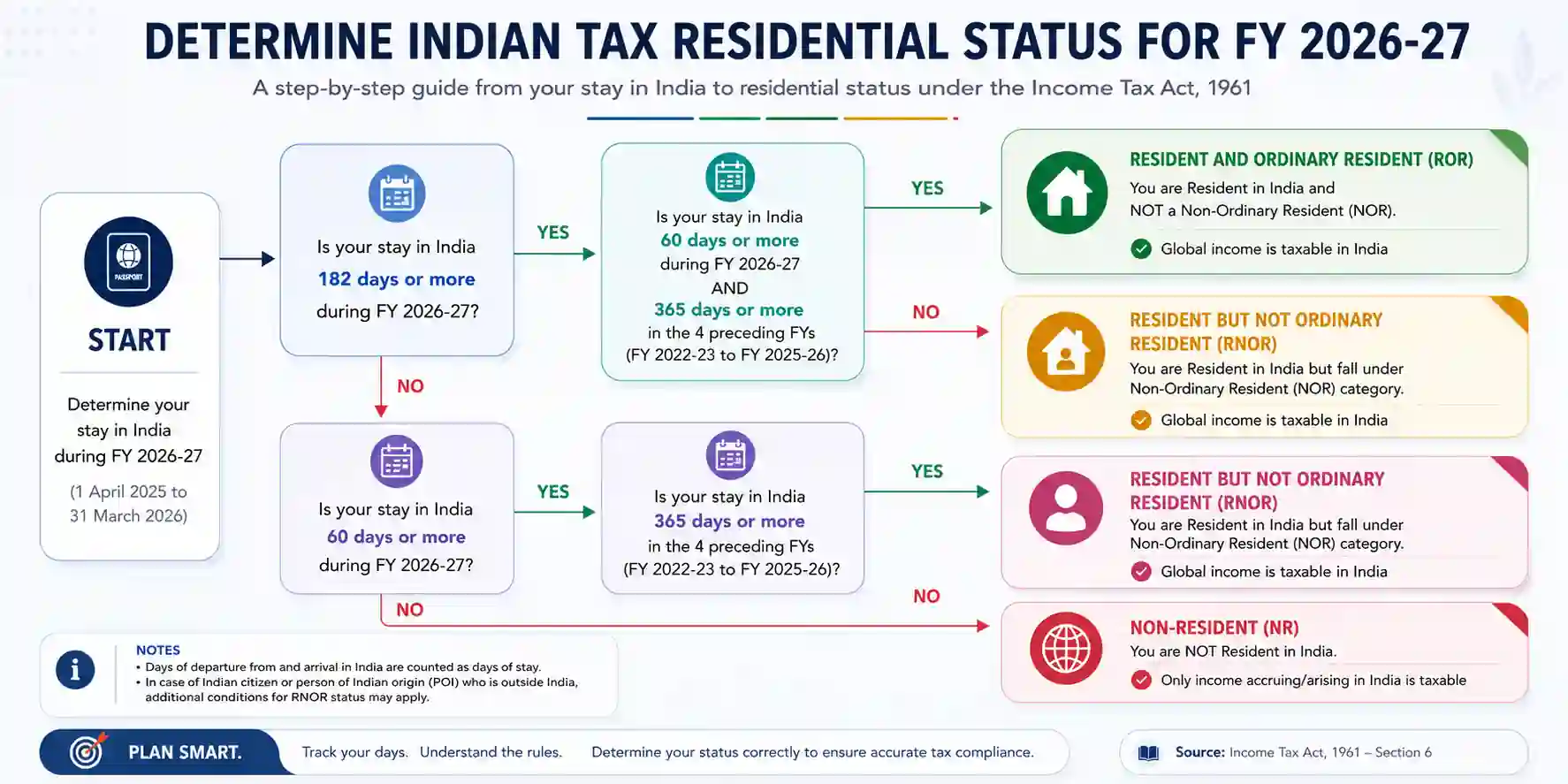
Your taxable income can be identified by following a sequence based on status, source and applicable tax rules.
Determine residential status for FY 2026-27 under the Income Tax Act, 2025.
Classify each income as Indian-source or foreign-source and identify its nature.
Check taxability using the provisions applicable to your status and income.
Apply permitted adjustments such as applicable exemptions, deductions and losses.
Review compliance requirements relevant to your circumstances.
For more details, use NRI residential status and foreign income and Indian tax
An NRI tax calculator can help estimate tax after you correctly identify your residential status and taxable income.
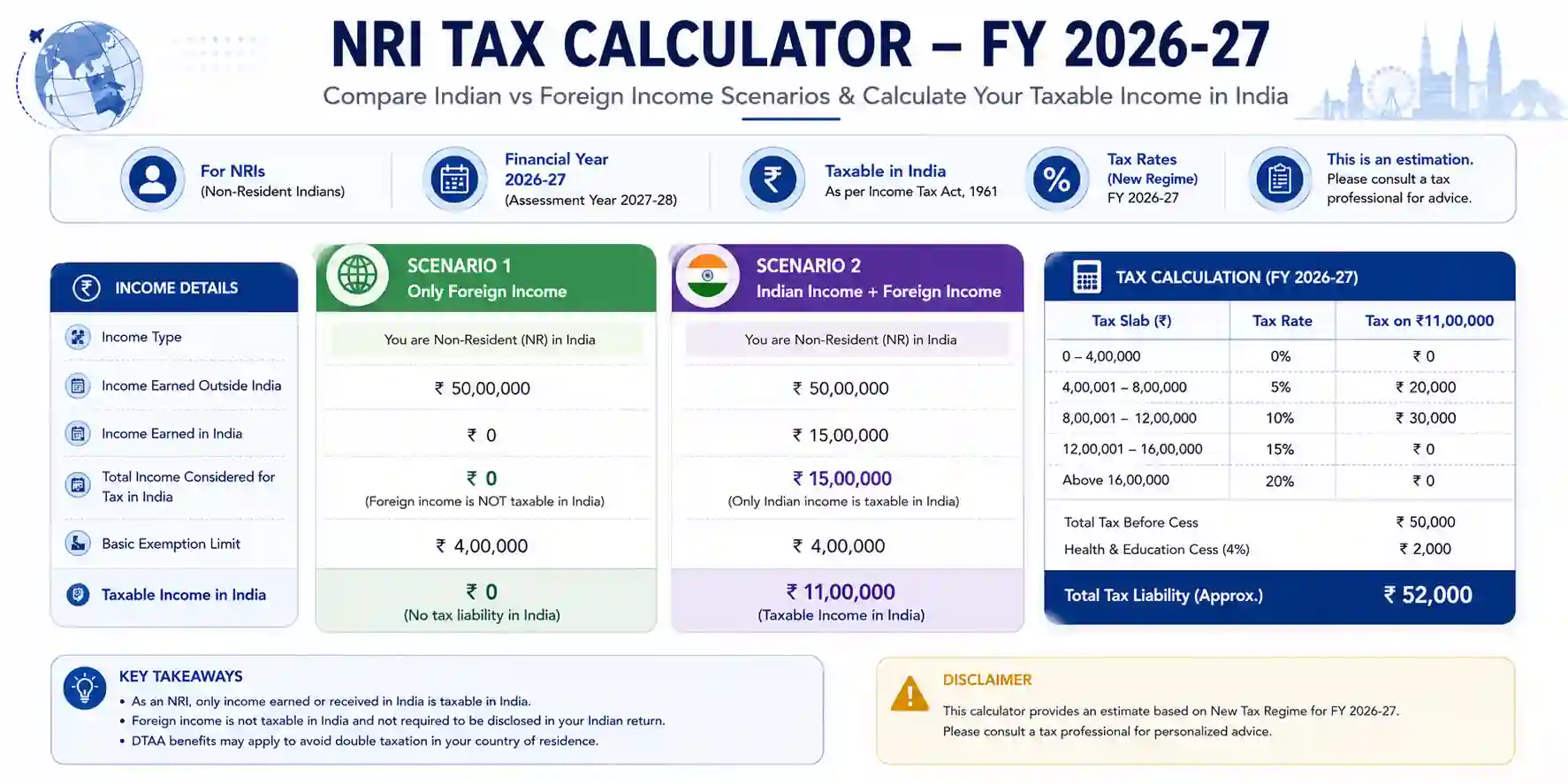
As a free cross-check, use the Income Tax Department’s e-filing resources; its guidance identifies foreign-source income schedules for residents and specific foreign-asset treatment for RNORs and non-residents.
Your next step is to determine residential status before calculating taxable income for FY 2026-27. For example, an NRI with foreign salary and Indian rent should evaluate each income separately rather than treating the entire bank balance as taxable or exempt.
Next, keep records of your days in India, income source, salary documents, investment statements and Indian property income. For complex cross-border situations, professional tax review can help you apply the correct provisions.
Taxable income for NRIs and Indian Residents differs primarily because residential status changes the scope of income considered under Indian tax law. For FY 2026-27, use the Income Tax Act, 2025 and determine your residential status before evaluating Indian and foreign income.
Finally, do not judge taxability simply by where money is deposited. By correctly identifying residential status, income source and applicable provisions, you can make a more accurate Indian tax assessment.
This article is for general informational purposes only and does not constitute tax, legal, financial, or investment advice. Laws, regulations, rates, and procedures may change over time and may vary based on individual circumstances.
While SaveTaxs makes reasonable efforts to keep the information accurate and up to date, readers should verify applicable rules with official authorities or consult a qualified professional before making decisions based on this information.
Vipul Jain is the Co-Founder of SaveTaxs and a tax expert with experience in Indian and NRI taxation. He advises individuals, NRIs, and businesses on tax filing, tax planning, capital gains, DTAA, and compliance matters. He focuses on making complex tax concepts simple and helping taxpayers make informed, compliant decisions. See Full Bio
Want to read more? Explore Blogs