


Investment & Financial Planning
NRI Property Sale: How to Calculate Capital Gains TaxNRI Property Sale: How to Calculate Capital Gains Tax
Written by Shubham Jain


For NRIs, investing in the Indian real estate market is a profitable opportunity. The growing Indian property market, fueled by commercial development, urban expansion, and favorable policies of the government, provides NRIs a chance to participate in high returns.
However, from abroad, handling the complexities of the Indian property market can be difficult for NRIs. To help you out in this and make informed decisions, this blog consists of the top 8 mistakes that NRIs should avoid when buying property in India. So, whether you are planning to buy commercial or residential property, avoiding these mistakes can save you money, legal hassle, and time.
NRIs always have an emotional appeal for Indian real estate. For them, it is a home, and it is tangible. However, sometimes by getting emotional, NRIs make some investment mistakes that further impact their growth potential. Considering this, before buying a property in India, they should conduct thorough market research to know the future development potential of the property. Additionally, avoid the following common mistakes that they made unknowingly.
Many NRIs do not know that there are some property restrictions on them in India. For this, the Foreign Exchange Management Act (FEMA) has strict rules and regulations. Considering this:

Further, if you already have inherited agricultural land or a farmhouse, you can hold it. However, without the permission of the Reserve Bank of India (RBI), you cannot sell it. Additionally, you cannot purchase more agricultural land.
In case you violate this rule, under FEMA regulations, you are liable to pay three times the transaction value or INR 2,00,000 if not quantifiable. Also, potential asset confiscation and, in severe cases, criminal prosecution.
At Savetaxs, we help you fulfill your NRI tax obligations in India on time and get you available tax refunds.
Another common mistake that NRIs usually make is not thoroughly verifying the property title and ownership. Property title disputes in India are common, and failing to confirm the reliability of the title can outcome in legal issues. So, before buying a property in India, certify that it has a clear title:
Further, to conduct due diligence, hiring a legal professional will assist you in avoiding these problems. Also, if you are purchasing property from a developer, make sure that he/she have gotten the approvals. For instance, building permits and land use permissions.
It is one of the biggest investment mistakes that NRIs make through financial planning when purchasing property in India. Most of the NRIs will only look at the buying price and do not consider the overall cost of having a property. It includes the cost of stamp duty, registration, and legal costs. Additionally, the maintenance and renovation costs also play a vital role. So, when buying a property in India, NRIs should also go through these hidden costs.
Further, let's know how to avoid this mistake.
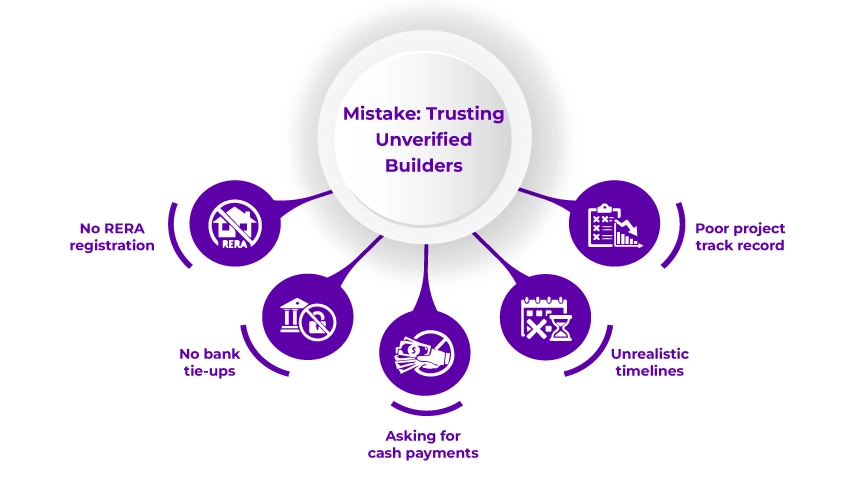
NRIs investing in Indian property should understand what is happening in the market. Additionally, based on the tempting offerings and prices, you should not trust unverified builders. Always opt to work with reliable and trustworthy brokers. It is one of the important factors to consider that the property has all the relevant licenses and permits that you are planning to purchase. Further, let's know the red flags you should look for:
Among NRI investors, cities like Delhi NCR, Mumbai, and Bangalore, because of high returns, are popular for property investment. However, solely focusing on these cities is a big mistake. It is because, often, these markets are oversaturated, leading to lower returns and inflated prices in the long run.
Instead of these, consider emerging cities like Hyderabad, Pune, and Tier-2 cities such as Jaipur, Chandigarh, and Lucknow. With higher appreciation potential and lower entry costs, these cities provide a better growth trajectory.
Further, in Delhi NCR, finding new commercial projects or choosing Chandigarh for property investment could provide you with better returns as these areas are developing rapidly.
For NRIs, it is a significant challenge to manage property from overseas. Considering this, many of them forget to plan for property management. It further led to issues like rent collection, property maintenance, and tenant management. Now, let's know how you can avoid this:
Connect with Savetaxs, and choose the best property investment options in India available for NRIs.
This is where most of the NRIs made a huge mistake. For NRIs, it is vital to understand the NRI property tax rules in India when buying a property. Ignoring the tax implications further results in facing legal and tax complications. Considering this:
Further, NRIs can also reduce the capital gains tax:
Imagine you bought a flat in Mumbai and after some time sold it for INR 1.5 crore. Now, you want to transfer this money to your US bank account. You think the fund transfer process is straightforward, but it is not. You need to follow the FEMA repatriation rules to transfer your funds to your foreign bank account. In case of property purchase, it depends on how you bought the property.
| Source of Funding | Repatriation Limit |
|---|---|
| NRE Account or Foreign Remittance | Two residential properties, fully repatriable, i.e., principal + capital gains amount. |
| NRO Account (Indian Income) | Up to USD 1 million per financial year is repatriable. It includes both principal and capital gains amounts. |
| Inherited Property | Up to USD 1 million per financial year. |
Further, currency fluctuation also plays a key role when investing in Indian property. The exchange rate between the currency of your home country and the Indian rupee can impact the total investment cost. For instance, in 2016, you purchased a property in India when $1 = INR 63. Now, in 2025, when $1 = INR 83, you sell the property.
Here in rupees, you made a profit of INR 60,00,000. However, in dollars, your profit is less, as the value of the rupee has depreciated by 32% against the dollar. So, when calculating profits, think in dollars, not in rupees.
Moreover, these were some of the real estate investment mistakes NRIs make while purchasing property in India.
Lastly, for NRIs, investing in the Indian real estate market is a good way to generate passive income and long-term growth. However, the path to success is avoiding the common mistakes that impact your investment. From understanding FEMA and RBI regulations to managing financial risks and fulfilling tax implications, every step needs careful consideration.
Further, by connecting with reputable financial and investment NRI professionals like Savetaxs, you can make informed decisions and reduce risk. With expert guidance, your NRI real investment in India can be a profitable and hassle-free experience.
This article is for general informational purposes only and does not constitute tax, legal, financial, or investment advice. Laws, regulations, rates, and procedures may change over time and may vary based on individual circumstances.
While SaveTaxs makes reasonable efforts to keep the information accurate and up to date, readers should verify applicable rules with official authorities or consult a qualified professional before making decisions based on this information.
Shubham Jain is the Founder of SaveTaxs and has extensive experience in Indian and NRI taxation. He advises individuals, NRIs, and businesses on tax filing, tax planning, capital gains, DTAA benefits, fund repatriation, and compliance matters. He regularly writes about taxation and related financial topics. His focus is on making complex tax concepts easy to understand. Through his articles, he helps taxpayers stay informed, avoid common mistakes, and stay compliant with Indian tax laws. See Full Bio

Want to read more? Explore Blogs
_1781845771869.webp&w=828&q=75)
_1778936280179.webp&w=828&q=75)