



Investment & Financial Planning
NRI Property Sale: How to Calculate Capital Gains TaxNRI Property Sale: How to Calculate Capital Gains Tax
Written by Shubham Jain
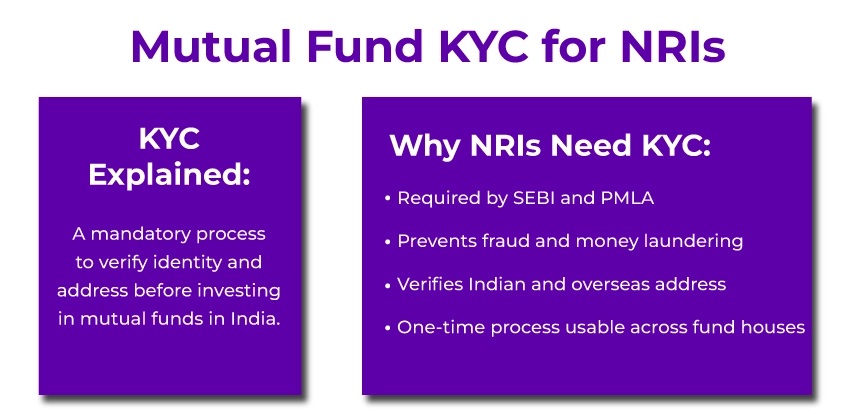
KYC (Know Your Customer) is a verification process used by financial institutions that helps confirm an individual's identity and source of funds. It ensures that your investments adhere to the regulations of SEBI, RBI, and FATCA/CRS. An NRI KYC helps verify identity, evaluate potential risks, avoid fraud, and comply with legal and regulatory requirements.
It is a mandatory verification process for all NRIs who wish to invest in Indian mutual funds. Upon successful completion of KYC, the details are stored centrally by KRAs, avoiding the need to re-do the process for every new fund you wish to invest in. Keep reading the blog further to know about mutual fund KYC for NRIs.
Financial institutions conduct a KYC "Know Your Customer" process to verify and confirm your identity, address, and financial background before giving you the permit to invest. A KYC is mandatory for investing in mutual funds in India, enforced under the Prevention of Money Laundering Act, 2002, and governed by SEBI (Securities and Exchange Board of India) regulations.
Here is what the KYC process does:
Your details are stored in a central database upon successful completion of KYC with one asset management company (AMC). The information is then maintained by KYC registration agencies (KRAs). It means when you invest with a different fund house, you will not have to redo KYC.
The table below shows the required documents for NRI mutual KYC, along with the purpose and accepted proofs.
| Type of Document | Purpose | Accepted Proofs |
|---|---|---|
| PAN card | Links your investment to India's tax network. | PAN card issued by NSDL or UTIITSL. |
| Identity Proof | It is required to verify your identity. | Photo and address pages of your passport. |
| Overseas Address Proof | Confirms your residence abroad. | Utility bill, bank statement, or residence permit (issued within the last three months). |
| Visa/OCI card (if applicable) | Confirms residency type | OCI (Overseas Citizen of India), or PIO (Person of Indian Origin) card, a valid Indian visa. |
| Bank Account Proof | Required to link NRE/NRO accounts. | Cancelled cheque or bank statement (reflecting IFSC and account number). |
| Indian Address Proof (if applicable) | To confirm your Indian residency/link for tax and regulatory compliance. | Aadhaar, voter ID, driving license, or property document. |
| Passport-size photograph | To verify identity and avoid financial crimes. | Recent photograph, signed across the image. |
| KYC Form | Ensure compliance with SEBI regulations | Duly filled and signed. Can be accessed from the AMC or KRA website. |
Choosing the online process for KYC is faster and convenient. You can complete the entire process while sitting in the comfort of your home. Here are the steps you need to follow to complete the online KYC process for NRIs:
You need to choose one from the following three options:
From the platform's website, download the KYC application form and fill it out with accurate information. Ensure to:
Scan and upload all the documents required in PDF or JPG format. Before submitting, ensure that:
To declare your tax residency status, this form is a mandatory requirement as it helps India comply with global tax treaties. You will have to submit the following documents reflecting:
To reduce your tax liability, mention the Double Taxation Avoidance Agreement (DTAA) (if you live in a country that has a DTAA signed with India).
IPV is required to confirm your identity, verifying that you are the person in the documents. The IPV is done by making a video call using Zoom, Skype, or the platform's app.
During the IPV process:
Ensure that you take the call while sitting somewhere with good lighting and a stable internet connection.
Your details will be uploaded to the central database by the KRA upon successful verification. You will get:
**Keep a copy of your KYC acknowledgement number readily avaiable, as you might need it when opening new folios with different AMCs.
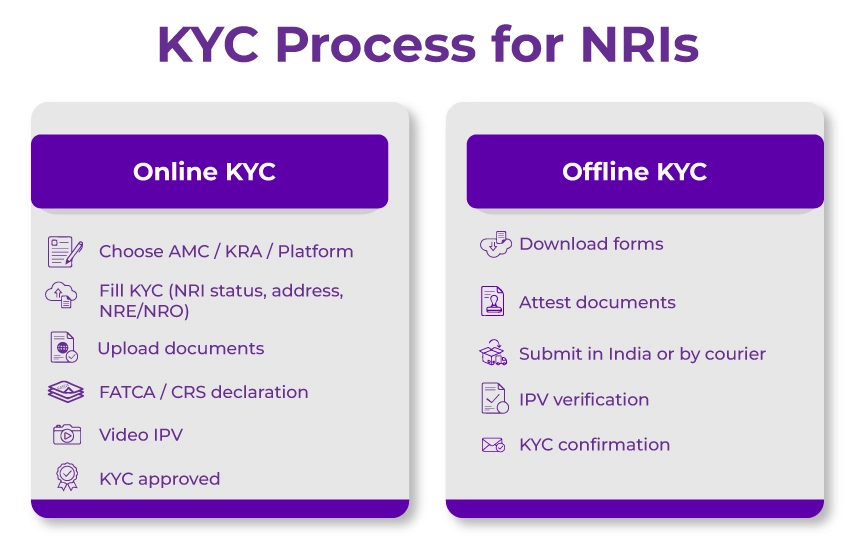
Here is the process for offline KYC, if you choose offline KYC or if your chosen AMC requires it:
Visit the CDSL Ventures (CVL) website or your AMC's website and download:
Fill out the form with accurate details and get every document attested by an authorized entity.
You get two options for submission:
Ensure to use a trackable courier service (DHL, FedEx, Aramex).
The AMC or distributor will arrange the IPV (In-Person Verification) if you submit the documents via courier.
Some AMCs might permit video-based IPV even for offline submission. Others may need you to visit the Indian Embassy in your country.
The processing time might take 7-10 business days, after which you will receive:
Get expert solutions and secure an NRI PAN card with confidence.
An NRI can track the status of their KYC on any KRA website by following the steps below:
Option 1: CVL KRA
Option 2: CAMS KRA
Option 3: Karvy KRA
The screen will display the status as either "KYC Validated", "KYC Registered", or "On Hold".
Invest smartly and unlock your wealth potential with expert consulting.
FATCA (Foreign Account Tax Compliance Act) and CRS (Common Reporting Standard) are international frameworks that help in avoiding tax evasion.
Failing to complete the FATCA and CRS declaration means your KYC process is incomplete, regardless of whether you have submitted other documents. This ensures tax transparency between India and your country of residence.
As an NRI, when you invest in Indian mutual funds, these forms notify the Indian authorities about your tax residency. Additionally, it permits regulated sharing of information with your country of residence.
To put it plainly, FATCA applies mainly to U.S. citizens and residents, while CRS covers NRIs from all other nations. You must not skip these, as it can lead to rejection of your KYC or may impose investment restrictions in the future.
| Regulation | Full Form | Applicable To | Purpose | Information Collected |
|---|---|---|---|---|
| FATCA | Foreign Account Tax Compliance Act. | NRIs who are citizens of the U.S. or U.S. tax residents. | Its purpose is to report U.S.-linked investments to the IRS through Indian authorities. | U.S. citizenship, address, birth country, TIN. |
| CRS | Common Reporting Standard | NRIs residing in non-U.S. countries | Enables tax data exchange between India and 100+ countries. | TIN, nationality, address, and country of tax residence. |
Completing the mutual fund KYC process is an essential step for NRIs looking to invest in Indian markets. It is a crucial part of adhering to FEMA and AML (Anti-Money Laundering) regulations. It not only ensures compliance with regulatory requirements but also facilitates easier investment practices via a centralized verification system. Being aware of FATCA and CRS declarations is crucial in maintaining tax compliance.
Additionally, if you need expert-backed assistance with an NRI mutual fund KYC process or anything related to this matter, reach out to an expert at Savetaxs. Our team of experts will provide you with real-time guidance and satisfactory results. Connect with us today as we are working 24/7 across all time zones to serve our precious clients.
This article is for general informational purposes only and does not constitute tax, legal, financial, or investment advice. Laws, regulations, rates, and procedures may change over time and may vary based on individual circumstances.
While SaveTaxs makes reasonable efforts to keep the information accurate and up to date, readers should verify applicable rules with official authorities or consult a qualified professional before making decisions based on this information.
Shubham Jain is the Founder of SaveTaxs and has extensive experience in Indian and NRI taxation. He advises individuals, NRIs, and businesses on tax filing, tax planning, capital gains, DTAA benefits, fund repatriation, and compliance matters. He regularly writes about taxation and related financial topics. His focus is on making complex tax concepts easy to understand. Through his articles, he helps taxpayers stay informed, avoid common mistakes, and stay compliant with Indian tax laws. See Full Bio

Want to read more? Explore Blogs
_1781845771869.webp&w=828&q=75)
_1778936280179.webp&w=828&q=75)
Typical document requirements include those for NRI mutual fund KYC:
PAN
Passport (photo and address pages)
Recent overseas address proof
Passport-size photo and signature
Bank proof for NRE/NRO account
Visa/OCI/PIO proof (may be required based on residency and passport)