


Investment & Financial Planning
NRI Property Sale: How to Calculate Capital Gains TaxNRI Property Sale: How to Calculate Capital Gains Tax
Written by Shubham Jain

For NRIs, mutual funds are popular investment options in India as they offer strong returns of generally 10-15%. However, being an NRI managing your investment in India, probably right now, you are making at least 3-4 mistakes. Additionally, these mistakes also impact your investments, make you non-compliant with FEMA guidelines, and cause you to pay over-taxes.
To help you out, in this blog, we have mentioned some of the common mutual fund investment mistakes that NRIs made. So read on and gather all the information about it.
Being an NRI, navigating the complex world of Indian investment can be daunting, specifically when you have a busy schedule and are away from your homeland. Considering this, let's look at common mutual fund investment mistakes NRIs should avoid.
These are the primary mistakes that occur before investments. There are the most common and often the most costly ones that you fix later.
Once your residential status changes from Indian to NRI, under the FEMA (Foreign Exchange Management Act), you are no longer allowed to continue your Indian savings accounts for investments. Many NRIs ignore this. It further results in the following things:
So, to avoid all these impacts once you become an NRI, convert your resident savings account to an NRO account. Additionally, depending on your investment goals, you can also open an NRE account.
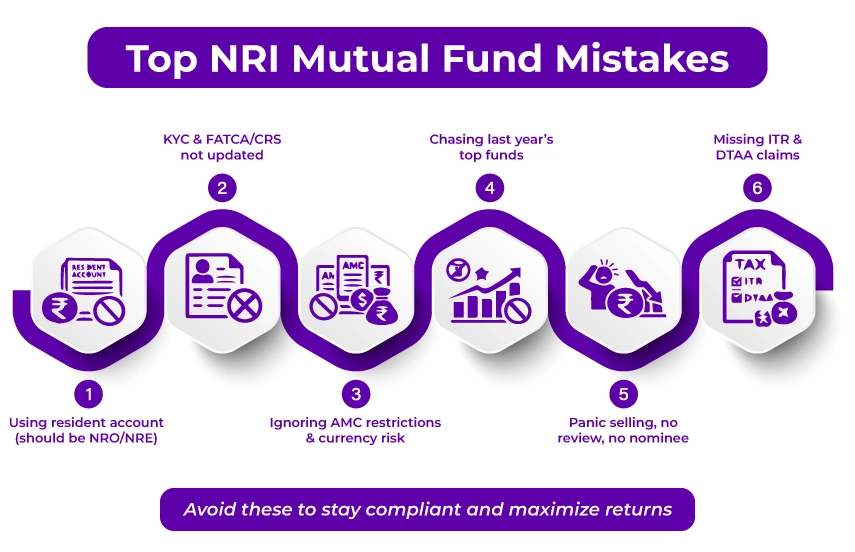
Once your residential status changes to NRI, it is mandatory for you to update your KYC with the KRA (KYC Registration Agency) within a reasonable time. It further results in:
So once you gain the NRI status, immediately update your KYC.
All NRIs who are investing in India need to follow FATCA (Foreign Account Tax Compliance Act) and CRS (Common Reporting Standards). It is a part of your KYC process. Many NRIs fill these forms incorrectly, or some even skip this, thinking they are not citizen of America, so on them FATCA will not apply. Considering this, it can result in:
Further, instead of facing all this, honestly file the FATCA/ CRS declaration.
Once you set up your account, the next mistake you make is choosing the wrong mutual funds to invest in.
One thing you should know is that not all Asset Management Companies (AMCs) accept investments from all foreign countries. This situation is generally faced by the Canadian and US-based NRIs due to the compliance requirements of FATCA. Considering this, being an NRI, if you invest in a fund through an AMC that does not accept NRIs from your nation, then you may:
So, it is advisable before investing check the AMC policy.
Every January, "Top 10 Mutual Funds of the Year" is posted by the financial websites. NRIs, according to these lists, select their investment. It is one of the most common mistakes that NRIs generally make. It further outcomes in:
Considering this, instead of chasing top performers, focus on consistency over 3-5 years.
NRIs earn in foreign currency, i.e., GBP, USD, AED; however, they invest in mutual funds in India denominated in rupees. Well, for every person, whether he/she is a resident Indian or an NRI, enormously the rupee-to-foreign-currency exchange rate matters. Many NRIs forget about this. When they see their invested fund provide a 15% return, they assume that in their home country, they also earn 15% but it is not so. Further, NRIs should not ignore the currency risk.
At Savetaxs, we take care of your ITR returns, maximize your refunds, and guide you at every step of the tax filing process.
Once you correctly invest in the mutual fund, the next set of mistakes you make is when holding your investments.
NRIs are scared of market crashes. They live far away from India, and reading headlines of the market downfall creates a stressful situation for them. Considering this, many NRIs during the 2020 COVID crash sold their mutual funds at 30-40% losses. Within six months, the market recovered. Here, those who held the investment in the next year received 15-20% returns. Further, let's know why it is an issue:
So, to avoid these types of circumstances, you should follow a disciplined approach.
Many NRIs, when feeling optimistic, set up SIPs. After that, for a year, they forget about them, no rebalancing, reviews, or updates. Now, see how it impacts their investments:
Considering this, annually review your mutual fund portfolio so you can also take advantage of market growth and increase your returns.
Indian mutual funds need to have a nominee. For instance, if due to health reasons you passed away without nominating anyone. In this scenario, your legal heirs face a lengthy procedure to claim your funds. Additionally, sometimes it takes years as well. Considering this, from June 1, 2025, SEBI made it mandatory for all investors to have a nominee on all mutual funds and demat accounts. Yet many NRIs do not consider it, and after that, their legal heirs face the following situations:
Further, to avoid these types of situations, add nominees to all your mutual fund investments.
These mistakes are associated with the tax filing and maintaining compliance with the Indian and foreign tax officials.
If you have a taxable income in India, no matter whether you are a resident or an NRI, you need to file income tax returns. It includes dividend income from mutual funds, capital gains received from the redemptions of mutual funds, and interest from NRO accounts. Further, let's see why this is a problem for NRIs:
So, stay compliant with tax laws and file your ITR on time.
Do you know that India has signed Double Taxation Avoidance Agreements (DTAA) with 20+ countries? This agreement helps you from paying taxes on the same income twice. However, the DTAA benefits do not apply automatically. You need to claim them explicitly. Now, let's know why it is an issue:
To avoid this type of situation, claim the DTAA benefits in both India and the country where you are currently residing.
Connect with us today, and with our expert guidance, claim your DTAA benefits in minutes without facing the complex process.
The last mistakes generally happen when it comes to the end of your investment or return to India.
You can repatriate the principal and gain the amount fully through your NRE account. However, using an NRO account, if you have invested in mutual funds, then per financial year, you can repatriate up to USD 1 million. Many NRIs forget about this until they have to transfer money overseas. So instead of transferring money, first plan ahead to avoid any legal trouble.
If you are planning to permanently return to India, 2-3 years before your return, you should plan your mutual fund strategy. Many NRIs do not think about it. They moved to India and realized that their mutual funds were still linked with their NRI accounts, which they needed to convert earlier.
Considering this, if you correctly convert your accounts, without disruption, your mutual funds continue. In case you don't do so, you face compliance issues.
These were the common mutual fund investment mistakes that NRIs should avoid while investing in India. Moving ahead, let's know how NRIs can avoid these issues.
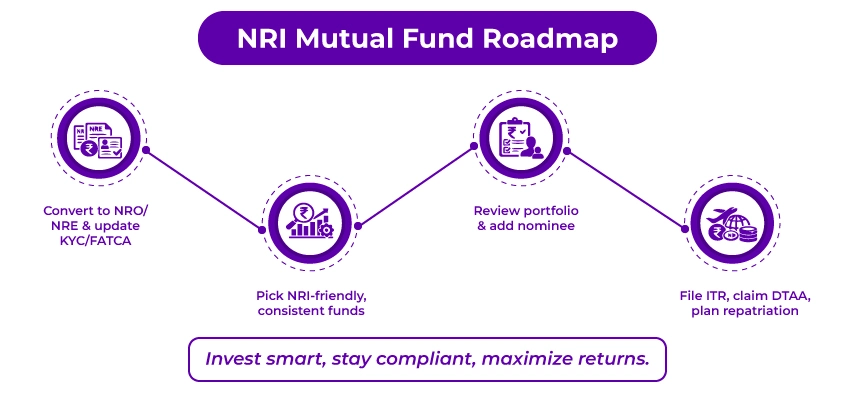
Here is how NRIs can avoid these investment mistakes:
These were some strategies that you can implement to avoid the common mutual fund mistakes while investing in India.
Lastly, NRIs should be aware of these common mutual fund investment mistakes and make proper strategies to avoid them. By doing so, they can have a successful and smooth investment experience in India, creating a way for a secure financial future.
Further, if you still have confusion or need guidance with your investments, connect with Savetaxs. Our team of financial experts will solve all your investment-related queries and help you select the right investment plans as per your financial goals without making any mistakes.
This article is for general informational purposes only and does not constitute tax, legal, financial, or investment advice. Laws, regulations, rates, and procedures may change over time and may vary based on individual circumstances.
While SaveTaxs makes reasonable efforts to keep the information accurate and up to date, readers should verify applicable rules with official authorities or consult a qualified professional before making decisions based on this information.
Shubham Jain is the Founder of SaveTaxs and has extensive experience in Indian and NRI taxation. He advises individuals, NRIs, and businesses on tax filing, tax planning, capital gains, DTAA benefits, fund repatriation, and compliance matters. He regularly writes about taxation and related financial topics. His focus is on making complex tax concepts easy to understand. Through his articles, he helps taxpayers stay informed, avoid common mistakes, and stay compliant with Indian tax laws. See Full Bio

Want to read more? Explore Blogs
_1781845771869.webp&w=828&q=75)
_1778936280179.webp&w=828&q=75)