

Investment & Financial Planning
FCNR Deposit Interest Rates in 2026FCNR Deposit Interest Rates in 2026
Written by Vipul Jain

With India's economy on an exponential rise, NRIs are actively investing in India. But as they say, not all roads lead to Rome; similarly, not all investments are equal.
When we talk about NRI investment, diversification is key, but it's also essential to understand which types of investments are worth diversifying into. NRI investors have different financial goals, time horizons, references, and risk appetites, so investing isn't a one-size-fits-all activity. What investment product is suitable for your friends doesn't mean it's good for you, too.
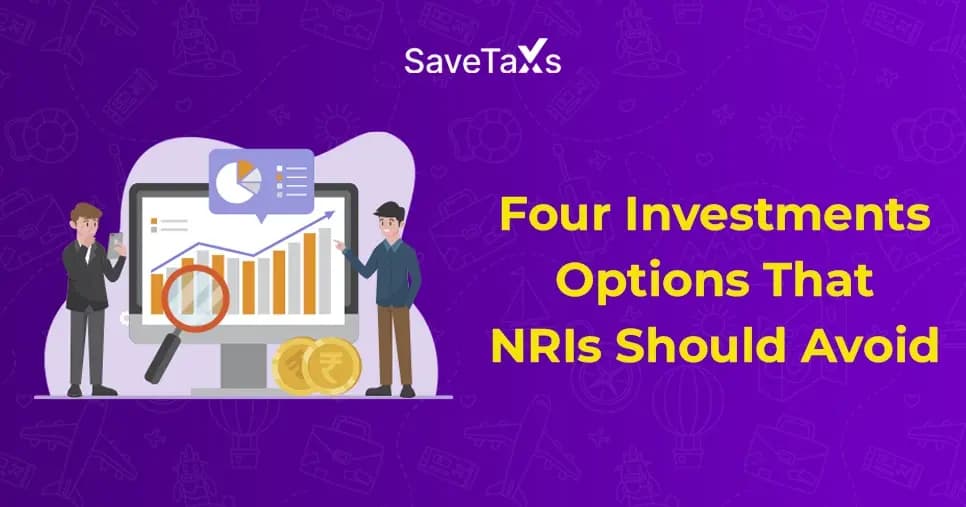
Regardless of goals and risk appetite, there are certain investments NRIs must keep at bay. Therefore, in this blog, we will discuss four investments NRIs should avoid in India, so they don't want ot attract legal hassles, tax issues, and financial losses.

This type of investment is a hybrid product that combines the best of both worlds: investment and insurance. ULIPs offer individuals a life cover along with the choice of fund to invest in. This means the premium you, as an NRI investor, pay for a ULIP is divided into two parts. The first half of your premium goes toward your life insurance coverage, while the other half is invested in your chosen market-linked funds to generate good potential returns.
Securing your life while generating good returns can be an attractive option, but NRIs must be cautious when investing in ULIPs.
High Charges: ULIPs incur multiple charges, including premium allocation, policy administration, fund management, mortality, surrender charges, and more. These charges can hinder your returns and ultimately reduce the actual value of your investment.
Lock-in period: ULIPs generally have a lock-in period of five years during which, as an investor, you cannot switch or withdraw any funds. This restriction limits the liquidity flexibility of ULIPs.
Low Returns: ULIP returns depend significantly on how the underlying funds perform, which may or may not be consistent with your investment goals.
Investment Choice: The number of investment options in ULIPs is limited, which can hinder your portfolio diversification.
Yes, investing in stocks can be all glittery, tempting, and attractive, with potentially high returns, until you step into the market and invest in the wrong stocks with little to no knowledge. Remember that what brings in high returns also brings high risks and challenges for NRIs.
Volatility Market: India's market is volatile, and this volatility affects the stock market the most. The market is prone to fluctuations, even with minor changes, in economic conditions, news, events, business performance, audience sentiment, and more. These fluctuations can cause the stock price to rise sharply or fall sharply, leaving you and your hard-earned money at the mercy of uncertainty and high volatility.
Some NRI investors like to play along with the market, given their keen understanding of how it works, including the Indian stock market.
Research, Research & Some More Research: It's said that the three Rs of investing are research, research, and research. Scouring market conditions and then investing in the right stocks requires extensive research. You have to identify among the right companies, trends, and sectors to get that one stock that fits the best for your financial goal and risk appetite. And it doesn't end here after the investment is made; regular monitoring of the stock is also needed to make a timely decision, whether to hold or sell it.
Now that the time zone of India and the NRI's country of residence might not match, this can become time-consuming for NRIs unless an NRI investment expert from India is helping you manage your stocks.
High Brokerage & Taxes: Generally, stock investments incur brokerage fees. These fees are paid to intermediaries like banks, stock brokers, or depositary receipts, which help you execute the trade. Any capital gains from stock investments are subject to tax based on their holding period: short-term capital gains or long-term capital gains.
Operational Difficulty: Operating stocks is not easy, especially when you are staying abroad and handling most of it from there.
NRIs, file your ITR in India the right way with Savetaxs.
Equity futures and options trading involves speculating on future price movements of stocks or indices by leveraging derivatives contracts. These kinds of investments are used for hedging, speculation, or, lastly, arbitrage purposes. However, equity transfers and options are not advisable for NRIs for the following reasons.
Complex: The equity F&O is a complex instrument that requires the investor to have a thorough understanding of everything, the concepts, strategies, and the risks involved. This investment product is not suitable for a novice or inexperienced investor, who may not be able to understand or manage it effectively.
High Leverage: This type of investment involves using leverage, which allows an investor to trade with a higher position size than their actual investment. This helps amplify leverage and losses, which usually depend on the stock price's momentum. Leverage can do both: increase margin requirements and risk, which forces you to liquidate at the point of loss.
High Regulation: Equity F&O is subject to strict regulations by the Reserve Bank of India (RBI) and the Securities and Exchange Board of India (SEBI) for NRIs.
As an NRI, you should follow the guidelines and regulatory framework set by the Foreign Exchange Management Act (FEMA) and the Income Tax Act for equity and F&O transactions.
Non-resident Indians (NRIs) must strictly avoid unrestricted investments and should instead look only for RBI-regulated investments.
These unregulated investments are often illegal and claim to offer high returns while carrying high risks. Some examples of unregulated investments include Agritech platforms and digitized assets such as non-fungible tokens- NFTs.
Such investments are products of a market that lacks regulatory oversight and are subject to fraudulent activities and scams. When dealing with such investments, you must take precautions and avoid investing in anything not approved by India's regulatory bodies.
Uncertain: Since these inevitabilities are unregulated and also subject to unpredictability and uncertainty. And beyond being uncertain, these investments are vulnerable to scams, hacking, loss, or theft because no security measures are in place to protect them.
Highly illiquid: These unregulated investments are highly illiquid, meaning you cannot easily convert them into cash or sell them in the market. Additionally, they usually do not have standard or transparent pricing, making the mechanism unreliable or accessible for trading.
Along with these, unregulated investments also cause delays when redeeming them, and this influence on redemption is not helpful in times of distress.
Along with this, NRIs must also be aware of the U.S.-listed ETFs, as they also have similar challenges and regulatory concerns.
Don't just invest your money make strategies to grow it.
As an NRI investing in India, it's essential to prioritize transparency, regulatory compliance, and stability. The core of a successful portfolio is to invest in the Indian market only after assessing your risk appetite, financial goals, and the investment time horizon.
However, as an NRI, it's essential to have professional guidance backing you as you are making investment decisions in the Indian market. And when it comes to NRI investment guidance, Savetaxs is the name to trust.
We have been helping NRIs across 90+ countries with their investments in India. Our experts provide personalized guidance and management throughout the investment process, from setting goals and managing risk to building a portfolio that is so proficient you can adapt to market changes easily.
Connect with us today, and let's make your NRI investment portfolio greener.
This article is for general informational purposes only and does not constitute tax, legal, financial, or investment advice. Laws, regulations, rates, and procedures may change over time and may vary based on individual circumstances.
While SaveTaxs makes reasonable efforts to keep the information accurate and up to date, readers should verify applicable rules with official authorities or consult a qualified professional before making decisions based on this information.
Shubham Jain is the Founder of SaveTaxs and has extensive experience in Indian and NRI taxation. He advises individuals, NRIs, and businesses on tax filing, tax planning, capital gains, DTAA benefits, fund repatriation, and compliance matters. He regularly writes about taxation and related financial topics. His focus is on making complex tax concepts easy to understand. Through his articles, he helps taxpayers stay informed, avoid common mistakes, and stay compliant with Indian tax laws. See Full Bio

Want to read more? Explore Blogs
_1781845771869.webp&w=828&q=75)
_1778936280179.webp&w=828&q=75)
_1778936089630.webp&w=828&q=75)