


Investment & Financial Planning
FCNR Deposit Interest Rates in 2026FCNR Deposit Interest Rates in 2026
Written by Vipul Jain


Among investors, specifically for NRIs, who due to tax implications and market fluctuations in India, face different considerations, active vs passive mutual funds have remained a topic of debate. The founder of the Vanguard Group, John Bogle, in 1976, revolutionized the industry of mutual funds by launching the first passive index fund. Since then, the discussion has started about whether active or passive funds provide better returns.
To help you out, the blog will tell you about the key differences between them, pros and cons, and the best investment options for NRIs. So read on and gather all the information.
In active mutual funds, funds are managed and monitored by the fund manager, appointed by the fund house. The fund manager constantly analyzes the individual stocks and market trends to decide which stocks to purchase, hold, or sell. These funds aim to beat their benchmark index constantly.
Active mutual funds quickly adapt to the market conditions, which is beneficial during economic fluctuations. Additionally, compared to the market index, these funds have the potential for higher returns. However, as these funds are managed by experts, their cost is quite high.
This was all about active mutual funds. Moving ahead, let's know how these funds work.
The working of active mutual funds depends on the strategies of the fund manager. It includes in-depth qualitative and quantitative analysis. Based on the following information, these funds perform well:
This is how active mutual funds work. Now, moving further, let's know about passive mutual funds.
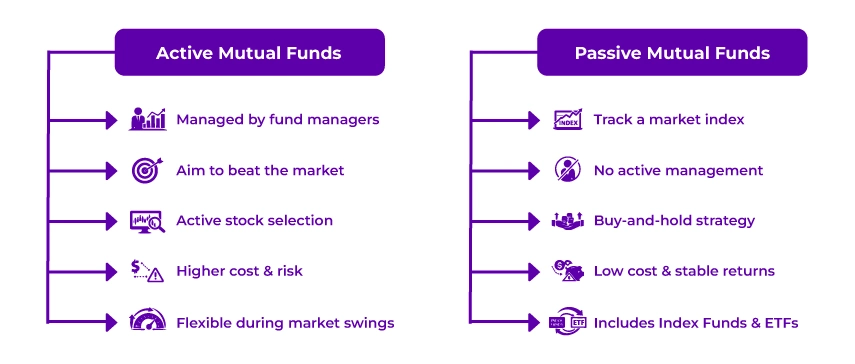
Passive mutual funds with a strategy to purchase and hold a portfolio that monitors and tracks a specific benchmark index. Here, the fund manager does not play an active role in buying and selling bonds or stocks. These funds are cost-effective compared to active funds, the expense ratio is lower, and there are little to no transaction costs.
Further, the passive funds are of two types:
Index Funds: These funds have a passive nature and imitate their respective benchmark indices. Additionally, these funds are without trying to outperform the index aim for constant performance.
Passive Exchange-Traded Funds (ETFs): These funds are traded on the stock exchange and replicate their benchmark indices. Additionally, compared to traditional mutual funds, ETFs offer more liquidity and generally have lower expense ratios. Also, to invest in these funds, you need to have a trading or demat account.
This was all about passive mutual funds. Moving ahead, let's know how these funds work.
Passive mutual funds work on a buy-and-hold strategy. This limits the transaction costs and keeps the expenses lower. This structure of the passive mutual fund attracts NRIs seeking market-matching performance without paying high fees.
Further, as mentioned above, in passive funds, the managers play a very passive and small role. Additionally, restrict themselves to purchasing and holding stocks.
So, it is how passive mutual funds work. Moving further, let's know the key difference between active and passive funds.
The table below showcases the key differences between active and passive funds:
| Sr. No. | Basis | Active Mutual Funds | Passive Mutual Funds |
|---|---|---|---|
| 1. | Investment Strategy | Outperform the benchmark index. | Copy the benchmark index. |
| 2. | Fund Manager | Have active involvement in purchasing and selling funds. | As the role of the fund manager is to mirror the index, they have low intervention. |
| 3. | Expense Ratio | Due to a high turnover ratio, it has a high expense ratio. | Due to and buy-and-hold strategy, it has a low expense ratio. |
| 4. | Risk Level | Active mutual funds have high risk, including managerial risk. | High risk, but compared to active funds, it is lower. |
| 5. | Market Efficiency | These funds assume the market is inefficient and seek for right opportunities. | These funds believe that the market is efficient and provides the desired outcomes. |
| 6. | Flexibility | Asset allocation, market timing, stock selection, and sectors | No such flexibility is available in passive mutual funds. |
These were the key differences between active and passive mutual funds. Moving ahead, let's look at the pros and cons of both mutual funds.
Here are the pros and cons of active and passive mutual funds:
These were the pros and cons of active and passive mutual funds. Now, moving further, let's know among the two funds, which one NRIs should opt for investment.
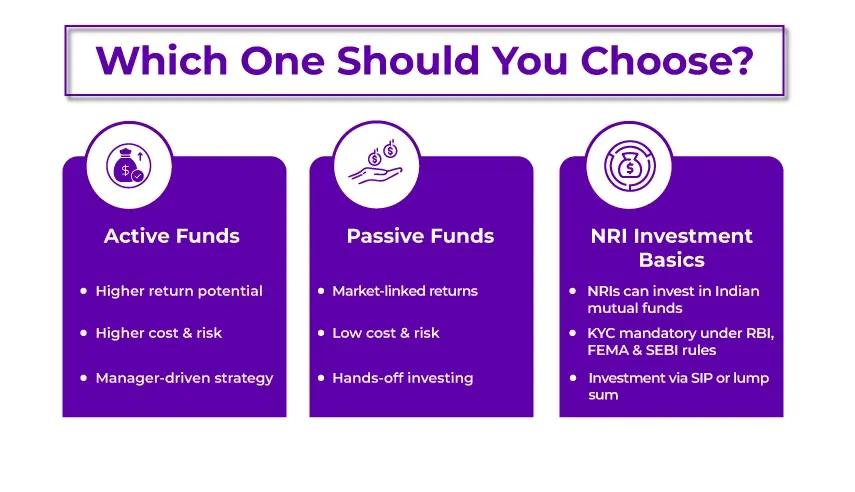
Opting between active mutual funds and passive mutual funds depends on several factors. It includes your risk tolerance, investment goal, financial goal, and investment horizon. Here to help you out, some conditions are mentioned that assist you in choosing the right investment.
Opt Active Mutual Funds If:
Opt for Passive Mutual Funds If:
These are some of the conditions that can assist you in choosing between active and passive mutual funds. Moving ahead, let's know how NRIs can invest in these funds.
Resolve your tax issues and file your taxes simply with the expert guidance of Savetaxs.
NRIs in Indian markets can legally invest in mutual funds. However, for investment, they need to fulfill a few rules and regulations. It includes completing your mutual fund KYC, along with adhering to the rules of the RBI, FEMA, and SEBI. Once you complete your KYC, you can invest in all the mutual fund schemes provided by AMCs via lump sum or SIPs. Mutual fund KYC is one of the mandatory requirements that you need to fulfill when you invest in mutual funds in India.
Further, the Securities and Exchange Board of India (SEBI) under the Prevention of Money Laundering Act (PMLA), 2002, has specified a set of regulations. It states that intermediaries and mutual fund houses, before they are ready to make investments, complete their due diligence on investors.
This is how NRIs can invest in active and passive funds.
Lastly, due to low cost and simplicity, the popularity of passive mutual funds over the years has increased. On the other hand, active mutual funds are a good option if you believe in the fundamental and technical analysis of the fund manager in investments. In active vs passive mutual funds, it totally depends on your financial goals, investment strategy, and risk tolerance, which is the best option for NRIs.
Furthermore, if you are still confused and looking for reliable NRI investment guidance, connect with Savetaxs. We have a team of financial experts who help you choose the best investment option as per your goals. So, contact us today and begin your investment journey in India with clarity and confidence.
This article is for general informational purposes only and does not constitute tax, legal, financial, or investment advice. Laws, regulations, rates, and procedures may change over time and may vary based on individual circumstances.
While SaveTaxs makes reasonable efforts to keep the information accurate and up to date, readers should verify applicable rules with official authorities or consult a qualified professional before making decisions based on this information.
Shubham Jain is the Founder of SaveTaxs and has extensive experience in Indian and NRI taxation. He advises individuals, NRIs, and businesses on tax filing, tax planning, capital gains, DTAA benefits, fund repatriation, and compliance matters. He regularly writes about taxation and related financial topics. His focus is on making complex tax concepts easy to understand. Through his articles, he helps taxpayers stay informed, avoid common mistakes, and stay compliant with Indian tax laws. See Full Bio

Want to read more? Explore Blogs
_1781845771869.webp&w=828&q=75)
_1778936280179.webp&w=828&q=75)
_1778936089630.webp&w=828&q=75)