US Tax Filing and Compliance
FEIE Reporting Errors: Corrective Measures for NRIsFEIE Reporting Errors: Corrective Measures for NRIs
Written by Hatim Dudhiyawala
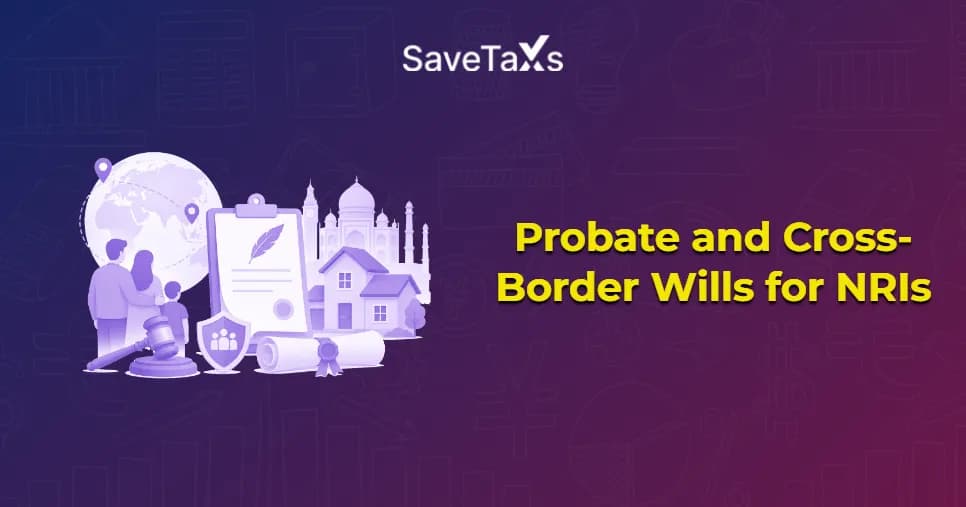
Imagine you are an NRI living in the US and your parents live in India. They passed away and left their property, investments, and bank accounts in India to you. You assume that, under their will, you can simply get those assets. However, this is not how it works. To transfer and administer inherited Indian assets, you may need to establish the validity of the will and complete the applicable succession and asset-transfer procedures. Since Section 213 of the Indian Succession Act was omitted effective December 20, 2025, probate is no longer universally mandatory, although it may still be useful or requested in particular cases.
Confused? What is it and how does it help in your cross-border property dispute in India? This guide explains how cross-border wills interact with Indian succession procedures, when probate may be relevant, and how NRIs can plan the transfer of Indian assets more efficiently.
A cross-border will covers assets an individual holds in more than one country. It is also known as an international will. It includes multiple jurisdictions such as bank accounts, property, or investments held overseas. Each country imposes its own laws on assets you hold there. Because assets in different countries can be subject to different legal and procedural requirements, a cross-border will should be carefully coordinated with the laws applicable to each jurisdiction.
A single will covering assets in multiple jurisdictions can require additional legal and administrative steps because each country may apply its own rules.
For instance, if you draft a will under U.S. law that also covers property in India, the will may still need to satisfy applicable Indian legal and procedural requirements when it is relied upon for the Indian property, which can make administration more complex.
A cross-border will can be valid and effective, but its administration may involve the laws and procedures of more than one jurisdiction. The key is to ensure that the will is properly drafted and coordinated with the rules applicable to each country's assets.
Connect with Savetaxs and fulfill your US tax obligations on time, without any issues.
NRIs may consider separate, carefully coordinated wills for assets in different countries where this structure can simplify local estate administration. However, a single properly drafted will may also be appropriate depending on the assets, jurisdictions, and applicable laws.
The right structure depends on the assets, jurisdictions, and applicable succession and estate-administration rules. The next question is how probate fits into this process for Indian assets.
Probate is a court-granted process through which a will is established for estate-administration purposes and the executor receives authority to administer the estate according to the will. A will executed outside India may still need to satisfy applicable Indian legal and procedural requirements when it is relied upon for Indian assets. Since Section 213 of the Indian Succession Act, 1925 was omitted with effect from December 20, 2025, probate is no longer universally mandatory under that provision. However, probate or another court order may still be relevant in particular circumstances, and banks, registries, housing societies, or other institutions may have their own documentation requirements. The ability to sell, transfer, rent, or otherwise deal with a particular asset may also depend on title records, co-ownership, registration requirements, and other applicable laws.
The Repealing and Amending Act, 2025 omitted Section 213 of the Indian Succession Act, removing the statutory requirement under that provision that probate be obtained before certain rights as executor or legatee could be established. The change applies generally and is not limited to NRIs or to a particular religious community.
Understanding the role of probate is only one part of cross-border inheritance. The next step is to consider how a will executed outside India can be used in connection with Indian assets.
Getting a correct and recognized will across borders generally includes:
If there is no will, the applicable succession process depends on the deceased's personal law, the type of asset, and the circumstances of the estate. Letters of administration may be relevant where court administration is required, while a succession certificate is primarily used for specified debts and securities. A succession certificate does not, by itself, transfer title to immovable property; property may require separate mutation, registration, or other transfer procedures.
Property and other assets may require separate transfer, mutation, registration, or institutional procedures. To handle the process smoothly, it is essential to seek financial advice.
So, this is how wills for NRIs with Indian assets are executed and validated across countries. Moving ahead, let's know why cross-border estate planning for NRIs is important.
For an Indian resident holding only Indian assets, estate planning may involve fewer cross-border complications, although the applicable succession, property, tax, and asset-specific rules can still make the process complex. For NRIs, the same thing is divided into two legal systems: India and their country of residence, and managing it alone without proper planning becomes quite difficult. Additionally, Indian property is controlled by Indian succession law under the lex situs principle. Considering this, it often creates a few genuine complications for them, such as:
Without proper coordination, these differences can lead to additional documentation, procedural delays, or disputes over how the estate should be administered. Now, moving ahead, let's look at the common mistakes NRIs should avoid when creating cross-border wills.
Here are some common mistakes NRIs should avoid with cross-border wills:
Confused? Let's better understand it with an example.
Ramesh, a green card holder in the US, owns an inherited flat of his parents in Chennai. He also has home and retirement accounts in the US. He thought of drafting a single cross-border will covering all his Indian and US assets.
However, after consulting with his US estate attorney and Indian lawyer, he learned that Indian immovable property would still need to be administered under the applicable Indian legal and procedural framework, even if his US will also referred to that property. Additionally, the Indian authorities may require documents or information in a form that satisfies their applicable Indian procedural requirements, even when the underlying will was prepared in the United States.
He also learned that Section 213 of the Indian Succession Act was omitted by the Repealing and Amending Act, 2025, so probate is no longer universally required under that provision. However, his housing society may still require probate or another appropriate succession document under its internal transfer procedure.
To simplify the administration of his assets, he chose two separate, carefully coordinated wills—one covering his Indian assets and another covering his U.S. assets. Both wills clearly identified the assets they covered and were drafted to reduce the risk of overlap or unintended revocation. Tax consequences were analyzed separately under the laws of the relevant jurisdictions.
Ramesh's situation illustrates why the appropriate estate-planning structure should be determined based on the assets and jurisdictions involved rather than assuming that either one global will or two separate wills is always the correct solution.
At Savetaxs, get personalized guidance with a proper action plan according to your financial situation in India.
For NRIs with assets in multiple countries, effective estate planning requires coordination between the succession, property, tax, FEMA, and estate-administration rules applicable to each jurisdiction. Depending on the assets and countries involved, separate wills may simplify local administration, while a single properly drafted will may also be appropriate.
Further, if you need cross-border estate planning to navigate the complex issues of cross-border inheritance, connect with Savetaxs. The financial experts on our team help NRIs understand the tax and repatriation rules of India and foreign countries, and provide legal expertise for probate and wills for NRIs. So, reach out to us and get a clear image of what you should do as per your specific situation.
Note: This guide is for information purposes only. The views expressed in this guide are personal and do not constitute the views of Savetaxs. Savetaxs or the author will not be responsible for any direct or indirect loss incurred by the reader for taking any decision based on the information or the contents. It is advisable to consult either a CA, CS, CPA or a professional tax expert from the Savetaxs team, as they are familiar with the current regulations and help you make accurate decisions and maintain accuracy throughout the whole process.
Hatim Dudhiyawala is a Certified Public Accountant (CPA) with SaveTaxs and specializes in Indian and NRI taxation. He advises individuals, NRIs, and businesses on income tax filing, capital gains taxation, DTAA benefits, fund repatriation, and tax compliance. With experience in cross-border tax matters, Hatim helps taxpayers understand complex regulations and make informed decisions. Through his articles, he shares practical insights to help readers stay compliant and manage their tax obligations with confidence. See Full Bio

Want to read more? Explore Blogs