-for-401(k)_1790057066765.webp&w=828&q=75)
US Tax Filing and Compliance
Net Unrealized Appreciation (NUA) for 401(k): A Guide for NRIs Moving to IndiaNet Unrealized Appreciation (NUA) for 401(k): A Guide for NRIs Moving to India
Written by Vipul Jain

_1786539605834.webp&w=3840&q=75)
Dual tax residency is when you have strong financial ties in two different countries and both countries treat you as a tax resident during the same tax year. You must be thinking that the term "dual tax resident" indicates that you are liable to pay tax twice on all your income; don't worry, that's not the case. Even though your filing and reporting responsibilities do increase if you have dual tax residency, there is relief available. There are various tax treaties and relief mechanisms designed to prevent an individual from being taxed twice.
That being said, it's very important for every individual to understand how dual tax residency works, regardless of whether you are a green card holder who returned home or a U.S. citizen living in India. In this blog, we will learn the concept of dual tax residency, how it works, what it means for you, and the steps you need to take to ensure compliance.
Being a dual tax resident does not automatically mean paying tax twice. It means two countries may have a claim to tax the same income, while domestic rules, tax treaties, foreign tax credits, and other relief provisions determine how double taxation is reduced.
| Concept | Meaning |
|---|---|
| Dual Tax Residency |
Two countries treat you as a tax resident under their domestic laws
|
| Dual Taxation | The same income is taxed by both countries |
| Tax Treaty | Provides rules for resolving overlapping taxation |
| Foreign Tax Credit |
May reduce tax in one country for qualifying tax paid to the other
|
| Tie-Breaker |
May determine treaty residence when an individual is resident under both countries' domestic laws
|
Dual tax residency is when you are treated as a tax resident by two countries during the same tax year. It's possible for an individual to qualify as a resident in both places at the same time because every country has its own set of residency rules. To clear up the confusion, let's use an example.
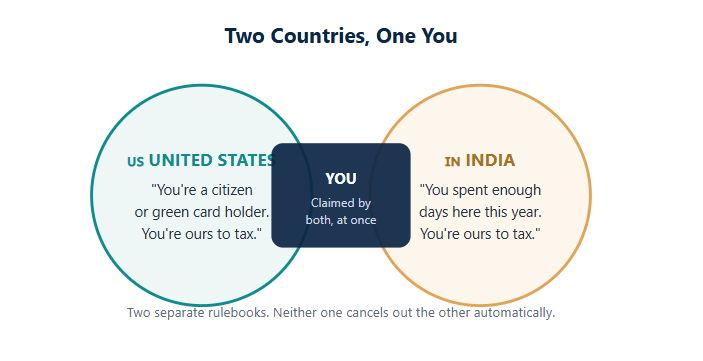
For example, in India, your tax residency will be determined mainly based on how many days you spend in the country, along with some other conditions. Conversely, in the United States, green card holders and US citizens will be treated as US tax residents, irrespective of where they reside. Therefore, it's very normal for a person to become a tax resident of both the US and India legally at once. Considering this, both countries may have the authority to tax either some or all of your income.
However, that doesn't mean you automatically become liable to pay tax twice. Instead, you will likely face additional tax filing, reporting, and compliance requirements in both countries.
Now comes the main confusion: why does this situation occur? It's because every country has its own method to identify a tax resident. Let's understand this in detail.
Each country has its own rules and methods for determining who qualifies as a tax resident, which can lead an individual to be treated as a dual tax resident.
In the United States, there is a citizenship-based taxation system. This means that if you are a US citizen or a green card holder, you will be obliged to comply with US tax rules, regardless of whether you live abroad permanently.
Conversely, India works on a residency-based taxation system. In this case, your tax residency is determined by considering the number of days you stay in India during a financial year. It also requires you to fulfill certain conditions under Indian tax law.
Both the rules work independently, which means you can easily satisfy both countries' requirements in the same year. This situation commonly occurs when:
If you find yourself in any of these situations, remember that both countries may consider you a tax resident, which will result in dual tax residency.
"I got the dual tax residency status. Will I face any changes"? Well, that's a very common question, and the answer is yes. Let's see the changes that occur when you become a dual tax resident.
Once you become a dual tax resident, it's not necessary that your tax bill will increase. However, your compliance responsibilities will surely increase based on your situation. You may need to fulfill the below-mentioned requirements based on your circumstances:
These additional requirements are very common for individuals who have cross-border financial ties. You must ensure you plan everything properly to stay compliant while reducing any unnecessary taxes and avoiding penalties.
Now, the biggest fear that people have when they hear dual taxation is paying tax twice on the same income. Fortunately, there are mechanisms that can help you either avoid or reduce the risk of double taxation. Moving forward, we will learn what these mechanisms are.
As discussed, the biggest concern for people with dual taxation is being taxed twice on the same income in two different countries. However, the good thing is that there are mechanisms between India and the US that can help reduce or prevent double taxation entirely.
When you have paid income tax in one country, you may be eligible to claim a foreign tax credit in the other country. Using this mechanism, you can reduce your overall tax liability by offsetting either some or all of the taxes that you have paid already.
Under the Foreign Earned Income Exclusion, eligible US taxpayers who reside abroad may qualify to exclude a portion of their foreign employment income from US taxation. However, this mechanism is subject to certain annual limits set by the IRS.
When a person qualifies as a tax resident in both India and the United States simultaneously, the India-US DTAA follows a tie-breaker test to determine your treaty residence. Under these rules, various factors are considered, such as your permanent home, personal and economic ties, and habitual place of residence.
It's important not to confuse yourself. Keep in mind that these treaty provisions do help determine how the tax relief is applied, but they do not necessarily eliminate the US filing obligation for US citizens and many green card holders.

To understand everything better, let's use an example.
Joicy worked in the US on a work visa for eight years and got a green card. After that, she decided to move back to Mumbai to spend more time with her family, stay close to them, and find a job there. Once she moved back, she still retained the green card, but she just hadn't used it in years.
This is where it all started. So since she still has a green card, the US considers her a tax resident. But now that she lives in India permanently, she is treated as an Indian resident as well. This situation means that she's a dual tax resident, even if she has no plans to move back to the US again.
So, every year, Joicy files an Indian tax return on her Indian salary along with a US tax return to report that same salary plus any other global income. However, for the Indian tax she's already paid, she claims a US tax credit, helping her bring her tax bill almost to zero in most years.
She also manages her Indian mutual funds and even files a separate form that is not related to how much tax she owes. This is where she reports her Indian bank accounts to the US government.
Consider this example to understand that even if you are an NR moving back to India, the dual tax residency triggers additional responsibilities. Next, suppose you are a green card holder and were enjoying peace of mind thinking that the treaty will help you prevent double taxation, but then comes a surprise. The US asks you to pay tax even after claiming the treaty. Don't worry, let's clear this confusion.
This is one situation where people often get confused and surprised. You use the "tie-breaker" to ensure that India is your real tax home. However, here comes the catch: the US has the authority to tax its own citizens and green cardholders, even if you claim the rule.
In easy words, if you are a US citizen, you become liable to follow the country's rules, and you simply can't avoid them just because you moved away. Regardless of which country the tie-breaker rule states as your real tax home, the US will keep taxing your global income and expect you to file a return every year.
The tie-breaker rule doesn't affect the decision of whether you need to file with the US at all; instead, it affects the calculation of the relief (the tax credit).
Apart from this major surprise, there are a few other tax issues that dual residents must stay aware of. Let's discuss these rules.
Similar to how the US may overlook the "tie-breaker" rule, there are other tax rules that dual tax residents must also stay aware of.
Under US tax law, most Indian mutual funds are treated as passive foreign investment companies (PFICs). As a result, you may face complex reporting requirements and higher US taxes than anticipated.
In India, retirement and savings schemes get favorable tax treatment, such as the National Pension System (NPS) and Public Provident Fund (PPF). However, these benefits are not automatically considered by the US, and their tax treatment depends on your specific situation.
If you own US assets (stocks, real estate, etc.), your estate may become subject to US estate tax rules. As the gap here is about domicile, not citizenship; a green card holder who has relocated abroad and no longer intends to return may be treated as a non-domiciliary for estate tax purposes, facing a $60,000 exemption on US-situs assets instead of the multi-million-dollar exemption available to US domiciliaries. This can catch long-departed green card holders off guard.
Several countries follow totalization agreements, but India and the United States don't. As a consequence, certain self-employed individuals or cross-border workers may face social security obligations in both countries.
You can easily avoid potential taxes, penalties, and reporting errors by understanding these rules early and following them carefully.
Lastly, we will understand what you must do if you are a dual tax resident.
Managing dual tax residency doesn't have to be a task. You can make the process easy by following a few practices, which are as follows:
The simple factor to manage dual tax residency is to plan everything properly. This will help you reduce your tax burden while also ensuring that you stay compliant with both US and Indian tax laws.
From determining residency status to tax filing, Savetaxs can simplify your cross-border tax obligations.
Although dual tax residency brings in additional requirements, it doesn't mandate you to pay tax twice on the same income. For every dual tax resident, the biggest challenge is understanding their filing obligations and claiming relief using the foreign tax credit, India-US DTAA, and foreign earned income exclusion treaties.
If you are an NRI moving back to India, a US citizen, or someone with cross-border financial ties, you must carefully review your tax residency every year. You must also stay compliant with all the other requirements to prevent any issues or costly mistakes.
Moreover, it's advised to consult a cross-border tax professional to better understand your tax situation. When it comes to experts, there's no website more reliable than Savetaxs.
At Savetaxs, we have an entire team of experts who can help NRIs and US taxpayers determine their tax residency, claim all eligible benefits, avoid the risk of double taxation, and ensure compliance with both countries' laws. Connect with us right away and fulfill your tax obligations with confidence while also reducing your overall tax burden.
This article is for general informational purposes only and does not constitute tax, legal, financial, or investment advice. Laws, regulations, rates, and procedures may change over time and may vary based on individual circumstances.
While SaveTaxs makes reasonable efforts to keep the information accurate and up to date, readers should verify applicable rules with official authorities or consult a qualified professional before making decisions based on this information.
Vipul Jain is the Co-Founder of SaveTaxs and a tax expert with experience in Indian and NRI taxation. He advises individuals, NRIs, and businesses on tax filing, tax planning, capital gains, DTAA, and compliance matters. He focuses on making complex tax concepts simple and helping taxpayers make informed, compliant decisions. See Full Bio

Want to read more? Explore Blogs