

US Tax Filing and Compliance
FBAR Filing Deadline 2026: October 15 Extension & RulesFBAR Filing Deadline 2026: October 15 Extension & Rules
Written by Shubham Jain

_1786964607070.webp&w=3840&q=75)
Who doesn't love coming back to their home, their roots, and their India after several years of living abroad? Yes, this journey can be exciting and overwhelming, but it can also trigger certain tax residency questions. Among many questions that frequently come up for NRIs returning to India is the RNOR (Resident But Not Ordinarily Resident) status.
Understanding the residency status of an RNOR is important for NRIs returning to India, as it significantly affects how their foreign income will be taxed in India. Furthermore, for NRIs returning to India who hold US pension investments, bank accounts, other overseas investments, and other overseas income, their residential status transitions from NRI to RNOR, and they will face certain tax implications. In this guide, we will understand the tax implications and RNOR tax benefits, who may qualify for this status, and how efficiently you can plan for this period.
The Income-tax Act, 2025 applies to tax years beginning on or after April 1, 2026. The Income Tax Department has confirmed that the core RNOR criteria have not changed. An individual can qualify as not ordinarily resident if they were non-resident in 9 out of the 10 preceding tax years or were in India for 729 days or less during the preceding 7 tax years.
For tax years beginning before April 1, 2026, residential status continues to be determined under the Income-tax Act, 1961. The earlier years can still be relevant when applying the continuity-based RNOR tests under the new Act.
With respect to Indian tax law, the tax year runs from April to March. Here, the term "year of return" simply refers to the financial year in which you physically moved back to India with the intention of staying for the long term. The maintained year count in India exceeds a certain threshold that makes you an Indian resident again, after the years you have spent as an NRI.
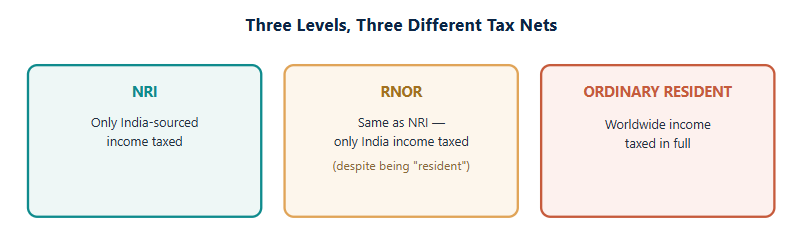
Generally, under Indian tax law, once you become an Indian resident, your worldwide income is taxable in India, including your foreign salary, investments, and stock holdings. Now, if the residential status of an Indian resident is applied fully and immediately in the tax year when you are returning to India, it can catch a lot of your hard-earned income and assets off guard. Which is why the Indian tax authorities understand this loophole and have made an exception for returning NRIs with a specific transition status.
RNOR is a transitional residential status that can restrict the taxation of certain foreign-source income in India. However, RNOR does not mean that all foreign income is automatically exempt. Foreign income can still be taxable in India if it is received or deemed to be received in India, deemed to accrue or arise in India, or is derived from a business controlled in India or a profession set up in India.
Before checking RNOR, you must first determine whether you are resident in India for the relevant tax year. Under the current rules, an individual generally becomes resident if they are in India for 182 days or more during the relevant year, or if they satisfy the applicable 60-day plus 365-day test, subject to special rules for Indian citizens, persons of Indian origin and certain other situations.
Therefore, simply moving back to India does not automatically make you RNOR. The number of days spent in India and your specific circumstances must first be evaluated.
Savetaxs helps NRIs file their taxes in India with utmost precision.
For a returning NRI who becomes resident in India, the two most commonly relevant RNOR tests are whether the individual was non-resident in 9 out of the 10 preceding tax years or was in India for 729 days or less during the preceding 7 tax years. The Income-tax Act, 2025 also contains additional rules that can result in an individual being treated as not ordinarily resident in specific circumstances.
People living abroad for several consecutive years often meet at least one of the RNOR requirements mentioned above.
RNOR is not automatically granted for a fixed number of years. Residential status is determined separately for each tax year. Therefore, a returning NRI should reassess their residential status and RNOR eligibility every year.
A person who has spent many years outside India may continue to satisfy the RNOR conditions for more than one year after returning, but the exact period depends on the individual's residence history and the applicable statutory tests.
Your timing in returning to India generally matters because the RNOR has the power to limit Indian taxation of your foreign income; however, along with this, the timing of your financial decision may also matter. For instance, selling the foreign investments, receiving deferred compensation, or restructuring the overseas investments all of this can have a different tax treatment based on what your residential status says, whether you are an NRI, RNOR, or ROR when the income is received, or when it arises. Therefore, it is advisable to review your major transactions before your residential status changes.
Kartik has lived in the US for 12 years while working, and he plans to return to Chennai to be with his parents and become an Indian tax resident based on his stay in India during the relevant tax year of return. During his RNOR period, qualifying foreign-source income may remain outside the Indian tax net, but this depends on the source, receipt, nature of the income, and whether it is connected with a business controlled from India or a profession set up in India.
During his RNOR period, certain foreign income from these US investments will not fall within the Indian tax scope under certain rules on the source of income, receipt, and the nature of the Income. Hereafter, he will review all of these foreign investments before the RNOR status ends.
The following is a checklist for NRIs to follow when returning to India after spending several years abroad:
NRIs returning to India, plan and structure your finances and taxes smartly with Savetaxs.
For NRIs returning to India after living several years abroad, The "year of return" is not a separate statutory tax status. It is simply a convenient term for the tax year in which a returning NRI comes back to India. For that year, the individual must first determine whether they are Resident or Non-Resident under the applicable stay and other rules. If they are resident, they must then determine whether they qualify as RNOR or are Resident and Ordinarily Resident (ROR).
As an NRI, if you are planning to return to India before booking your ticket, plan and check your residential status, the eligibility of the RNOR status in your case, your investments and foreign income sources, and make a sturdy financial plan to ensure you end up making the best of your RNOR status.
Now, as the RNOR status is temporary, it is strongly advisable to have good financial planning during this period to avoid any unexpected tax consequences later. One such tax professional who can help NRIs make the best of their transition status is Savetaxs. Their tax expertise will help NRIs returning to India understand the RNOR eligibility, tax residency, foreign income sources, overseas assets, and India-US tax implications.
Connect with us today as we serve our clients 24/7 across all time zones.
This article is for general informational purposes only and does not constitute tax, legal, financial, or investment advice. Laws, regulations, rates, and procedures may change over time and may vary based on individual circumstances.
While SaveTaxs makes reasonable efforts to keep the information accurate and up to date, readers should verify applicable rules with official authorities or consult a qualified professional before making decisions based on this information.
Vipul Jain is the Co-Founder of SaveTaxs and a tax expert with experience in Indian and NRI taxation. He advises individuals, NRIs, and businesses on tax filing, tax planning, capital gains, DTAA, and compliance matters. He focuses on making complex tax concepts simple and helping taxpayers make informed, compliant decisions. See Full Bio
Want to read more? Explore Blogs

-for-401(k)_1790057066765.webp&w=828&q=75)