NRI Income Tax Compliance
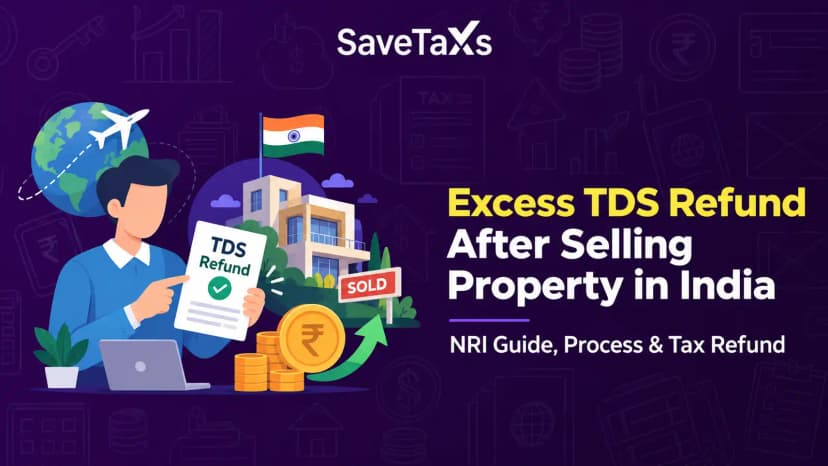
How to Claim Excess TDS Refund After Selling Property in India as an NRIHow to Claim Excess TDS Refund After Selling Property in India as an NRI
Written by Shubham Jain

-(1)_1785327607052.webp&w=3840&q=75)
Submitting your Income Tax Return (ITR) doesn't automatically mean your tax journey is over. If you overpaid tax through tax deducted at source (TDS), Tax Collected at Source (TCS), Advance tax, or self-assessment tax, you can claim a refund. However, it is processed only when the Income Tax Department completes its mandatory verification checks and the taxpayer e-verifies the filed return successfully.
After e-verification, the refund is credited to the taxpayer's bank account within 4-5 weeks (in most cases). Taxpayers can keep track of the income tax refund status through the Income Tax e-filing portal to stay aware of any delays or failures. But the question is: how can you track your refund status? Keep reading further to know the steps to check your income tax refund status, reasons for refund failure, and things to do after a delay in refund.
Before starting the refund tracking process, ensure you have a valid user ID and password for the income tax e-filing portal. Also, you must make sure that your PAN is linked to Aadhaar and you have filed an ITR to claim a refund. After that, follow the steps below to track your income tax refund status:
The status may show that your return is being processed, refund has been issued, partially or fully adjusted, or has failed. You can also check the lifecycle of the filed return.
According to the Income Tax Department, there can be several reasons for income tax refund failures. The most common reason is the taxpayer's PAN being inoperative due to non-linking with Aadhaar.
The portal will display a warning message in such a situation, and the refund will not be processed until you complete the PAN-Aadhaar linking process. Apart from this, other reasons for income tax refund failure can be;
If you have not received your refund within the expected timeframe, check your status online to confirm that no further action is needed. Also, check your registered email or notices from the Income Tax Department, as they may include information about any mismatch on the return or additional verification requirements.
Link your PAN with Aadhaar and ensure that the bank account you provide for receiving the refund is pre-validated. Further, fill in your bank details accurately to avoid refund delays or failures.
Get professional support from Savetaxs and simplify the ITR Filing process.
Filing your ITR is only a part of the filing process. You also need to ensure your refund is credited correctly, your PAN is linked to Aadhaar, successful e-verification, and timely follow-up. You can prevent delays in refund with a quick pre-submission checklist. If your refund is delayed or failed, don't worry; check your status on the portal, resolve any mismatches or issues, and revalidate your bank account.
Further, if you need expert assistance with filing your ITR or facing issues with the income tax refund, connect with Savetaxs. Our team can help with the entire ITR filing process, e-verification, and even income tax refund status tracking. Contact us today, as we are actively working 24/7 to ensure your refund reaches you without any unnecessary delays.
This article is for general informational purposes only and does not constitute tax, legal, financial, or investment advice. Laws, regulations, rates, and procedures may change over time and may vary based on individual circumstances.
While SaveTaxs makes reasonable efforts to keep the information accurate and up to date, readers should verify applicable rules with official authorities or consult a qualified professional before making decisions based on this information.
Shubham Jain is the Founder of SaveTaxs and has extensive experience in Indian and NRI taxation. He advises individuals, NRIs, and businesses on tax filing, tax planning, capital gains, DTAA benefits, fund repatriation, and compliance matters. He regularly writes about taxation and related financial topics. His focus is on making complex tax concepts easy to understand. Through his articles, he helps taxpayers stay informed, avoid common mistakes, and stay compliant with Indian tax laws. See Full Bio
Want to read more? Explore Blogs