
US Tax Filing and Compliance
S Corporation Salary vs Distributions: How Owners Should Pay ThemselvesS Corporation Salary vs Distributions: How Owners Should Pay Themselves
Written by Shubham Jain

Suppose you are a U.S. taxpayer working in New York and you receive an email from your Indian stockbroker saying your account has been frozen because your FATCA declaration is incomplete. Like you, many NRIs may not fully understand cross-border reporting obligations.
If you are a U.S. taxpayer investing as an NRI in India, you must know the FATCA Form 8938 filing deadlines. If you meet the applicable reporting requirements, filing this form is a legal obligation. A broker’s FATCA declaration and IRS Form 8938 are separate compliance requirements. You file Form 8938 with your annual U.S. income tax return.
So, want to know more about the FATCA Form 8938 filing deadline in detail? Read the blog for answers.
The due date for filing FATCA Form 8938 is generally the same as the federal income tax return: April 15. However, if you are a qualifying U.S. citizen or resident alien living abroad, you may get an automatic two-month extension, so you have until June 15 to file Form 8938. If you need more time to file, complete IRS Form 4868 by the applicable deadline for requesting an extension, generally April 15 or June 15 for eligible taxpayers using the automatic overseas extension. This generally extends the filing deadline until October 15. Let's take a quick overview of it with the table below:
| Your Situation | Form 8938 Deadline | Available Extension |
|---|---|---|
| U.S. citizen or resident alien not qualifying for the overseas extension | April 15 | October 15 (File Form 4868 by April 15) |
| Eligible U.S. citizen or resident alien living abroad | June 15 (automatic) | October 15 (file Form 4868 by June 15) |
| Active military in a combat zone | Special rules apply | Generally, at least 180 days after leaving the combat zone, subject to applicable rules |
Unlike FBAR, there is no separate filing system for Form 8938. Attach Form 8938 to your applicable federal income tax return and submit them together. These deadlines generally also remain the same for U.S. citizens living in India as an NRI, subject to the applicable extension conditions.
For instance, suppose Rahul is a U.S. citizen or resident alien living in India as an NRI. He recently moved to India and fulfills the IRS conditions for a two-month automatic extension. Now, instead of filing the tax return and Form 8938 on April 15, he can file on June 15.
Also, if you are not sure whether you should complete Form 8938, read our blog on IRS Form 8938, from reporting threshold to filing requirements, for a detailed overview.
For the automatic two-month extension, what matters is his U.S. tax status and whether he meets the extension conditions. Being an NRI alone does not qualify him for an automatic extension.
This was all about the IRS Form 8938 due date. The dates mentioned apply to individual U.S. taxpayers filing calendar-year returns. Depending on your taxpayer status, return type, or special IRS relief, different rules may apply. Moving ahead, let's know whether the June extension also extends the payment deadline.
At Savetaxs, we help you determine your U.S. tax obligation based on your residential status and file your taxes on time.
Yes, eligible U.S. citizens and resident aliens living abroad may receive an automatic two-month extension to pay federal income tax, generally until June 15. However, interest on unpaid taxes generally accrues from April 15, the original payment due date. This is an important distinction for eligible U.S. taxpayers who qualify for the two-month extension.
Hence, while living in India as an NRI, do not assume that the two-month automatic extension gives you an interest-free period to pay taxes. Now, moving further, let's find out whether Form 4868 extends the Form 8938 deadline.
Yes, Form 4868 also extends the Form 8938 deadline. This form is an application for an automatic extension of time to file a U.S. individual tax return. By filing Form 4868, you generally get a six-month extension, until October 15 for calendar-year taxpayers, to file both your tax return and FATCA reporting.
Additionally, this form is also available for U.S. taxpayers living overseas. They can also use this form if they need more time to file their tax returns and report foreign income and assets. However, their extension period generally remains until October 15. Eligible taxpayers living abroad who qualify for the automatic two-month extension generally need to file Form 4868 by June 15 to obtain this additional filing time.
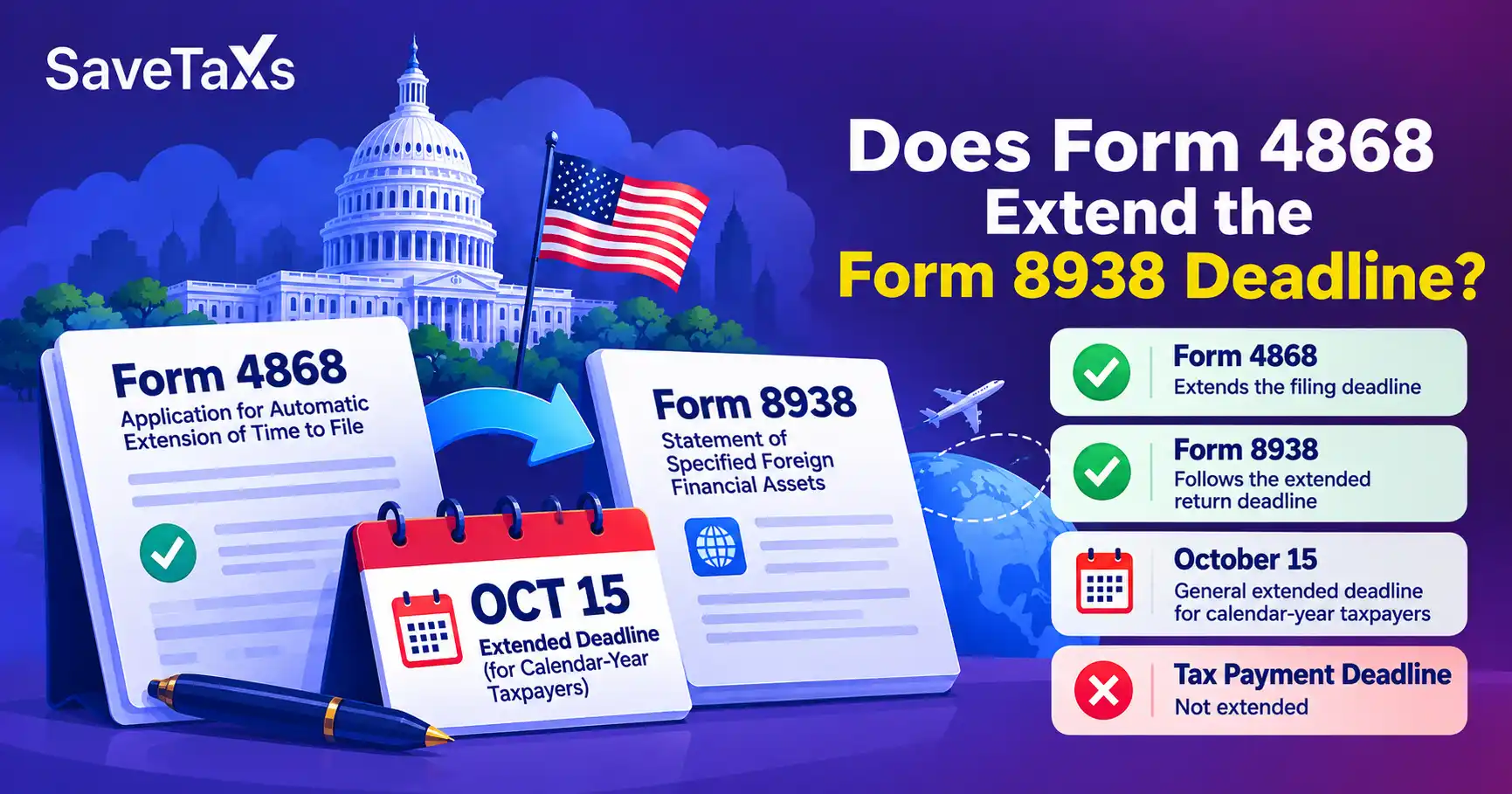
No, Form 4868 does not extend the payment deadline; it extends your filing deadline. If you pay late, you may face interest and IRS penalties on your unpaid taxes. If you're unsure about your tax obligations, estimate them and pay by the applicable payment deadline. This further helps you avoid unnecessary interest and penalties on unpaid taxes.
So, based on the information above, it is clear that a valid Form 4868 extension also extends the Form 8938 deadline. Moving forward, let's find out whether an NRI can get more time after October 15.
Qualifying U.S. taxpayers living outside the country can request a discretionary two-month extension until December 15 after October 15. However, this is not the same as Form 4868, where you fill out the form and get an extension. Under it, you need to send a letter to the IRS explaining why you need the extension. You must submit this letter by the applicable extended deadline, generally October 15 for calendar-year individual taxpayers.
Additionally, some U.S. taxpayers face restrictions. For instance, the IRS says the December 15 extension isn't available to U.S. taxpayers who have an approved extension on IRS Form 2350.
So yes, an eligible U.S. taxpayer living abroad may get more time after October 15 if they meet the applicable requirements. However, this is not an automatic extension like Form 4868; they must request it from the IRS and explain the reason. Now, moving ahead, let's consider what happens if you miss the Form 8938 filing deadline.
If you miss the Form 8938 filing deadline, you could face significant IRS penalties. The initial penalty starts at $10,000 for failing to file the form by the due date, including applicable extensions. If you do not file a complete and correct form within 90 days after receiving an IRS notice, an additional $10,000 penalty may apply for each subsequent 30-day period, or part of a period, that you fail to file. These additional penalties can be up to $50,000.

However, if you have reasonable cause, you may be relieved of penalties. Additionally, under Internal Revenue Code Section 7203, a willful failure to comply with applicable tax obligations may result in criminal consequences, including:
These criminal consequences are not automatic for every late Form 8938 filing and depend on the applicable legal requirements.
Now, let's look at what you should do after missing the deadline.
Don't wait for the IRS notice; review your filing situation and take corrective action promptly. The correct action depends on your circumstances, including:
If you fail to attach Form 8938 to your U.S. tax return, correcting this mistake may include filing an amended return with the form attached, depending on your circumstances and applicable IRS procedures. The right action depends on the facts, not just on filing Form 8938 and submitting it to the IRS.
The CPAs and Enrolled Agents at Savetaxs help U.S. expats file Form 8938 accurately and avoid IRS penalties.
Lastly, FATCA compliance is an important area of expat taxation. One of the most essential things to consider is the FATCA Form 8938 filing deadline. You file this form with your U.S. tax return, so the general due date is April 15 for calendar-year individual taxpayers. Additionally, you attach this form to your tax return and generally get the same filing extension as your return.
If you are facing issues filing Form 8938 or are unsure whether you need to fill out this form, contact Savetaxs. Our team of cross-border tax experts helps you determine your obligation and, if applicable, file this form.
This article is for general informational purposes only and does not constitute tax, legal, financial, or investment advice. Laws, regulations, rates, and procedures may change over time and may vary based on individual circumstances.
While SaveTaxs makes reasonable efforts to keep the information accurate and up to date, readers should verify applicable rules with official authorities or consult a qualified professional before making decisions based on this information.
Vipul Jain is the Co-Founder of SaveTaxs and a tax expert with experience in Indian and NRI taxation. He advises individuals, NRIs, and businesses on tax filing, tax planning, capital gains, DTAA, and compliance matters. He focuses on making complex tax concepts simple and helping taxpayers make informed, compliant decisions. See Full Bio

Want to read more? Explore Blogs