US Tax Filing and Compliance
S Corporation Late Election Relief: Form 2553 RulesS Corporation Late Election Relief: Form 2553 Rules
Written by Shubham Jain

Choosing a retirement plan for your S corporation involves more than deciding how much money to save. Your business structure, W-2 compensation, employee headcount, contribution goals, and plan administration requirements can all affect which retirement plan fits your needs.
S corporation owner-employees may consider a Solo 401(k), SEP IRA, or SIMPLE IRA. However, these plans do not follow identical contribution rules. A Solo 401(k) may allow eligible owners to make both employee and employer contributions, while a SEP IRA is funded through employer contributions. A SIMPLE IRA combines employee salary-reduction contributions with required employer contributions under its applicable rules.
One important distinction is that S corporation distributions generally do not count as compensation for retirement-plan contribution purposes. Contributions for a shareholder-employee are generally based on eligible W-2 compensation, subject to the rules of the chosen plan.
This guide compares the main options, explains how owner contributions are calculated, and highlights employee eligibility and compliance requirements.
An S corporation can establish a qualifying retirement plan for eligible employees, including shareholder-employees who meet the plan's requirements.
Three options worth comparing are:
These plans differ in how money enters the account, who must receive contributions, and what ongoing responsibilities apply.
The distinction matters particularly for S corporation owners because the corporation's tax status does not allow owners to calculate retirement contributions from shareholder distributions.
Compare retirement options and contribution rules with professional guidance tailored to your S corporation's compensation, workforce, and savings goals.
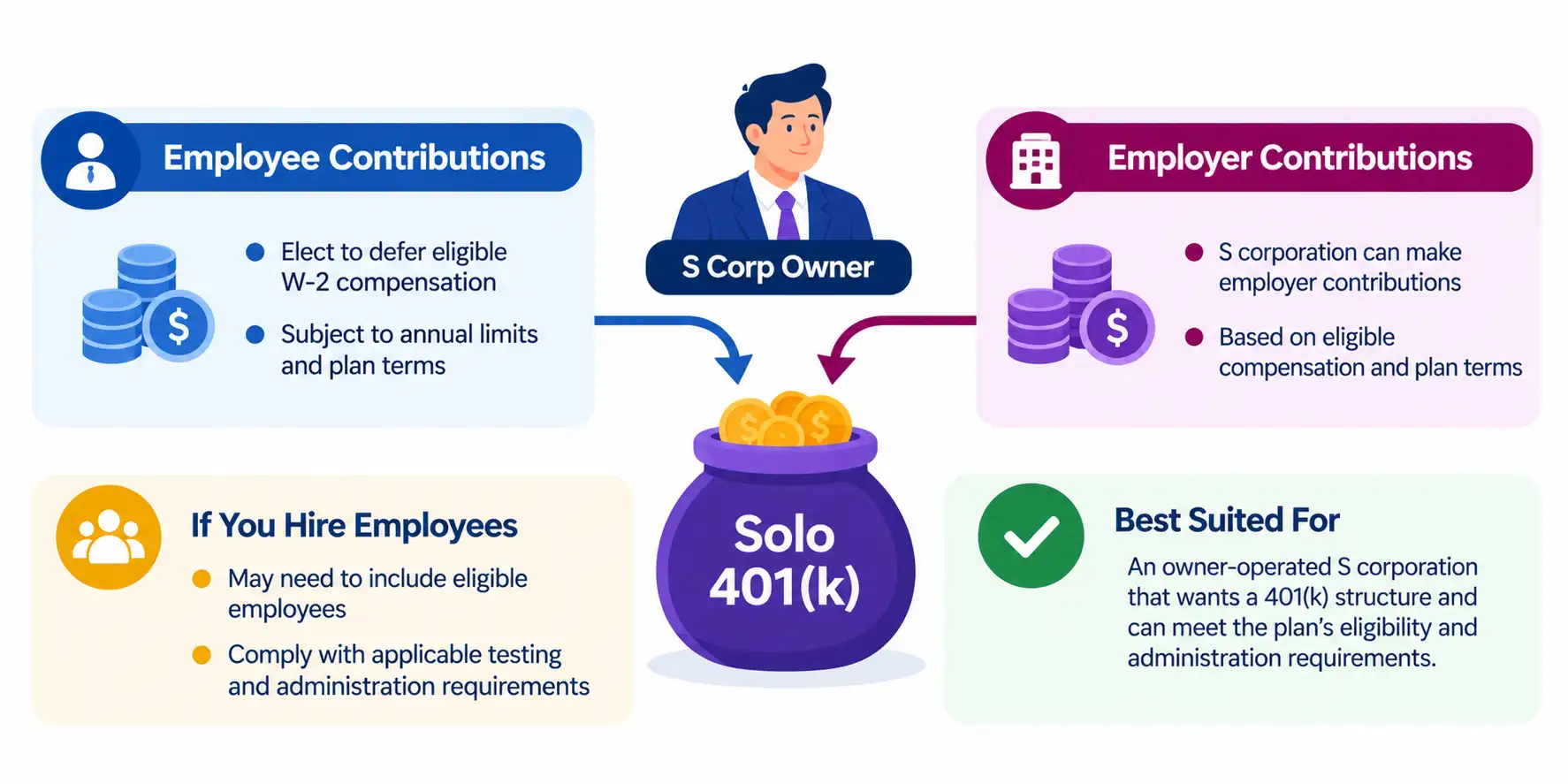
A Solo 401(k), also called a one-participant 401(k), can be an option for an owner-operated S corporation that has no employees who must be covered under the plan, apart from the owner and potentially the owner's spouse.
The owner participates in two capacities: as an employee and as the employer.
The owner can generally elect to defer eligible compensation into the 401(k), subject to annual limits and plan terms. For an S corporation shareholder-employee, these contributions are based on eligible W-2 compensation rather than shareholder distributions.
The S corporation may also make employer contributions based on eligible compensation and the plan's terms. Applicable contribution limits and compensation rules must be followed.
The total amount cannot simply be calculated by adding two maximum amounts without considering the relevant annual limits and the owner's compensation.
The Solo 401(k) label does not exempt a business from employee-coverage requirements. If the company hires employees who meet the plan's eligibility rules, it may need to include them and comply with applicable testing and administration requirements.
Best suited for: An owner-operated S corporation that wants a 401(k) structure and can meet the plan's eligibility and administration requirements.
Official guidance: IRS — One-Participant 401(k) Plans.
A Simplified Employee Pension (SEP) IRA is an employer-funded retirement arrangement. The corporation contributes to SEP-IRAs established for eligible employees, including eligible shareholder-employees.
Unlike a 401(k), a SEP IRA does not use employee salary deferrals under the standard SEP structure.
For an S corporation owner-employee, employer contributions are generally calculated using eligible compensation reported through the corporation, subject to the applicable contribution percentage and annual dollar limit.
The business must follow the plan's allocation rules and applicable employee-coverage requirements. It cannot automatically contribute for the owner while excluding other employees who are entitled to participate.
Under the IRS's standard SEP eligibility requirements, employees generally must:
A plan may adopt less restrictive eligibility rules where permitted. The applicable compensation threshold changes over time, so confirm the threshold for the relevant year.
SEP IRAs are generally simpler to establish and administer than many conventional employer retirement plans. However, the employer must adopt the required plan arrangement, provide applicable employee information, establish accounts for eligible employees, and calculate contributions correctly.
Best suited for: An S corporation seeking an employer-funded retirement plan with relatively straightforward administration, provided it can meet the applicable contribution and employee-coverage rules.
Official guidance: IRS — Simplified Employee Pension Plan.
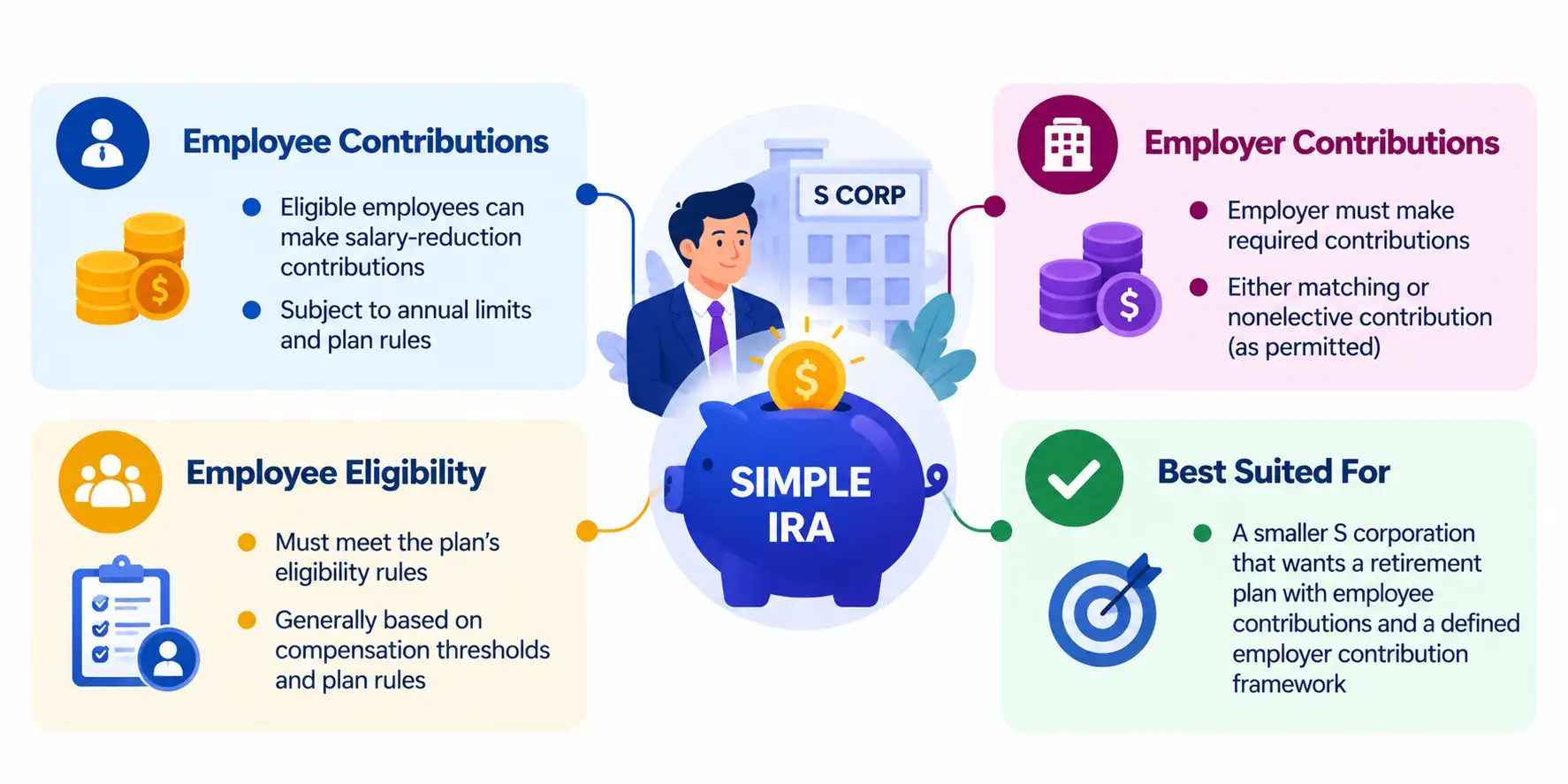
A Savings Incentive Match Plan for Employees (SIMPLE IRA) is generally designed for smaller employers. It allows eligible employees to make salary-reduction contributions while requiring the employer to make contributions under the applicable plan rules.
Eligible employees can elect to contribute part of their compensation to the plan, subject to annual limits and plan requirements. An S corporation owner-employee's contributions are generally based on eligible compensation, not shareholder distributions.
The employer generally must make the contribution required under the SIMPLE IRA rules. Depending on the permitted arrangement, this commonly involves either a matching contribution or a non-elective contribution for eligible employees.
The business must follow the applicable formula and deadlines rather than choosing contributions on an ad hoc basis.
SIMPLE IRA plans have their own eligibility rules. Under the general IRS framework, an employee who received at least the applicable compensation threshold in two preceding years and is expected to receive the threshold in the current year generally must be included, subject to the plan rules and permitted exclusions.
Employers may adopt less restrictive eligibility rules where allowed. They cannot impose requirements that are more restrictive than permitted by law.
Best suited for: A smaller S corporation that wants a retirement plan with employee contributions and a defined employer contribution framework.
Official guidance: IRS — SIMPLE IRA Plan.
This is one of the most important considerations when selecting a retirement plan.
For an S corporation shareholder-employee, eligible W-2 compensation generally determines the compensation base used for retirement-plan contributions. Shareholder distributions generally are not treated as earned income for this purpose.
Suppose an S corporation owner receives:
The owner generally cannot calculate retirement-plan contributions using $130,000 by adding the wages and distributions together.
Instead, the applicable plan's rules determine how the eligible $90,000 of W-2 compensation is used to calculate contributions. The actual allowable amount depends on the plan type, the annual contribution limits, and other applicable rules.
This distinction can materially affect how much the owner can contribute.
If an owner receives low W-2 wages and substantial distributions, the eligible compensation base for retirement-plan contributions may be lower than expected.
The owner should not increase or decrease salary solely to target a desired retirement contribution. Compensation must also comply with the applicable S corporation reasonable compensation rules.
Employee deferral limits, employer contribution limits, catch-up contribution rules, and compensation thresholds can change. If the owner participates in another employer's 401(k), the employee elective-deferral limit may also need to be coordinated across plans.
Use the current IRS guidance and plan documents to calculate the allowable amount rather than relying on an old contribution-limit table.
Official guidance: IRS — Retirement Plan FAQs Regarding Contributions: S Corporation.
Hiring employees can change which retirement plans are available and how they must be administered.
A plan that appears straightforward when the business has only an owner may require additional compliance once other employees become eligible.
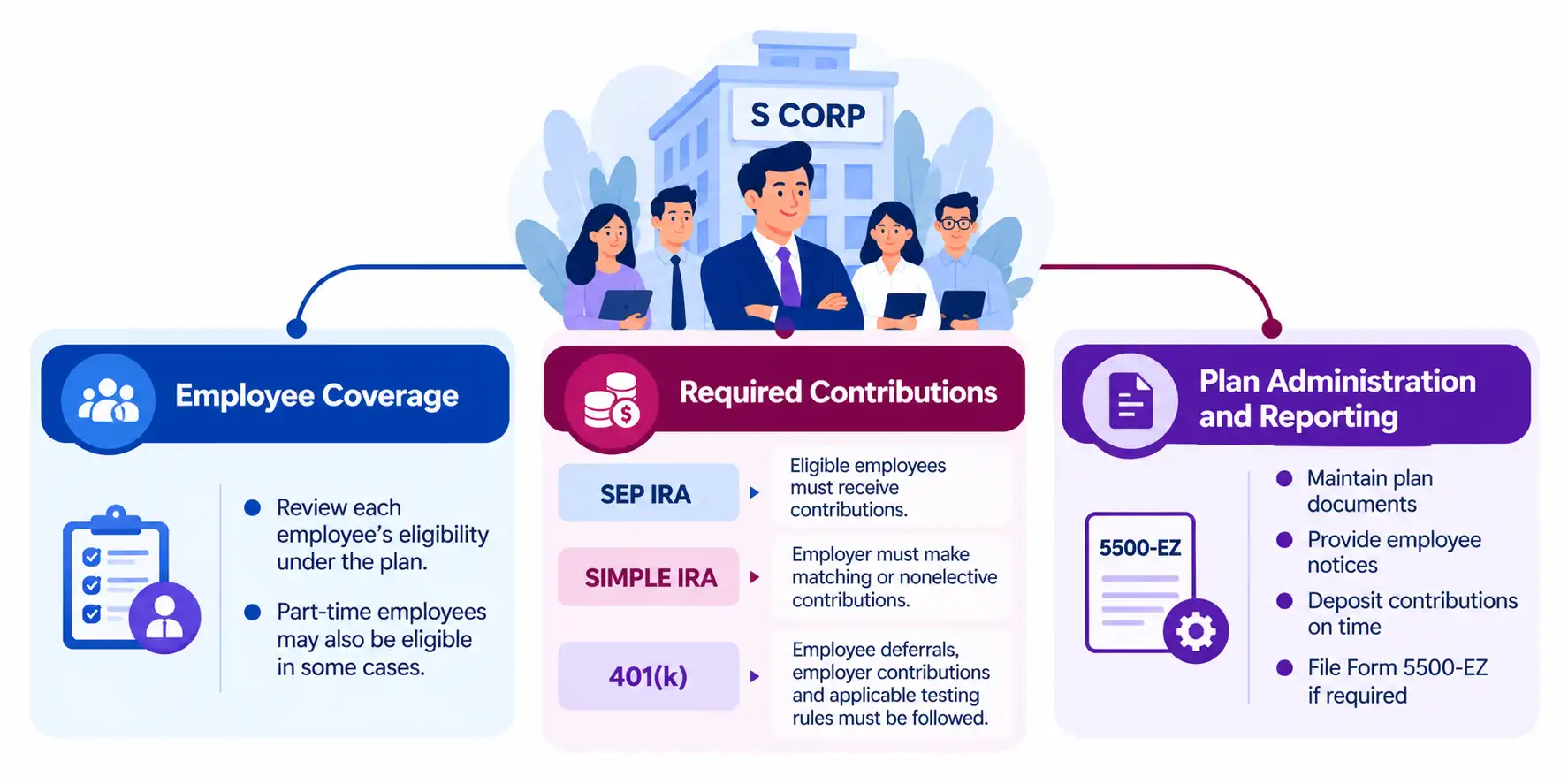
Review each employee's eligibility under the specific plan. Age, service, compensation, plan terms, and permitted exclusions may affect when an employee must be included.
Do not assume that part-time status alone automatically excludes an employee. Long-term part-time employee rules and other eligibility provisions may apply, depending on the plan.
Under a SEP IRA, eligible employees generally must receive contributions according to the plan's allocation formula when the employer makes contributions for the year.
Under a SIMPLE IRA, the employer must follow the applicable matching or nonelective contribution requirements.
Under a 401(k), employee deferrals, employer contributions, and applicable testing or safe-harbor rules must be administered correctly.
Depending on the plan, the employer may need to maintain plan documents, monitor eligibility, provide employee notices, deposit contributions on time, and meet reporting requirements.
A one-participant 401(k) generally must file Form 5500-EZ when its assets reach the applicable filing threshold, with exceptions and special rules applying in certain circumstances. Hiring employees can also change the plan's reporting and testing responsibilities.
Before adopting a plan, consider not just the owner's contribution opportunity but also the cost and work involved in meeting employee obligations.
The right plan depends on the owner's compensation, workforce, contribution goals, and willingness to manage plan administration.
Use the following comparison as a starting point.
| Feature | Solo 401(k) | SEP IRA | SIMPLE IRA |
|---|---|---|---|
| Typical structure | Owner-only business, subject to eligibility rules | Employer-funded plan | Smaller-employer retirement plan |
| Employee contributions | Yes, through eligible salary deferrals | No under the standard SEP structure | Yes, through salary reduction |
| Employer contributions | Permitted under plan rules | Employer contributions | Required under applicable rules |
| Employee coverage | Eligible employees can affect owner-only status and compliance | Eligible employees generally must receive required contributions | Eligible employees generally must be covered |
| Administration | Plan-specific requirements; possible annual reporting | Generally simpler administration | Employee notices and employer contribution rules apply |
| Main calculation basis for S Corp owner | Eligible W-2 compensation | Eligible W-2 compensation | Eligible W-2 compensation |
Compare the options using current plan rules and the business's actual circumstances. A plan that works well for an owner-only company may not be the right fit once the company hires employees.
Get support reviewing owner contributions, employee eligibility, plan requirements, and related S corporation tax reporting obligations.
S corporation owners have several retirement-plan options, but each comes with different contribution mechanics and employee-coverage rules. A Solo 401(k) may allow eligible owners to contribute as both employee and employer, a SEP IRA relies on employer contributions, and a SIMPLE IRA combines employee contributions with required employer contributions.
Before choosing a plan, confirm the owner's eligible W-2 compensation, employee eligibility, contribution limits, and administrative obligations. Careful planning helps align retirement savings with the business's workforce and compliance requirements.
This article is for general informational purposes only and does not constitute tax, legal, financial, or investment advice. Laws, regulations, rates, and procedures may change over time and may vary based on individual circumstances.
While SaveTaxs makes reasonable efforts to keep the information accurate and up to date, readers should verify applicable rules with official authorities or consult a qualified professional before making decisions based on this information.
Shubham Jain is the Founder of SaveTaxs and has extensive experience in Indian and NRI taxation. He advises individuals, NRIs, and businesses on tax filing, tax planning, capital gains, DTAA benefits, fund repatriation, and compliance matters. He regularly writes about taxation and related financial topics. His focus is on making complex tax concepts easy to understand. Through his articles, he helps taxpayers stay informed, avoid common mistakes, and stay compliant with Indian tax laws. See Full Bio

Want to read more? Explore Blogs