NRI Income Tax Compliance
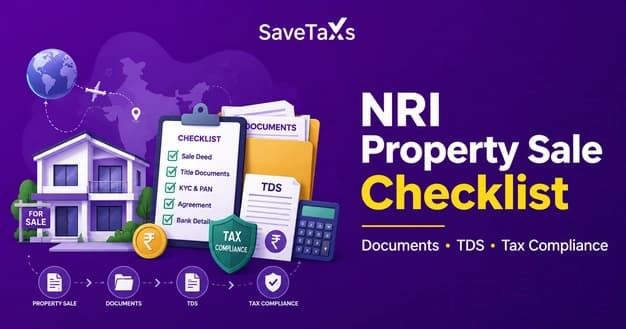
NRI Property Sale Checklist: Documents, TDS & Tax ComplianceNRI Property Sale Checklist: Documents, TDS & Tax Compliance
Written by Shubham Jain
The Government of India imposes taxes on entities and individuals to generate revenue for public expenditures. Generally, each person or organization is liable to pay their own taxes, and this liability cannot be passed on to another party. In India, taxes are categorized into two categories: Direct Taxes and Indirect Taxes.
The direct taxes are imposed directly on individuals or entities and cannot be transferred to anyone else. The central government collects direct taxes through TDS, that is, tax deducted at source at the time of income generation; advance tax, that is, tax paid in installments during the financial year; and, lastly, self-assessment tax.
In this blog, we will cover all aspects of self-assessment tax for NRIs, including how to calculate it, how and where to pay it, due dates, penalties, and more.
NRIs who have not paid enough of the advance tax for their financial year. Advance tax is generally the prepayment of income tax payable in installments during the financial year. And if an NRI's advance tax payment fails to cover their total tax liability, they are required to pay the remaining balance in the form of self-assessment tax (SAT).
Next come the NRIs who have income from sources that are not subject to TDS (tax deduction at source). TDS is a system in which tax is deducted from an individual's income at the source by their bank or employer. Henceforth, if an NRI has income from sources not subject to TDS, they are required to pay self-assessment tax on that income.
Lately, NRIs have made adjustments to their income or tax deductions after filing their advance taxes. If your deductions or income change after they have filed the advance tax return, they might just need to adjust their self-assessment tax payments accordingly.
The following is a step-by-step procedure to calculate the self-assessment tax for NRIs.
Calculate Total Income: Starting with you, calculate the total income you have earned from all the sources in India. Now, this can be salary, capital gains, sales, rent, or anything else.
Deduct the Deductions: As an NRI, you must be eligible for certain deductions. Ensure the deduction is applied to the total calculations. Under the Income Tax Act 1961, you can seek a deduction under section 80C, 80D, etc.
Tax Calculations: Post-subtracting the tax deduction, you have the remaining amount after deductions. The final tax liability will be applicable on this amount. Henceforth, on the basis of the income tax slabs, you are required to calculate the tax liability on this account.
Wherein;
Note: Under section 234A, interest will be charged in the case of late filing of income tax returns.
Section 234B/234C will be paid only in the case of an Advance Tax late payment.
NRIs can pay the self-assessment tax online by following these steps.
Step 1: Visit the income tax e-filing portal and log in to your account.
Step 2: Select the "e-pay tax" under the e-file from the top Row.
Step 3: Click on the new payment button.
Step 4: Select the 1st option, " Income Tax ", from the list of options and click on "Proceed".
Step 5: Then select the right "Assessment Year" and select "Self Assessment Tax (300)" from the dropdown menu, and continue towards the next step.
Step 6: Enter the tax amount here, then continue to complete the payment section.
Step 7: Choose the bank via which you will make the payment and the preferred payment mode.
Once the payment is successful, you shall download the Challan by clicking on the download button.
The NRI self-assessment tax date for the Financial year 2025-26 (AY 2026-27) is July 31, 2026. File timely to avoid interest charged being applicable under section 234A/234B/234C. The due date of September 15 applies only to specific categories notified by the CBDT (mainly audit-related or transfer pricing cases), not NRIs by default.
The due date timeline is as follows:
| Category of the Taxpayer | Original ITR Filing Due Date | Belated/Revised Return Deadline |
|---|---|---|
| Individuals (In non-audit cases) | Filing is by 31 July, 2026. | December 31, 2026 |
| Businesses (Audits required) | October 31, 2026 | December 31, 2026 |
Under Section 140A of the Income Tax Act 1961, if an NRI does not make the self-assessment tax payment on time, this results in high interest and penalties. Any individual or entity that fails to pay the full tax owed is classified as an "assessee in default".
Under section 234F, a late filing fee of Rs 5000 is applicable if you miss the ITR deadline, which is generally 31 July, for no-audit cases, unless the CBDT plans to extend it, and for filing of taxes after this date but before December 31, 2025. As an NRI, if you fail to pay the self-assessment tax, this can result in the taxpayer being treated as an "assessee" by default. This will attract interest under sections 234A/234B/234C of the Income Tax Act and recover the proceedings under the Act.
Savetaxs helps NRIs start and grow their businesses in India with confidence.
Self-Assessment Tax is an important part of NRI tax compliance. As an NRI filing taxes in India, it is essential for you to understand when you owe the SAT, how to calculate your self-assessment tax accurately, and how to file it to avoid any penalties.
We believe you have now understood the importance of self-assessment tax. Now is the time to get ahead and file your ITR. For NRIs filing ITR in India while managing other tax components, such as TDS, SAT, and more, can sound overwhelming, but not anymore. Savetaxs is here to rescue from the complex tax maze.
Savetaxs is a dedicated team of expert CAs and CPAs helping NRI individuals with end-to-end tax compliance in India and across borders. From determining your residential status to ITR preparation, filing, TDS management, e-verification, DTAA benefits, capital gains optimization, investment advisory, repatriation of funds, and more, our experts help you at every step of your journey.
For NRIs, taxation stress is a thing of the past. Connect with us as we serve our NRIs 24/7 across all time zones.
This article is for general informational purposes only and does not constitute tax, legal, financial, or investment advice. Laws, regulations, rates, and procedures may change over time and may vary based on individual circumstances.
While SaveTaxs makes reasonable efforts to keep the information accurate and up to date, readers should verify applicable rules with official authorities or consult a qualified professional before making decisions based on this information.
Vipul Jain is the Co-Founder of SaveTaxs and a tax expert with experience in Indian and NRI taxation. He advises individuals, NRIs, and businesses on tax filing, tax planning, capital gains, DTAA, and compliance matters. He focuses on making complex tax concepts simple and helping taxpayers make informed, compliant decisions. See Full Bio
Want to read more? Explore Blogs