
NRI Income Tax Compliance
How to Claim Excess TDS Refund After Selling Property in India as an NRIHow to Claim Excess TDS Refund After Selling Property in India as an NRI
Written by Shubham Jain
_1770119673104.webp&w=3840&q=75)
You've probably already searched for the ITR filing last date for AY 2026-27, but one deadline does not apply to every taxpayer. The applicable date depends on your taxpayer category, business or professional income, audit requirements, and transfer-pricing status; in this guide, you'll find the relevant deadline and how to verify it.
The ITR filing due date is the deadline prescribed for submitting an income-tax return for a particular assessment year. The applicable date can differ according to the taxpayer's filing category and statutory requirements.
Moreover, the assessment year identifies the period in which income from the preceding financial year is assessed. For example, income earned from 1 April 2025 to 31 March 2026 belongs to FY 2025-26 and is reported in AY 2026-27. The Income Tax Department confirms that returns for FY 2025-26 are filed for AY 2026-27 under the Income Tax Act, 1961.
In addition, AY 2026-27 and Tax Year 2026-27 are not the same filing obligation. AY 2026-27 covers income earned during FY 2025-26, whereas Tax Year 2026-27 relates to income earned during FY 2026-27 and is generally reported after that tax year ends.

The ITR filing due date matters because taxpayers must meet the deadline applicable to their filing category to remain compliant with the prescribed return-filing requirements. Using another taxpayer's deadline can result in an incorrect assumption about when your return is due.
For example, a salaried individual filing a regular non-audit return may work with a 31 July deadline, while a taxpayer with eligible business or professional income under a non-audit category may have a 31 August deadline. The official Income Tax Department confirms 31 August 2026 as the AY 2026-27 due date for ITR-4.
At the same time, the relevant deadline can be later when tax-audit or transfer-pricing provisions apply. That difference is why taxpayers should identify their filing category before assuming that July 31 is their ITR last date.
For AY 2026-27, the applicable ITR filing deadline depends on the taxpayer's category and whether audit or transfer-pricing provisions apply. The principal statutory dates reflected in the current official guidance are 31 July, 31 August, 31 October and 30 November 2026.
| Taxpayer / Filing Category | Applicable condition | AY 2026-27 ITR due date |
|---|---|---|
| Individuals and other taxpayers in the regular non-audit category | Where the applicable return is not subject to audit or transfer pricing | 31 July 2026 |
| Eligible business/professional taxpayers in the specified non-audit category | Business or professional income where accounts are not required to be audited and transfer pricing does not apply | 31 August 2026 |
| Tax audit cases | Accounts required to be audited and transfer pricing does not apply | 31 October 2026 |
| Transfer-pricing cases | Section 92E / transfer-pricing provisions apply | 30 November 2026 |
The Income Tax Department's Finance Bill materials distinguish these categories and prescribe 31 August for specified non-audit business/professional cases, 31 October for audit cases, and 30 November where transfer-pricing provisions apply.
Importantly, the 31 July and 31 August 2026 deadlines have already passed as of 9 September 2026. Taxpayers whose applicable original deadline has passed should use the dedicated guidance on missed ITR deadlines rather than treating this page as a late-filing tutorial.
You can identify your applicable ITR due date by checking your taxpayer category, income type, audit status, and transfer-pricing applicability. The form you use can help identify your filing circumstances, but the legal due date ultimately depends on the prescribed category and conditions.
Individuals whose returns fall under the regular non-audit category generally follow the 31 July deadline for AY 2026-27. This commonly covers taxpayers such as salaried individuals and pensioners who do not fall into a category with a different prescribed deadline.
For example, an eligible salaried taxpayer using ITR-1 or ITR-2 without an audit requirement would generally look to the regular non-audit deadline. The Income Tax Department's AY 2026-27 guidance lists ITR-1 for eligible resident individuals and ITR-2 for individuals and HUFs who are not eligible for ITR-1.
Specified non-audit business and professional taxpayers can have a 31 August 2026 deadline for AY 2026-27. This category is particularly important because assuming that every individual taxpayer has a 31 July deadline can be incorrect.
For example, ITR-4 for AY 2026-27 has an official filing due date of 31 August 2026, according to the Income Tax Department's ITR-4 guidance.
Taxpayers whose accounts are required to be audited generally have a 31 October 2026 ITR deadline for AY 2026-27 when transfer-pricing provisions do not apply. The audit requirement therefore changes the applicable filing timetable.
For example, a business subject to tax audit should not use the ordinary 31 July deadline merely because its owner is an individual; the audit status is relevant to determining the prescribed return deadline. The Income Tax Department also states that the tax-audit report deadline precedes the corresponding ITR deadline.
Taxpayers to whom transfer-pricing provisions under section 92E apply generally have a 30 November 2026 ITR deadline for AY 2026-27. This is the latest of the principal filing dates in the AY 2026-27 schedule.
For example, an assessee covered by specified international or domestic transfer-pricing requirements should check the 30 November deadline rather than the 31 October audit deadline.
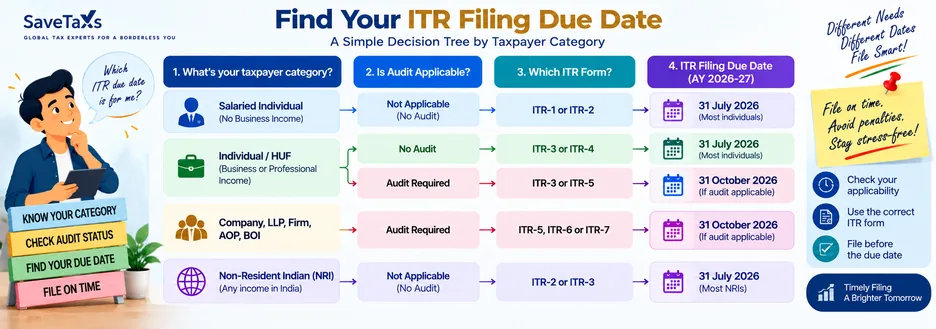
ITR due dates differ because the law assigns different filing deadlines to taxpayer categories based on audit, business, professional, and transfer-pricing requirements. These differences give taxpayers with additional compliance requirements more time to complete the necessary reporting and audit processes.
For example, a taxpayer whose accounts require an audit may need to complete audit-related compliance before filing the return, while a straightforward non-audit return does not involve the same process. The statutory framework therefore uses different dates rather than one universal deadline.
Moreover, the ITR form alone should not be treated as the only test for determining the due date. A taxpayer should consider the underlying filing conditions, including whether audit or transfer-pricing provisions apply.
The government can change or extend an ITR filing deadline through an official notification or other applicable announcement. Therefore, a date found in an older article, social-media post, or previous year's tax calendar may not reflect the latest position.
For example, taxpayers should verify the deadline against current Income Tax Department announcements when approaching a filing deadline because the department publishes updates and taxpayer communications through its official channels. The department's current portal has published AY 2026-27 filing communications and maintains current ITR utilities for the assessment year.
As such, always verify the applicable ITR filing date immediately before filing, particularly when a deadline has been the subject of an extension or clarification.
The safest way to verify the latest ITR filing due date is to check the official Income Tax Department and e-Filing portal guidance for the relevant assessment year. Official sources should take priority over third-party tax calendars when dates conflict.
First, identify the relevant assessment year. For AY 2026-27, you are reporting income earned during FY 2025-26.
Second, identify your filing category by checking whether you are:
An individual or other taxpayer in the regular non-audit category.
A business or professional taxpayer in the specified non-audit category.
A taxpayer subject to tax audit.
A taxpayer covered by transfer-pricing provisions.
Third, check the latest official Income Tax Department guidance before submitting your return. The department currently provides AY 2026-27 ITR forms and filing utilities through its e-Filing portal.

You can verify current information through the Income Tax Department e-Filing portal and its official AY 2026-27 ITR resources.
A taxpayer who misses the original ITR filing due date may still have a belated-return route, subject to the applicable law, time limit, and late-filing consequences. This page does not cover the detailed procedure because post-deadline filing is a separate search intent.
For AY 2026-27, the Income Tax Department states that a belated return under the Income Tax Act, 1961 may generally be furnished on or before 31 December 2026 or before completion of assessment, whichever is earlier, subject to the applicable provisions.
The official Income Tax e-Filing portal is the primary practical resource for checking AY 2026-27 return forms and filing information. The portal currently provides ITR-1 through ITR-7 resources for AY 2026-27, along with filing utilities.
For example, the Income Tax Department's current downloads section lists a common offline utility for ITR-1, ITR-2, ITR-3 and ITR-4 for AY 2026-27, with the latest listed utility released on 2 September 2026.
Additionally, taxpayers can use professional tax guidance when their filing situation involves audit, business income, international transactions, or other complex conditions. Free official Income Tax Department resources should remain the first verification point, while professional advice can help interpret circumstances that are not straightforward.
The next step is to identify your filing category and verify the corresponding official deadline before relying on an ITR last date. A simple checklist can prevent the common mistake of assuming that July 31 applies to every taxpayer.
Use this process:
Identify the assessment year: For the current transition period, FY 2025-26 corresponds to AY 2026-27.
Identify your taxpayer category: Determine whether you are a regular individual taxpayer, business/professional taxpayer, audit case, or transfer-pricing case.
Check the applicable ITR form: Confirm whether ITR-1, ITR-2, ITR-3, ITR-4 or another return applies.
Verify the official deadline: Check the latest Income Tax Department guidance for any notification or extension.
File and verify the return: Submit the applicable ITR and complete the required verification process.
The correct ITR filing deadline depends on your taxpayer category and applicable filing requirements, not simply on whether you are an individual taxpayer. For AY 2026-27, the principal dates include 31 July for the regular non-audit category, 31 August for specified non-audit business or professional cases, 31 October for applicable audit cases, and 30 November for specified transfer-pricing cases.
Moreover, FY 2025-26 income is reported in AY 2026-27 under the Income Tax Act, 1961, despite the new tax-law framework coming into force from April 2026.
Finally, do not rely on a generic “ITR last date” when your circumstances may place you in a different filing category. Identify your category, verify the current official deadline, and file within the applicable statutory timeline.
This article is for general informational purposes only and does not constitute tax, legal, financial, or investment advice. Laws, regulations, rates, and procedures may change over time and may vary based on individual circumstances.
While SaveTaxs makes reasonable efforts to keep the information accurate and up to date, readers should verify applicable rules with official authorities or consult a qualified professional before making decisions based on this information.
Vipul Jain is the Co-Founder of SaveTaxs and a tax expert with experience in Indian and NRI taxation. He advises individuals, NRIs, and businesses on tax filing, tax planning, capital gains, DTAA, and compliance matters. He focuses on making complex tax concepts simple and helping taxpayers make informed, compliant decisions. See Full Bio
Want to read more? Explore Blogs