



Investment & Financial Planning
NRI Property Sale: How to Calculate Capital Gains TaxNRI Property Sale: How to Calculate Capital Gains Tax
Written by Shubham Jain


As an NRI who owns a property in India, renting it out can help you generate a steady stream of income. However, managing property and tenants from abroad is not easy, and that's when licenses or rental agreements come into play.
Being a property owner in India, it is crucial to understand the legalities of property leasing. In India, rent agreements are a standard method of renting out property, but leave-and-license agreements are an underexplored option that offers more benefits to NRI property owners than they may realize.
In this blog, we will understand why license agreements are a better choice than rental agreements for managing your property and tenants in India.
A leave and license agreement is a contract via which the property owners grant permission to another person (licensee) to use and occupy the property for a specific reason. However, the property owner retains full possession and control of the property.
The agreement includes all terms and conditions agreed upon by the licensor and licensee. Under this contract, the NRI property owners living abroad can balance the interests of the property owners and the occupant.
In a leave-and-license agreement, two parties are involved. The one is the owner of the property, also known as the licensor. Another is the one who has been granted temporary occupancy rights to the property, also known as the licensee.
Savetaxs helps NRI file ITR in India with expert assistance. We handle your taxes so you don't have to.
A rent agreement is a legal document in which the owner of the property transfers title and possession of the property to another person in lieu of payment. The payment is determined as rent. The possession of property is transferred for a definite period of time as agreed between both parties.
The two parties involved are the landlord, who owns the property, and the tenant to whom the property is let.
The following table clearly showcases the difference between a license and a rent agreement for NRIs.
| Situation | Leave and License Agreement | Rent Agreement |
|---|---|---|
| Non-Exclusive Possession | Here, the owner has the right to enter and use the property. The licensee cannot say otherwise, and as an NRI, you get to have complete control over your property. Additionally, the agreement's arrangement does not grant the tenant (licensee) exclusive possession. | Under the rent agreement, the tenant has full possession of the property for the entire duration of the lease. This limits your control as the property owner and makes it harder to access or inspect the property if you are not physically present in India. |
| Clear Terminology | To avoid legal misunderstandings, it is essential to use technical and accurate terminology. In a leave-and-license agreement, the terms used can be "licensee" or "licensor" instead of "tenant" or "landlord". This difference indicates that property possession is not exclusive. | Here, terms like landlord and tenant are used, which directly imply exclusive possession and can lead to disputes over the property's rights. |
| Maintaining The Possession | The leave and license agreement has a key feature: a clause stating that the licensor will keep one set of the property keys. This indicates that the possession remains with the landlord, hence reducing the risk of tenants claiming adverse possession. | With a rent agreement, the tenant has full possession of the property, without any stipulations that could complicate matters in the event of future disputes. |
| Notice Period Flexibility | In the leave and license agreement, the concept of notice period is not sufficiently relevant. The flexibility here lets you terminate the deal with ease, which is quite helpful if you have to manage the property remotely. | Under a rent agreement, either party must serve a notice period before terminating the contract, which can be a tedious process for NRIs who are not present in India. |
| The Impact Of Property Sale | If the property is sold, the leave or the license agreement will automatically terminate. This one provision is beneficial for NRIs planning to sell their property without the complications of dealing with tenants. | The rent agreement continues even after the property is sold, which can complicate future sales and transfers of ownership. |
For NRIs living abroad, ensuring your entry into India is handled properly and smoothly. License agreements will help you achieve that. Here are the reasons why license agreements have NRIs on their side.
Now, as NRIs are not physically available to deal with their tenants. Under the rent agreement, the tenant may have the right to remain in the property even when the owner wants the tenant to vacate.
Whereas with the license agreements, there are no such rights. If the licensee overstates or violates any terms of the agreement, the owner may revoke the license, and the licensee must vacate the property immediately.
This is why a license agreement for NRIs is ideal, as being an NRI, you cannot afford to waste your time being consumed in lengthy legal disputes from abroad.
While a rent agreement creates an interest in the property for the respective tenant, a license agreement does not.
This is why situations where tenants end up filing false claims of ownership, demanding extensions, or asserting adverse possession are left at bay.
In a nutshell, under a license agreement, the NRI property owner retains complete control.
Tenancy violation cases, such as failing to pay rent on time, refusing to vacate the premises, subletting the space, violating housing society rules, and misusing society premises, are common in India.
Under the rent agreement, addressing these issues requires a careful legal proceeding. In contrast, under the license agreement, the licensee will operate only with the licensor's permission, enabling the licensor to take quick action against a licensee that violates the terms.
Many NRIs rent out their properties for short work assignments, family members temporarily staying, travel, or relocation periods, or for year-round or seasonal occupancy.
A license agreement is more flexible and ideal for short-term arrangements, allowing the NRI property owner to reclaim possession quickly or whenever they need the property.
With a license agreement, an NRI has firm control over the operation, as they can impose clearer restrictions on it.
Now that the property occupant is a licensee, they must strictly adhere to the permissions granted to them.
In major cities such as Bengaluru, Mumbai, Pune, and Gurgaon, leave and license agreements are most widely used by NRIs because:
Hence, NRIs with priepsie sin big metro cities now that a license agreement aligns well with the standard practice and safeguards your orieoty while you are abroad.
NRIs, your financial uncertainty in India is over. Secure your financial future today with Savetax's expert financial planning service
Although rent agreements aren't always problematic, they do come with risks that NRIs must consider beforehand.
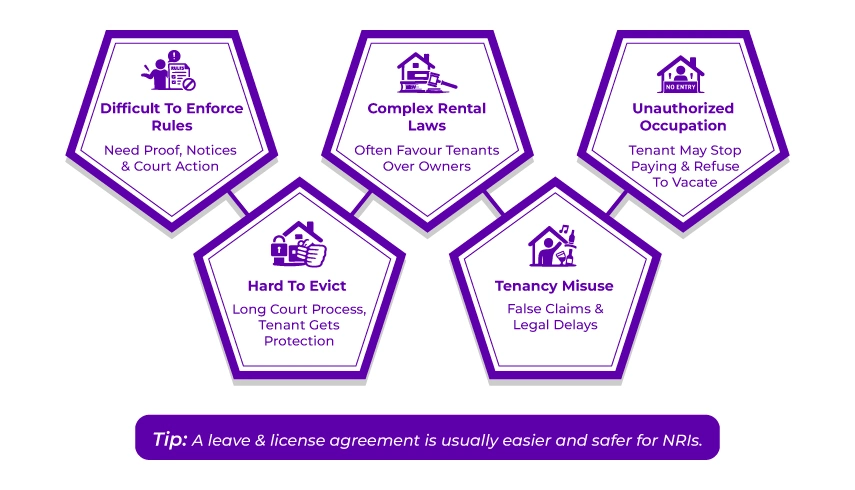
Evicting a tenant under a rent agreement for NRI can require a lengthy process of filing a case in the Rent Court. This case can take months or years to reach a final verdict, and there is a strong chance that tenants will receive statutory protection, making the process unpredictable and slow.
There are a few tenants that may claim additional rights or protection under the rental control law. Even if the tenant's claim is false, contesting it might need a lengthy legal process.
There are a few cases that disclose that long-term tenants, at times, stop paying rent and refuse to vacate the landlord's space. Now getting them out forcibly and legally is a time-consuming and costly process.
In the rent agreement, the enforcement clauses pertain to maintenance, damages, visitor restrictions, misuse of society property, and violations of society's rules.
Under the rent agreement, you, as the owner, cannot simply ask the tenant to pack up their things and leave immediately. To take action, the owner must have substantial proof, send a legal notice beforehand, possibly go to court, and wait through the court proceedings, because in court, the tenant is protected and has the right of possession.
Whereas the license agreement is easier to enforce, the owner retains complete control of the property, and if the licensee violates the law, the owner can cancel the license.
Different states have different rent control Acts. These laws are largely outdated and heavily skewed in favour of tenants, especially those for residential properties.
This is to ensure that under these laws, NRIs are sitting at a clear disadvantage.
By now, we believe that NRIs managing a property in India must have a clear understanding of how a leave and license agreement offers greater flexibility, legal clarity, and better control over the property than a rental contract.
These agreements include non-exclusive possession rights, written in precise terminology, add possession clauses, and ensure that the contract terminates upon the sale of the property, making leave-and-license agreements work better for NRIs than rental agreements.
Hence, as an NRI, choosing a lease agreement is a more intelligent choice. If you are looking for professional assistance in framing and executing this agreement in India, Savetaxs is the name to trust. We have been helping NRIs from 20+ countries in managing their properties in India.
This article is for general informational purposes only and does not constitute tax, legal, financial, or investment advice. Laws, regulations, rates, and procedures may change over time and may vary based on individual circumstances.
While SaveTaxs makes reasonable efforts to keep the information accurate and up to date, readers should verify applicable rules with official authorities or consult a qualified professional before making decisions based on this information.
Vipul Jain is the Co-Founder of SaveTaxs and a tax expert with experience in Indian and NRI taxation. He advises individuals, NRIs, and businesses on tax filing, tax planning, capital gains, DTAA, and compliance matters. He focuses on making complex tax concepts simple and helping taxpayers make informed, compliant decisions. See Full Bio
Want to read more? Explore Blogs

_1781845771869.webp&w=828&q=75)
_1778936280179.webp&w=828&q=75)