



NRI Income Tax Compliance
How to Claim Excess TDS Refund After Selling Property in India as an NRIHow to Claim Excess TDS Refund After Selling Property in India as an NRI
Written by Shubham Jain

A major relief for NRIs selling property in India has come into effect. However, the amendment primarily eases compliance for resident buyers purchasing property in India; for NRI sellers, it has a relevant impact, especially on seamless NRI property transactions and reduced delays.
The honorable Finance Minister, Smt Nirmala Sitharaman, in the Union Budget 2026-2027, has announced that resident buyers will no longer be required to obtain a TAN to deduct TDS on property purchases from NRI sellers.
This change is solely to simplify the entire NRI property sale transaction by removing the mandatory TAN requirement for TDS compliance under Section 195. However, this reform has nothing to do with the TDS rate on the NRI property sale; they remain unchanged.
In this blog, we will explore in detail what this reform means for NRI sellers and what has been proposed in Budget 2026-2027.
To understand why this change is helpful, let us first examine how buying property from NRIs worked before the budget changes.
When an NRI resident buys a property that is worth Rs 50 lakh from an NRI seller, the previous tax rules make it the buyer's responsibility to collect the taxes on behalf of the seller. The aim is to ensure that the government of India receives its share of tax on NRIs' property sales.
For this, the buyer was required to:
This entire process has a significant compliance burden, particularly because TAN is of no use beyond this single transaction, which delays the entire NRI property sale transactions.
Expert help and zero hassles in NRI ITR filing 24/7.
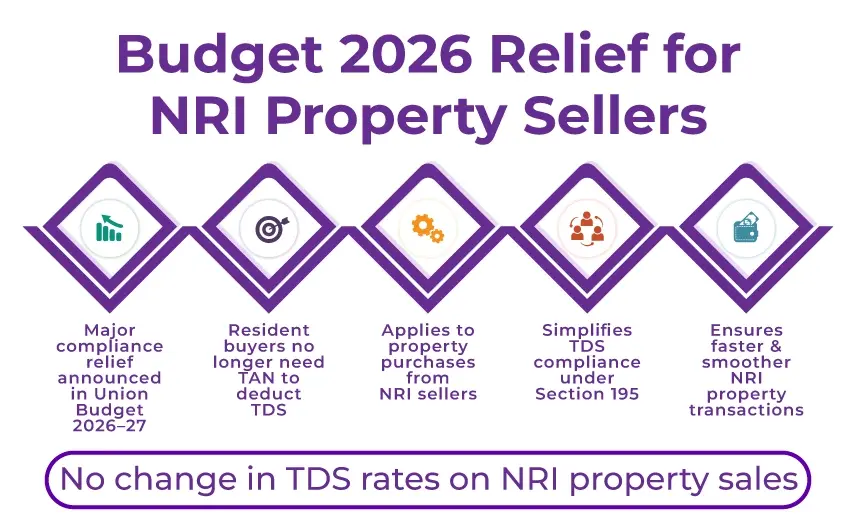
To eliminate the procedural hurdles, the Budget 2026 has initiated an amendment under Section 397(1)(c) of the Income Tax Act.
While presenting the Union Budget 2026-27, our honourable Finance Minister, Smt Nirmala Sitharam, announced a proposal to remove the requirement for resident buyers to get a TAN for deducting Tax Deducted at Source (TDS) on property purchase from NRIs.
The Proposed Change States:
TDS (tax deducted at source) on the sale of an immovable property by an NRI will be deducted and then deposited with the government using the buyer's PAN card.
The buyer of the property no longer needs to obtain a TAN solely for this transaction.
After the change comes into effect, here's what you should do now.
In a nutshell, under the new rules, buyers of property from an NRI no longer need to apply for a separate TAN. After the Budget 2026 introduced the TAN, the process has been more straightforward, similar to filing your regular income tax form.
Effective Date: This amendment document will apply from October 1, 2026.
Property buyers and sellers must know that this new rule is making the entire property transaction paperwork easy. The government's aim in making this change was to remove unnecessary steps from the process to make it more effective.
Secondly, this change will significantly speed up the entire property transaction process. Buying a property in India from an NRI involves multiple registrations and compliance checks. By eliminating the TAN step, the budget has cut weeks from the entire process, making everything quick and efficient.
Lastly, this change reduces the risk of legal trouble and fines. Under the old system, many buyers made minor technical mistakes because the process was quite complicated. Some buyers fill out the TAN forms incorrectly, while others miss the deadline, and some just do not understand the rules. These unintentional errors led to hefty penalties and, in the worst court cases.
Thanks to the 2026-27 budget, the PAN method has eliminated all these peculiar hassles and headaches.
With respect to the budget 2026-27, the TDS rates under Section 195 of the Income Tax Act remain unchanged on the sale of property by an NRI.
Savetaxs investment experts provide expert guidance tailored to your financial goals.
By substituting the requirement for TAN with a PAN-based TDS mechanism, the Budget 2026-2027 has successfully rolled out a practical reform, focused on execution, for NRIs selling property in India. This amendment has enhanced compliance, reduced transaction times, and improved certainty for both resident buyers and NRI sellers.
For NRIs planning to sell a property in India, this change is one of the most meaningful simplifications of compliance introduced in recent years, without changing any underlying tax framework.
As an NRI, if you are seeking professional assistance for consulting on selling your property in India, then Savetaxs is the name to trust. Our experts will act as a specialized intermediary, advising you on financial and logistical considerations for selling real estate in India while residing abroad. We provide end-to-end consultation services for property valuation, TDS compliance, and the repatriation of sale proceeds for NRIs.
Connect with us as we serve our clients 24/7 across all time zones.
This article is for general informational purposes only and does not constitute tax, legal, financial, or investment advice. Laws, regulations, rates, and procedures may change over time and may vary based on individual circumstances.
While SaveTaxs makes reasonable efforts to keep the information accurate and up to date, readers should verify applicable rules with official authorities or consult a qualified professional before making decisions based on this information.
Vipul Jain is the Co-Founder of SaveTaxs and a tax expert with experience in Indian and NRI taxation. He advises individuals, NRIs, and businesses on tax filing, tax planning, capital gains, DTAA, and compliance matters. He focuses on making complex tax concepts simple and helping taxpayers make informed, compliant decisions. See Full Bio
Want to read more? Explore Blogs


Answer: With respect to the Income Tax Act 1961, Section 195, TDS is generally:
The exact TDS rate depends on the nature of the property, whether it is a long-term asset or a short-term asset, or whether the seller has obtained a lower deduction certificate or not.
Answer: Here's what you have to do:
With the recent budget changes, there is no need to apply for a TAN anymore.