NRI Income Tax Compliance
CBDT Form 173A: Eligibility, Tax Exemption Rules and Details Required (2026)CBDT Form 173A: Eligibility, Tax Exemption Rules and Details Required (2026)
Written by Shubham Jain

Selling property in India while living in the USA requires coordination between Indian property-sale requirements and any applicable U.S. tax obligations. For NRIs, the challenge is not limited to completing the sale. It also involves understanding how the transaction may be taxed in both countries, reconciling Indian tax withheld with the final liability, and determining how eligible proceeds can be transferred overseas.
Your obligations depend on the property's ownership history, the date of sale, your Indian residential status, and your U.S. tax status. A U.S. citizen or resident alien, for example, may have U.S. reporting obligations even when the property is located in India.
This guide focuses on the India–USA tax and compliance considerations that NRIs should evaluate when selling Indian property from abroad. For the general sale process, documentation, and transaction steps, refer to our NRI property-selling guide.
Being an NRI for Indian income-tax purposes does not automatically establish your U.S. tax status. India determines residential status under Indian law, while U.S. tax status may depend on citizenship, green-card status, residency tests, and other applicable rules.
U.S. citizens and resident aliens generally have U.S. reporting obligations for worldwide income, subject to applicable rules and exceptions. Therefore, a property sale in India may need to be considered on your U.S. tax return even if you are a non-resident under Indian tax law. The reporting and tax treatment for a U.S. nonresident alien may differ.
Suppose an NRI living in New Jersey sells an inherited apartment in Delhi. The Indian tax computation will depend on the applicable Indian rules and the property's acquisition history. If the seller is also a U.S. citizen or resident alien, a separate U.S. computation may be required.
Do not assume that the gain calculated for the Indian return will be identical to the amount reported in the USA. The two tax systems may differ in their treatment of acquisition cost, capital improvements, selling expenses, currency conversion, and certain exemptions. For inherited property, the tax basis must be determined separately under the applicable Indian and U.S. rules.
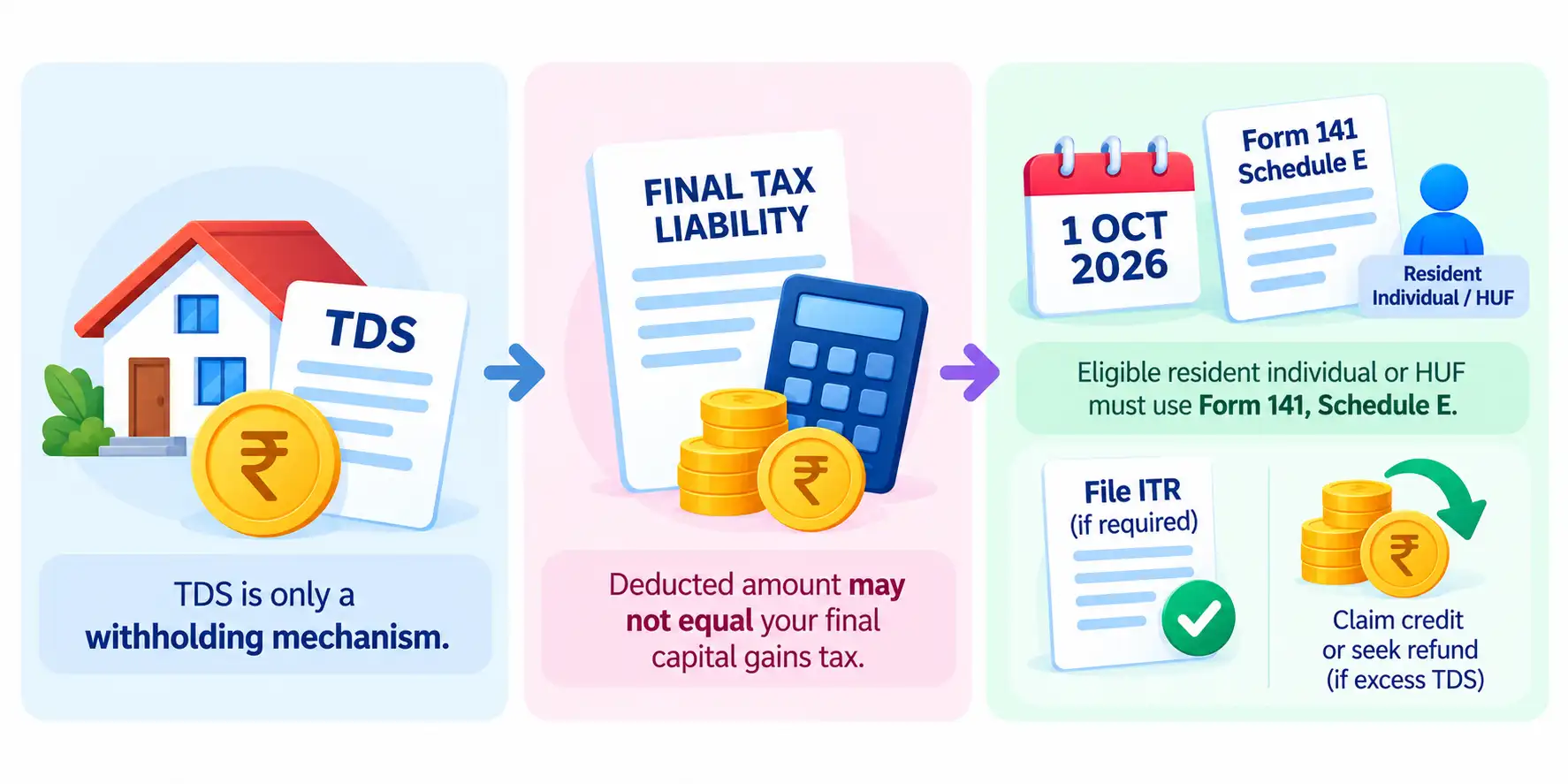
No. Tax deducted at source (TDS) during a property sale is a withholding mechanism. The amount deducted may not equal the seller's final Indian capital-gains tax liability.
For a sale by a non-resident, the buyer must follow the withholding and reporting procedure applicable to the transaction date and buyer category. From 1 October 2026, an eligible resident individual or Hindu Undivided Family (HUF) purchasing immovable property from a non-resident must use Form 141, Schedule E, where the transaction falls within Section 393(2) of the Income-tax Act, 2025. Before this change, the applicable procedure generally required a TAN and the prescribed TDS statement through TRACES for such resident individual/HUF purchasers. Confirm the procedure applicable to your transaction rather than relying on older guidance.
After the sale, reconcile the tax withheld with the applicable Indian tax computation. Depending on the circumstances, the seller may need to file an Indian income-tax return to report the transaction, claim eligible credits, or seek a refund of excess tax withheld.
If the expected withholding appears significantly higher than the estimated final tax, ask a qualified Indian tax professional whether a lower or nil deduction mechanism is available under the rules applicable to the transaction.
For the detailed withholding process, see our TDS guide for NRI property sales.
Get expert guidance on NRI property-sale taxation, TDS, capital gains, and Indian tax compliance while living abroad.
If you are subject to U.S. tax on worldwide income, the sale of Indian property may need to be included in your U.S. tax computation. The treatment depends on your tax status, the property's use, ownership history, and other facts.
The U.S. capital gain may differ from the Indian gain because the two countries can apply different rules for cost basis, inherited property, qualifying improvements, selling expenses, holding periods, and currency conversion.
If the property was used as your home, U.S. home-sale rules may also be relevant. However, an exclusion is available only when the applicable eligibility conditions are met. Do not assume that a property located in India automatically qualifies.
Keep records of the original acquisition, inheritance where relevant, capital improvements, sale proceeds, transaction expenses, and dates. Your U.S. tax adviser can determine how the transaction should be calculated and reported.
For additional guidance, refer to the IRS's Publication 523: Selling Your Home.
You may be eligible for a U.S. foreign tax credit for qualifying Indian income taxes paid or accrued. However, the credit is subject to U.S. eligibility requirements, limitations, and other conditions.
The amount withheld as Indian TDS should not automatically be treated as the amount of foreign tax credit available in the USA. First, reconcile the withholding with the actual Indian tax liability and establish which taxes qualify under U.S. rules. The amount of credit may also depend on the applicable payment or accrual method and timing requirements.
Depending on your circumstances, IRS Form 1116 may be required. The credit calculation can depend on the category and source of income, the applicable tax year, and the foreign tax credit limitation.
An NRI who has tax withheld when selling a property in India should retain the withholding records and reconcile them with the Indian tax return. A U.S. tax adviser can then assess whether a foreign tax credit is available and how much may be claimed.
Review the IRS's Foreign Tax Credit guidance and its guidance on foreign taxes that qualify for the credit.
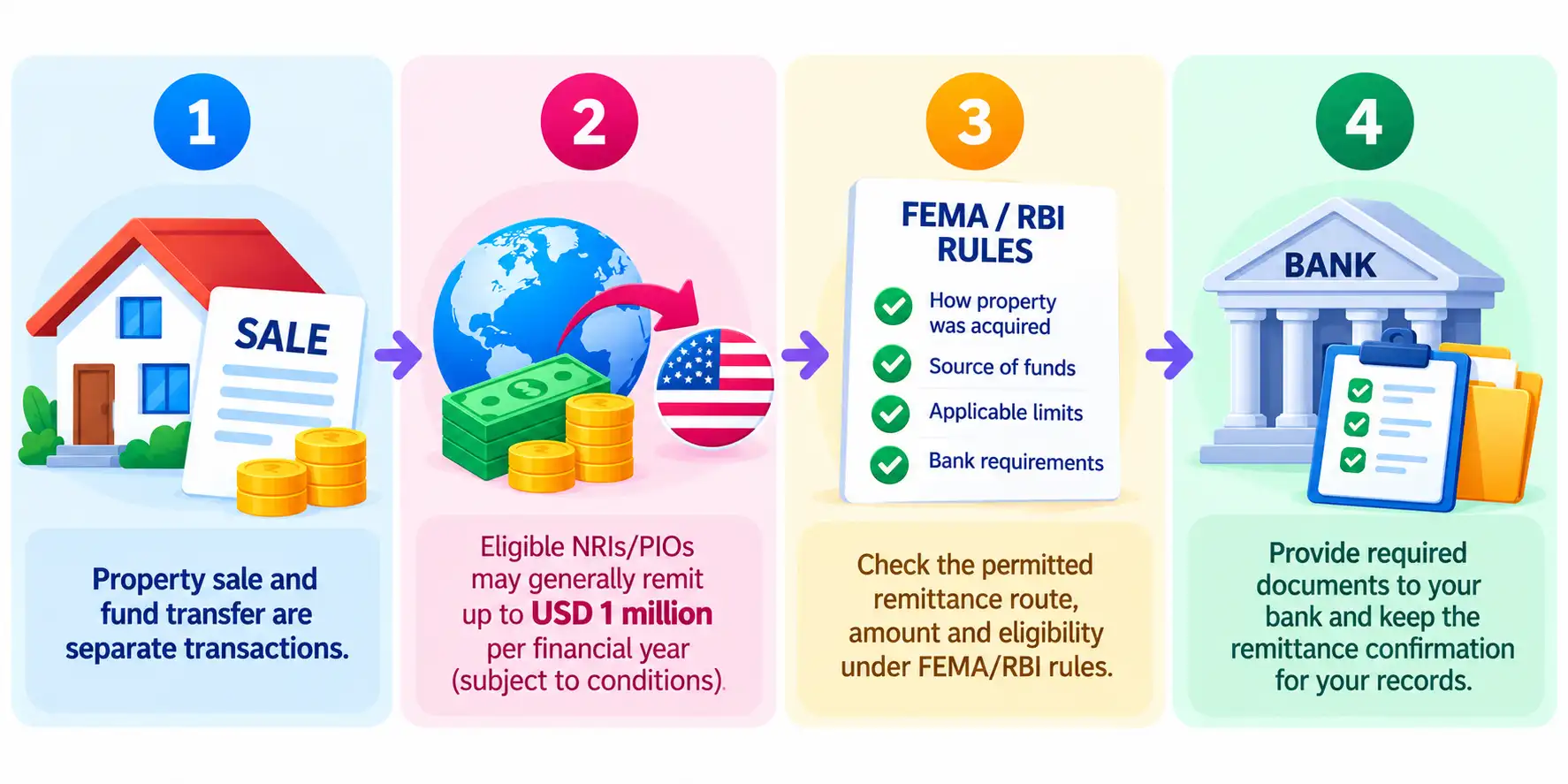
Selling the property and transferring the proceeds overseas are separate transactions. The permitted remittance route and amount can depend on how the property was acquired, the source of funds, applicable FEMA/RBI rules, taxes, and the authorised dealer bank's requirements.
Under the RBI's general remittance-of-assets facility, eligible NRIs and Persons of Indian Origin may generally remit up to USD 1 million per financial year from specified NRO balances or eligible asset-sale proceeds, subject to the applicable conditions. Separate provisions may apply to qualifying residential properties acquired using eligible foreign-exchange funds. Under those provisions, repatriation may be restricted by the amount originally paid through qualifying foreign-exchange funds and, for residential property, the limit of two such properties.
This does not mean that every seller can transfer the entire sale amount without restriction. Confirm the applicable route and eligibility with your authorised dealer bank before arranging the transfer.
The bank may request evidence relating to the sale, the source of funds, tax compliance, and the seller's identity. Retain the bank's remittance confirmation and supporting records for your files and any relevant tax reporting.
For the general rules and documentation, consult our NRI property taxation guide and confirm the current requirements with your bank.
Understand your Indian tax obligations and potential U.S. reporting requirements before transferring your property-sale proceeds.
The most useful step is to ensure that your Indian and U.S. tax advisers work from consistent transaction information. This can help prevent differences in reported proceeds, missing tax records, or incorrect assumptions about the foreign tax credit.
Before finalising the transaction:
Indian tax forms and procedures can change, so verify the rules applicable to the transaction date and buyer category. Avoid relying on an older article that describes an earlier form or withholding procedure without checking whether it still applies.
Selling property in India while living in the USA requires more than completing the property transfer. You may need to reconcile Indian TDS with your final tax liability, evaluate U.S. reporting obligations, determine whether a foreign tax credit is available, and confirm the rules for transferring eligible proceeds overseas.
The correct treatment depends on your residential and tax status, the property's ownership history, the transaction date, and the rules applicable in both countries. Review these issues before finalising the sale, and keep the supporting records needed for tax filing and remittance.
Need help with your India–USA property sale? Contact Savetaxs for guidance on your NRI tax and compliance requirements.
This article is for general informational purposes only and does not constitute tax, legal, financial, or investment advice. Laws, regulations, rates, and procedures may change over time and may vary based on individual circumstances.
While SaveTaxs makes reasonable efforts to keep the information accurate and up to date, readers should verify applicable rules with official authorities or consult a qualified professional before making decisions based on this information.
Shubham Jain is the Founder of SaveTaxs and has extensive experience in Indian and NRI taxation. He advises individuals, NRIs, and businesses on tax filing, tax planning, capital gains, DTAA benefits, fund repatriation, and compliance matters. He regularly writes about taxation and related financial topics. His focus is on making complex tax concepts easy to understand. Through his articles, he helps taxpayers stay informed, avoid common mistakes, and stay compliant with Indian tax laws. See Full Bio

Want to read more? Explore Blogs