NRI Income Tax Compliance
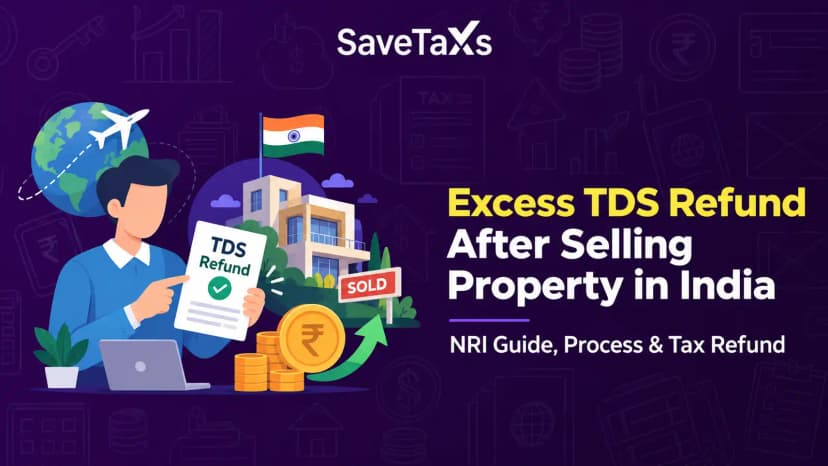
How to Claim Excess TDS Refund After Selling Property in India as an NRIHow to Claim Excess TDS Refund After Selling Property in India as an NRI
Written by Shubham Jain

_1784624542261.png&w=3840&q=75)
It's essential to verify the key documents and report all income sources while filing your ITR (Income Tax Return) to avoid notices, penalties, or additional tax liability. As the income tax filing season deadline approaches, millions of salaried taxpayers are preparing to file their returns.. Although the ITR filing process may seem easy, you may end up attracting scrutiny from the Income Tax Department even for a small mistake. So, you must review every detail carefully before submitting your return.
Also. tax experts advise that choosing the wrong tax regime, relying on incomplete information, or failing to report all sources of income are some common mistakes that can lead to penalties, interest charges, tax notices, and delayed refunds. In this blog, we will discuss the 7 common ITR (Income Tax Return) filing mistakes to avoid for salaried employees.
Based on eligibility and tax-saving preferences, taxpayers can choose between the old tax regime and the new tax regime. However, you may end up increasing your tax burden unnecessarily if you select a regime without comparing your tax liability under both options.
Therefore, you must compute tax under each regime before filing an ITR and select the one that offers more benefits based on your income profile and deductions.
Apart from salary income, there are other income sources that you need to report. This includes income earned from:
If you fail to report income accurately, it will lead to discrepancies detected by the tax department, which will potentially attract a notice.
A lot of taxpayers file their returns only based on Form 16 provided by their employer. However, this document does not cover all your financial transactions, and you may end up missing reporting an important detail. So, apart from Form 16, you must also compare the details available in:
Both these documents may include information that is not reflected in Form 16, such as bank interest, securities transactions, tax deducted at source, or other financial records. Avoid any mismatches or potential issues by reconciling these documents.
You may face problems during verification if you claim tax deductions without providing valid proof. You must claim deductions only under provisions like:
Ensure you maintain proper records of insurance premiums, investment receipts, loan certificates, and supporting documents to use in case of additional verification.
Another common mistake is submitting wrong bank details. To avoid that, you must ensure that you provide the correct:
Your income tax refund may be delayed or rejected if you submit incorrect details.
After submitting the ITR, you also need to complete e-verification. It must be done with the specified time limit. Your return will not be considered valid by the Income Tax Department until it is verified.
The verification can be completed by using Aadhaar OTP, internet banking, net banking-enabled bank accounts, or other approved methods.
Before finally submitting the return, you must review your return thoroughly. This is one of the easiest ways to avoid errors and future issues. Cross-check the following documents:
This will help you find out any discrepancies, missing income, or wrong information before the final submission.
In short, ensuring accuracy while filing ITR is important. Submitting wrong or incomplete information in your ITR can lead to income tax notices, refund delays, interest on unpaid tax, additional tax, and penalties as well.
Get expert solutions for all your NRI ITR filing challenges at Savetaxs.
Apart from uploading Form 16, ITR filing also has various other factors to consider. Salaried taxpayers must verify all tax documents, report every source of income, select the correct tax regime, claim deductions with valid documents, complete e-verification, and review the return carefully before submitting.
Moreover, if you still feel not confident about filing your ITR without expert assistance, contact Savetaxs. Our experts can help file your ITR with 100% accuracy and compliance to ensure you submit a complete and error-free return. We will guide you throughout the ITR filing process and also help with the e-verification process. Connect with us right away as we are actively working 24/7 across all time zones.
This article is for general informational purposes only and does not constitute tax, legal, financial, or investment advice. Laws, regulations, rates, and procedures may change over time and may vary based on individual circumstances.
While SaveTaxs makes reasonable efforts to keep the information accurate and up to date, readers should verify applicable rules with official authorities or consult a qualified professional before making decisions based on this information.
Shubham Jain is the Founder of SaveTaxs and has extensive experience in Indian and NRI taxation. He advises individuals, NRIs, and businesses on tax filing, tax planning, capital gains, DTAA benefits, fund repatriation, and compliance matters. He regularly writes about taxation and related financial topics. His focus is on making complex tax concepts easy to understand. Through his articles, he helps taxpayers stay informed, avoid common mistakes, and stay compliant with Indian tax laws. See Full Bio
Want to read more? Explore Blogs