US Tax Filing and Compliance
S Corporation Salary vs Distributions: How Owners Should Pay ThemselvesS Corporation Salary vs Distributions: How Owners Should Pay Themselves
Written by Shubham Jain

Moving to India or any other foreign country from the US does not exempt you from your state tax filing responsibilities. Depending on your U.S. citizenship or federal tax residency status, you may have U.S. federal tax obligations. Separately, your state residency, domicile, state-source income, and applicable state filing rules may create state tax obligations. However, unlike federal tax deadlines, U.S. state tax filing deadlines for taxpayers living abroad vary. The applicable deadline depends on the state, return type, tax year, and residency status.
Confused and want to know more about this in detail? Then you are on the right page. Read the blog on U.S. state tax filing deadlines for taxpayers living abroad and clear up all your doubts.
State tax deadlines for taxpayers living abroad, unlike federal tax returns, vary. To give you an idea of the state income tax deadlines for expats, the table below shows some common U.S. states where taxpayers living abroad may have previously lived or worked. These deadlines generally apply to 2025 tax year returns filed in 2026.
| U.S. State | Original 2026 Filing Deadline | General Extended Deadline | Important Requirement |
|---|---|---|---|
| California | April 15, 2026 | October 15, 2026; December 15, 2026, for qualifying taxpayers abroad | Automatic six-month filing extension generally to October 15. Qualifying taxpayers living or traveling outside the United States on April 15 generally have until June 15 to pay without late-payment penalties if paid by then, although interest may accrue from April 15. They may have until December 15 to file. |
| New York | April 15, 2026 | October 15, 2026 | Generally requires Form IT-370; a federal extension form cannot substitute for it. Certain qualifying federal nonresident noncitizens may obtain a December 15, 2026, filing deadline by following the applicable extension procedure. |
| New Jersey | April 15, 2026 | October 15, 2026 | Generally requires payment of at least 80% of the final tax liability by April 15 and compliance with the applicable extension procedure. |
| Virginia | May 1, 2026 | November 2, 2026 | Automatic six-month filing extension. Taxpayers living or traveling outside the United States or Puerto Rico on May 1 generally have until July 1, 2026, to file. Generally, at least 90% of the final tax liability must be paid by the original due date to avoid the extension penalty. |
Here's a detailed, state-by-state overview of the above-mentioned state tax deadlines for taxpayers living abroad.
This U.S. state grants individuals an automatic six-month filing extension. You do not need to fill out any form. However, to avoid applicable interest or penalties, you should pay your unpaid taxes by the applicable payment deadline. If you are living or traveling outside the United States on April 15, 2026, you generally have until December 15, 2026, to file and June 15, 2026, to pay your taxes without late-payment penalties if paid by then, although interest may accrue from April 15.
Savetaxs's CPAs and Enrolled Agents help U.S. taxpayers meet their filing deadlines and stay compliant with U.S. tax laws.
If you need extra time to file your New York State tax return, you generally need to file Form IT-370. If you qualify for a two-month automatic federal extension to file and pay while abroad, you can file Form IT-370 by June 15 to extend your filing date till October 15.
Certain nonresident noncitizens for federal tax purposes whose federal returns are due on June 15, 2026, may qualify to extend their New York State filing deadline to December 15, 2026, if they meet the applicable conditions and follow the required Form IT-370 procedure. You cannot use Form 4868 alone to extend your New York State tax return. Any tax due must still be paid by the applicable payment deadline to avoid interest and penalties.
To keep your state extension deadline valid in New Jersey, you generally need to pay 80% of your final state tax liability by April 15. You must also follow the applicable extension procedure. Depending on your circumstances, you may need to submit Form NJ-630. If you qualify to use the federal-extension procedure, provide a copy of your federal extension application or the IRS confirmation number when you file your New Jersey tax return.
The standard state tax filing date in Virginia is May 1, and it provides an automatic six-month extension to its taxpayers. Taxpayers living or traveling outside the United States or Puerto Rico on May 1 generally have until July 1, 2026, to file. However, it does not mean you get extra time to pay the taxes. You must still pay any tax owed by May 1. Generally, you must pay at least 90% of your final tax liability by the original due date to avoid the extension penalty.
The nominal six-month extension date is November 1, 2026, which falls on a Sunday; the applicable next-business-day deadline is November 2, 2026.
These were a few examples of the state tax filing deadlines for taxpayers living abroad. Before filing taxes, check the current tax instructions for your U.S. state. Now, moving ahead, let's see whether U.S. taxpayers living in India or abroad get extra time to file state taxes.
Federal and state tax returns are two different tax systems in the U.S.; both have their own rules, requirements, deadlines, and criteria. Qualifying U.S. citizens and resident aliens who meet the applicable overseas conditions generally receive an automatic two-month extension to file their federal tax return and pay federal income tax, from April 15 to June 15. Interest may still accrue on federal tax not paid by April 15. However, under U.S. state tax returns, every state follows its own rules and regulations for providing the extension.

This is how it works:
So, before assuming an automatic tax extension, every U.S. taxpayer living abroad should review the state tax rules of every U.S. state. Further, if you want a detailed overview of federal tax relief, read our blog on two-month tax extension vs. Form 4868 for taxpayers abroad.
Moving further, let's know whether Form 4868 extends your state tax return deadline.
IRS Form 4868 generally extends your federal tax return deadline. This form does not create one uniform filing extension across every U.S. state. Considering this, the U.S. state tax treatment generally falls into the following categories:
For instance, in California, you don't need to file any form or submit an application to extend your state tax return. However, if you want to extend your state tax return in New York, you generally need to fill out Form IT-370.
So do not assume that filing Form 4868 extends your state tax return. Moving forward, let us know whether the extended state filing deadline also extends your payment deadline.
No, a state tax filing extension generally does not extend your tax payment deadline. Your tax payments remain due by the applicable original payment deadline, subject to any special state provisions that may apply to taxpayers living abroad. For example, qualifying California taxpayers living or traveling outside the United States on April 15, 2026, generally have until June 15, 2026, to pay without late-payment penalties if paid by then, although interest may accrue from April 15. Additionally, interest on your unpaid taxes may start accruing from the date prescribed by the applicable state's rules.
For instance, if you extend your state tax return filing deadline from April 15 to October 15, then:
Further, determine your U.S. state tax obligation using Forms W-2 and 1099, business statements, rental records, and prior-year information.
So, getting a tax filing extension does not generally extend your tax payment deadline. Now, moving ahead, let's look at how to request a state tax extension from abroad.
Consider the following things before requesting a state tax extension from abroad:
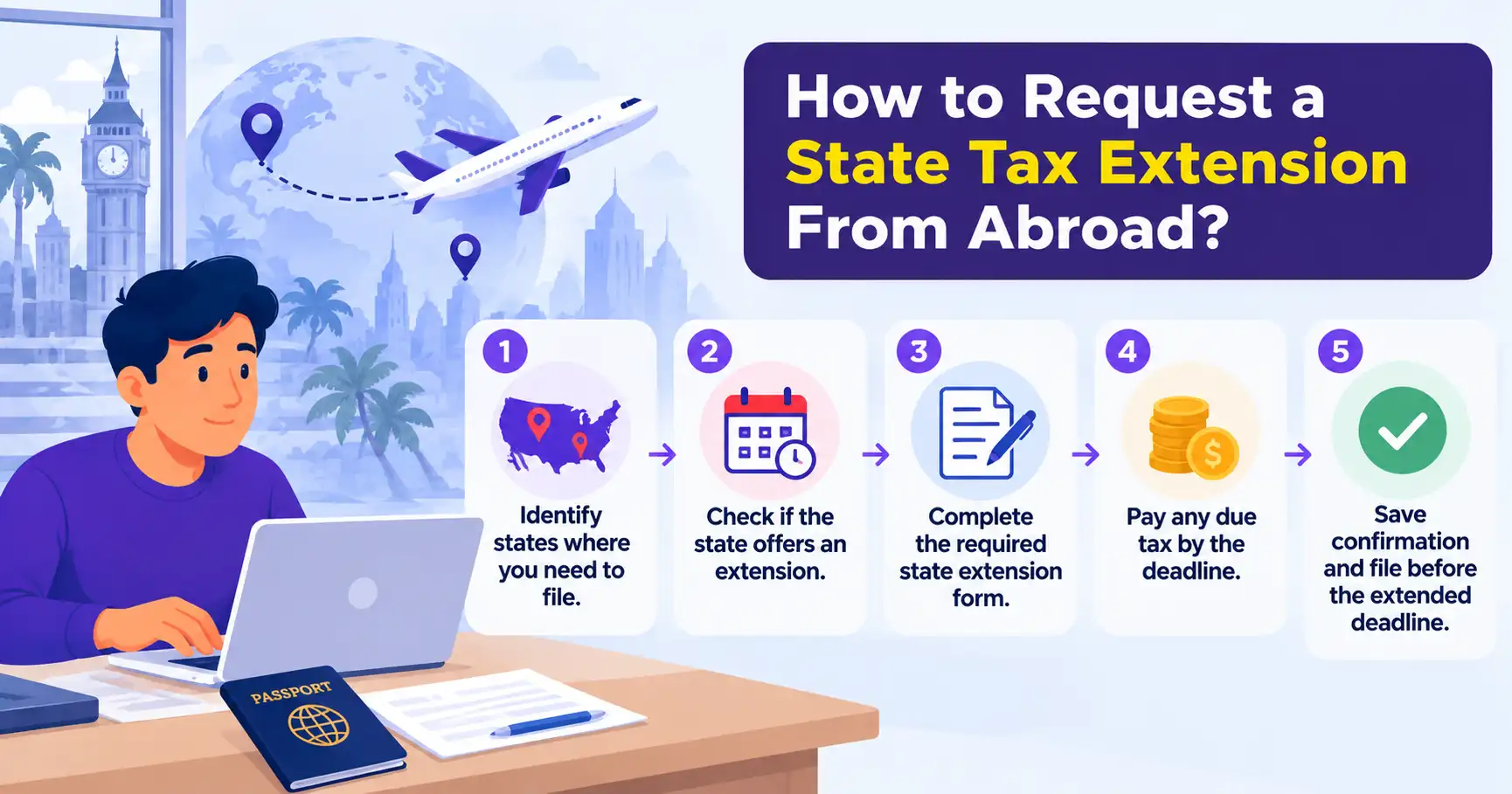
Do not mail your federal filing extension form to your state unless it asks for it. U.S. taxpayers living in India should also check whether they can file their state tax return online.
This is how you can request a state tax extension from abroad. Moving further, let's know whether a taxpayer living abroad can file state tax returns in multiple states.
A taxpayer living abroad may have to file multiple state tax returns if they:
Further, each U.S. state tax return has its own filing deadline and extension requirements. Moving to India does not automatically end your former state's tax residency or eliminate filing obligations for state-source income.
For instance, you are a U.S. taxpayer living as an NRI in India. Before moving to India, you worked in California and New York. Both U.S. states have their own rules and regulations for filing state tax returns. If you need an extension to file your New York state tax return, you generally must follow New York's extension procedure, including filing Form IT-370 where required. California state filing rules will not protect you from filing your New York tax return.
So, if you are liable to file state tax returns in more than one U.S. state, consider the state extension deadline and rules in each state. Moving forward, let's look at what happens if you miss the state extension deadline.
Schedule a call with our professional tax expert and plan your 2026 U.S. taxes smoothly.
If you miss the state extension deadline, do not wait for a notice from the state tax authority to rectify your mistake. Consider the following things:
The filing penalties vary state by state. Considering this, a U.S. state may impose a late filing penalty, interest, and a late payment penalty. File your state tax return promptly to avoid unnecessary penalties, and try to pay as much of your unpaid taxes as possible.
Lastly, U.S. state tax filing deadlines for taxpayers living abroad vary by U.S. state. Filing can also become difficult when you are abroad. However, you can make it easier by understanding your state filing obligations and planning accordingly. To stay compliant with U.S. state tax laws, keep up to date with changes.
Further, for more information about your U.S. state income tax returns, connect with SaveTaxs. Our team of professional CPAs, Enrolled Agents, and cross-border tax experts helps U.S. taxpayers meet their tax obligations and stay compliant with U.S. laws.
This article is for general informational purposes only and does not constitute tax, legal, financial, or investment advice. Laws, regulations, rates, and procedures may change over time and may vary based on individual circumstances.
While SaveTaxs makes reasonable efforts to keep the information accurate and up to date, readers should verify applicable rules with official authorities or consult a qualified professional before making decisions based on this information.
Hatim Dudhiyawala is a Certified Public Accountant (CPA) with SaveTaxs and specializes in Indian and NRI taxation. He advises individuals, NRIs, and businesses on income tax filing, capital gains taxation, DTAA benefits, fund repatriation, and tax compliance. With experience in cross-border tax matters, Hatim helps taxpayers understand complex regulations and make informed decisions. Through his articles, he shares practical insights to help readers stay compliant and manage their tax obligations with confidence. See Full Bio

Want to read more? Explore Blogs