US Tax Filing and Compliance
Is an S Corporation Worth It? Costs, Tax Benefits and Decision ChecklistIs an S Corporation Worth It? Costs, Tax Benefits and Decision Checklist
Written by Shubham Jain

_1786967632143.webp&w=3840&q=75)
What if you find out that after moving to the US, you need to report your Indian bank accounts, investments, and fixed deposits to the IRS? Well, like you, most NRIs did not know about this requirement and further face FBAR penalties or even criminal charges in serious cases. Generally, the FBAR penalties for NRIs and US expats depend on whether the reporting was willful or non-willful. Additionally, a late FBAR filing can be corrected without penalty if it was non-willful and you properly reported your foreign income.
According to the IRS, individuals who voluntarily come forward before receiving an IRS notice can reduce or eliminate the penalty through the Streamlined Filing or Delinquent FBAR Submission Procedures, provided it was non-willful.
Confused? This blog explains the potential FBAR penalties for NRIs and US expats and how they can overcome them with reasonable cause relief. So read on and gather all the information.
The Foreign Bank Account Report (FBAR), commonly known as FinCEN Form 114, is an electronic income information return required under 31 U.S.C. § 5314 and 31 C.F.R. § 1010.350. A U.S. person who has a financial interest in or signature authority over foreign financial accounts generally must file an FBAR when the aggregate value of those foreign financial accounts exceeds $10,000 at any time during the calendar year.
So, if you are a US resident and hold NRE, NRO, FCNR, or other foreign accounts that exceed the threshold, FBAR reporting is mandatory. In simple terms, FBAR is not your tax return; it is only an information form that contains details of your foreign financial accounts.
This form is separately filed through the BSA E-Filing system and not submitted with your Form 1040. Further, the deadline to complete this form is the same as for your US tax return, i.e., April 15, with an automatic extension to October 15.
This was all about FBAR. Moving ahead, let's know whether filing an FBAR late means you owe more taxes.
No, a late FBAR filing does not mean you owe more taxes. As mentioned earlier, FBAR is not an income tax return, so filing it late does not impose any additional tax. However, the income you earned from your foreign accounts, such as dividends, interest, or other taxable income, is already reported on Form 1040.
Considering this, it's important to know the difference between late FBAR filing and paying tax on your foreign income. If you properly reported your foreign income on your Form 1040 and paid taxes on it but missed the FBAR filing, your situation will be different from that of someone who missed both.
So, a late FBAR filing does not affect your tax obligations if you already reported your foreign income on your US tax return and paid taxes on it. Moving further, let's know the two categories, i.e., willful and non-willful, that decide the FBAR penalties for NRIs and US expats.
For your missed or late FBAR filing, whether you face manageable IRS penalties or harsh financial consequences depends on whether the violation was willful or non-willful. Considering this:
Further, you face IRS penalties for late or missed FBAR filings, depending on whether the filing was willful or non-willful.
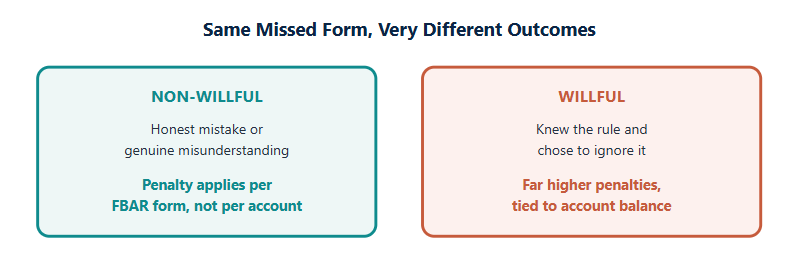
For 2026, the IRS penalty for non-willful FBAR is $16,536. The penalty is applied as per the annual report, not per foreign account, following the Bittner vs. United States decision.
Additionally, for willful FBAR violations, you face potentially higher IRS penalties. This is generally $165,353 or 50% of the account balance at the time of violation, whichever is greater.
This was all about willful and non-willful FBAR filing violations. Moving forward, let's know about the reasonable cause exception.
You can avoid paying FBAR penalties for your missed or late FBAR filing by providing non-willful reasonable cause and reporting your foreign account income in your tax return. However, simply saying, "I didn't know," does not prove your point that your missed FBAR filing was non-willful. Your reasonable cause should be fact-specific, explaining what happened, when you learned about the FBAR requirement, and what steps you took to correct the issue. To make your reasonable cause stronger, you may also include facts like:
So instead of saying "I didn't know about the FBAR requirement," you need to properly explain your situation to avoid IRS penalties. Now, moving ahead, let's know how you can correct your late FBAR mistake.
Connect with Savetaxs today, choose the right FBAR filing option, and stay compliant with US tax laws.
Fixing your late FBAR mistakes depends on your specific situation. Considering this:
If you are proactive, you can avoid or reduce your non-willful FBAR penalties. Additionally, instead of waiting for the US government to send you a late FBAR notice, it is vital to take action yourself and correct the mistake. Also, filing an FBAR for the current year and ignoring the missed past-year filings does not fix the errors but draws the IRS's attention to them.
This is how FBAR penalties for NRIs and US expats can be fixed. Moving forward, let's determine which FBAR compliance option applies to your situation.
The table below shows which FBAR compliance option may apply according to your situation:
| FBAR Situation | Potential FBAR Method to Use |
|---|---|
| Missed FBAR filing, but reported foreign income in tax return and paid tax on it | Delinquent FBAR Submission Procedures |
| Missed both FBAR and foreign income reporting in tax return, non-willful | May apply for Streamlined procedure |
| U.S. taxpayer living overseas and missed FBAR filing non-willfully | Streamlined Foreign Offshore Procedures may be available |
| Willful conduct or potential criminal exposure | Voluntary Disclosure Practice (VDP) |
| IRS already sent you a notice | Special consideration; check the eligibility criteria for certain procedures. |
Moving further, let's know the FBAR statute of limitations.
Yes. Federal law generally gives the Treasury six years to assess an FBAR civil penalty, measured from the date of the violation. The statute of limitations for assessment should not be confused with the FBAR filing deadline or the six-year period covered by the Streamlined Foreign Offshore Procedures.
Therefore, taxpayers should not assume that an old missed FBAR is automatically outside the government's reach. The specific year, filing history, contacts from the IRS, and other facts should be reviewed before deciding how to correct older FBARs.
Let's better understand this with an example.
Sanjana is a green cardholder living in Texas, and she had an NRO account back in India. While checking her tax obligations in the US, she realized that for the past two years she had missed FBAR filings for her NRO account. However, in her tax return, she reported all information about her foreign income and paid tax on it.
Here, she reported her foreign income properly in her tax return; her missed FBAR filing was non-willful, and she learned about it before the IRS; she can use the delinquent FBAR submission procedure. Through that, she can file her missed FBAR without facing IRS penalties.
This was all about the FBAR statute of limitations. Moving ahead, things to consider to avoid FBAR penalties.
Here is a quick checklist that you should consider to avoid missed FBAR penalties:
Considering the above points can help you avoid FBAR penalties for your missed or late FBAR filing.
Schedule a 30-minute call with our tax expert and get personalized guidance as per your tax situation in both countries.
Lastly, late FBAR filings do not always mean you need to face an IRS penalty. FBAR penalties for NRIs and US expats with foreign accounts may sound complex, but they are manageable if you act promptly. This is because the IRS has a clear distinction between non-willful mistakes and tax evasion. If you have missed FBAR reporting for your NRE, NRO, FCNR, or other foreign accounts, instead of waiting for an IRS notice, acting early can help you avoid paying tax penalties.
Further, if you need any assistance with your missed FBAR filing or choosing the correct compliance procedure, connect with Savetaxs. We have a team of tax professionals with years of experience in cross-border taxation. They help you choose the correct FBAR procedure according to your situation and avoid unnecessary tax penalties by filing on time.
This article is for general informational purposes only and does not constitute tax, legal, financial, or investment advice. Laws, regulations, rates, and procedures may change over time and may vary based on individual circumstances.
While SaveTaxs makes reasonable efforts to keep the information accurate and up to date, readers should verify applicable rules with official authorities or consult a qualified professional before making decisions based on this information.
Vipul Jain is the Co-Founder of SaveTaxs and a tax expert with experience in Indian and NRI taxation. He advises individuals, NRIs, and businesses on tax filing, tax planning, capital gains, DTAA, and compliance matters. He focuses on making complex tax concepts simple and helping taxpayers make informed, compliant decisions. See Full Bio

Want to read more? Explore Blogs