US Tax Filing and Compliance
FEIE Reporting Errors: Corrective Measures for NRIsFEIE Reporting Errors: Corrective Measures for NRIs
Written by Hatim Dudhiyawala
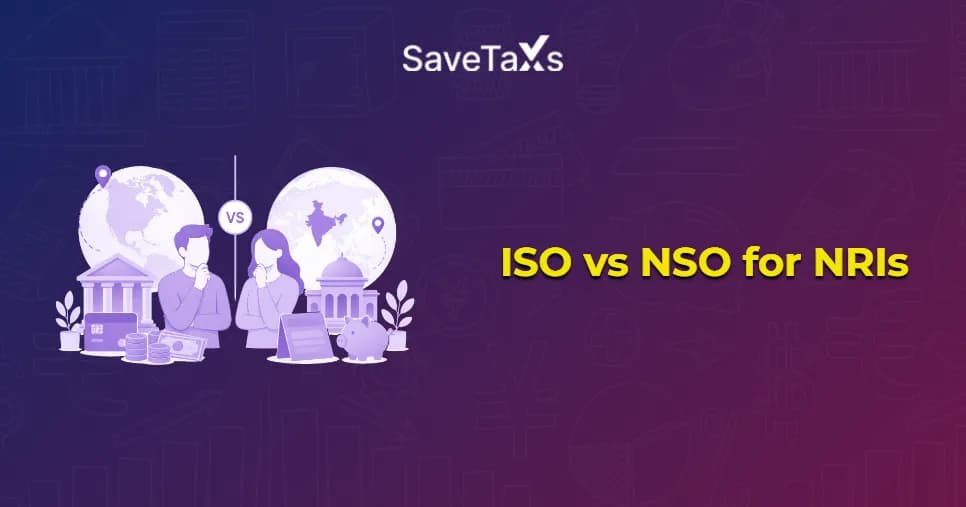
If you work for a US company, you have probably heard of ISOs (Incentive Stock Options) and NSOs (Non-Qualified Stock Options). These are a type of equity compensation that US companies offer to their employees. Mostly, you benefit from them when the stock of the company attains a higher value than its actual price. Both types of options allow you to buy the company's stock at a discounted price; however, there is a key difference between them.
Want to know about it? This blog explores ISO vs NSO for NRIs to help you understand the key differences between them and choose the right option. So read on and gather all the information.
Incentive Stock Options (ISOs) and Non-Qualified Stock Options (NSOs) are the most popular stock options offered by US companies to their employees. While you get the opportunity to purchase them at a discounted price, there are some key differences between them that impact your gains and tax obligations. Considering this:
This was a quick overview of ISOs and NSOs. Moving ahead, let's know the key difference between these two US stock options.
Connect with Savetaxs and fulfill your US tax obligations on time with complete accuracy.
The table below provides you with a quick overview of the key differences between ISOs and NSOs for NRIs.
| Particulars | Incentive Stock Options (ISOs) | Non-Qualified Stock Options (NSOs) |
|---|---|---|
| Granting entity | Qualifying corporations meeting IRC Section 422 requirements | May be granted under a wider range of compensation arrangements, subject to applicable rules |
| Who can receive | Qualifying employees only | Employees and other service providers, depending on the plan |
| Tax at exercise | Generally no regular federal income tax at exercise, but AMT may apply | Generally ordinary compensation income on the spread at exercise |
| Holding period for qualifying ISO treatment | Later of 2 years after the grant date and 1 year after the shares are transferred to the employee | No equivalent statutory ISO holding-period requirement |
| $100,000 limitation | Applies based on aggregate grant-date FMV of stock first exercisable in a calendar year | No equivalent ISO limitation |
| 10% shareholder rule | Generally requires exercise price ≥110% of FMV and a maximum 5-year term | No equivalent ISO rule |
| Maximum statutory term | Generally 10 years; 5 years for qualifying 10% shareholders | Determined by the option agreement |
| Post-employment exercise | Generally 3 months to retain ISO status, subject to special rules | Determined by the plan and option agreement |
This was a quick overview of ISO vs NSO. Now, let's understand the key differences between them in detail, along with some other points.
The tax rules and regulations of ISOs are governed under the Internal Revenue Code. For NSOs, the spread between the stock's FMV at exercise and the exercise price is generally treated as ordinary compensation income when the option is exercised. Any additional gain or loss after exercise is generally recognized when the shares are sold. ISOs can receive more favorable tax treatment when the statutory requirements and qualifying-disposition holding periods are satisfied.
ISOs are taxed under the Alternative Minimum Tax (AMT). This is a separate tax system that ensures high-income earners in the US pay a minimum tax. On the other hand, NSOs are not subject to the AMT regime.
The exercise price of ISOs is generally set at the fair market value of the company's stock on the grant date. NSOs do not have the same statutory exercise-price requirement as ISOs, but the exercise price and option terms must comply with applicable U.S. tax rules, which may include Section 409A requirements.
In terms of ISO vs NRO for NRIs, one key difference is that, upon the employee's termination, the ISO should be exercised within 90 days (three months). This time period can only be extended in case of disability or death. NSOs, on the other hand, can be exercised at any time before the expiry date of the stock. Additionally, ISOs are applicable when you are employed by the company, whereas NSOs do not require employment.
These are the key differences between ISO and NSOs. Moving forward, let's look at the India-US tax considerations for ISOs and NSOs.
Among ISO or NSOs, regardless of which stock option NRIs hold, they face a cross-border challenge. This is because the exercise income is taxable in both countries, i.e., the USA and India. Further, to prevent double taxation on the same income, the India-US DTAA (Double Taxation Avoidance Agreement) applies.
ISOs can create an additional U.S. tax consideration through the Alternative Minimum Tax (AMT). When you exercise an ISO and continue to hold the shares, the difference between the stock's FMV and exercise price may create an AMT adjustment. If you sell the shares in the same year as exercise, the special AMT adjustment generally does not apply. Further, this makes ISO more complicated for NRIs.
This was all about India-US tax considerations for ISOs and NSOs. Moving forward, let's know which of the two is the best option for an NRI.
There is no universal answer; it depends entirely on your situation. Considering this, if you fulfill the holding period requirements without triggering AMT, then ISO can provide you with better tax options. On the other hand, NSOs provide flexibility and simplicity for holders without any additional tax benefits. Further, when choosing them, you should consider the following points:
Let's better understand this with an example.
While living in the US, Arjun worked for a U.S. tech company for the first 18 months. During that time, while on an H-1B visa with the same employer, he worked full-time. During the 18-month period, he received NSOs from his company, and upon becoming an employee there, the company offered him ISOs.
When he exercised his NSOs, he was liable to pay tax on the proceeds as ordinary income. Additionally, the employer also applied a withholding period on NSOs. After becoming an employer there, when Arjun received ISOs, he needed to calculate them differently to determine whether they would trigger AMT since he did not sell the shares. Also, he wanted to know the eligible disposition holding periods to get good long-term capital gains.
Working with his cross-border tax professional, Arjun aligned his ordinary income from NSO and ISO AMT exposure for the same financial year and then coordinated the timing of these shares with his US-Indian residency status.
The case of Arjun is a reminder that, like him, many NRIs often end up holding stock options at different points in their careers. Considering this, like Arjun, they should also handle it properly with the guidance of a tax professional.
With Savetaxs, get personalized guidance as per your financial situation and manage your US investments simply.
Lastly, ISO vs NSO for NRIs depends on their situation and employment. Given this, ISO is available only to employees, whereas NSOs are available to board members, employees, contractors, and advisors. For NRIs, both US stock options and US-India cross-border taxation add complexity.
Furthermore, if you need assistance with managing ISOs or NSOs, connect with Savetaxs. We have a team of cross-border tax experts who help manage your US stock options to ensure full compliance between India and the USA.
Note: This guide is for information purposes only. The views expressed in this guide are personal and do not constitute the views of Savetaxs. Savetaxs or the author will not be responsible for any direct or indirect loss incurred by the reader for taking any decision based on the information or the contents. It is advisable to consult either a CA, CS, CPA or a professional tax expert from the Savetaxs team, as they are familiar with the current regulations and help you make accurate decisions and maintain accuracy throughout the whole process.
Shubham Jain is the Founder of SaveTaxs and has extensive experience in Indian and NRI taxation. He advises individuals, NRIs, and businesses on tax filing, tax planning, capital gains, DTAA benefits, fund repatriation, and compliance matters. He regularly writes about taxation and related financial topics. His focus is on making complex tax concepts easy to understand. Through his articles, he helps taxpayers stay informed, avoid common mistakes, and stay compliant with Indian tax laws. See Full Bio

Want to read more? Explore Blogs