US Tax Filing and Compliance
S Corporation Late Election Relief: Form 2553 RulesS Corporation Late Election Relief: Form 2553 Rules
Written by Shubham Jain

Running an S Corporation involves more than managing business income and expenses. The company must also report its financial activity to the Internal Revenue Service (IRS), provide shareholders with the information they need for their individual tax returns, and meet applicable filing deadlines.
Form 1120-S, U.S. Income Tax Return for an S Corporation, is the federal return used to report an S Corporation’s income, deductions, gains, losses, credits, and other tax information. Although S Corporations generally pass income and losses through to their shareholders, they still have their own federal filing responsibilities.
This guide explains who needs to file Form 1120-S, what information the return includes, when it is due, and how businesses can prepare for filing.
Form 1120-S is the annual federal income tax return generally filed by a corporation that has elected S Corporation status and whose election remains in effect.
Unlike a traditional C Corporation, an S Corporation generally passes its taxable income, losses, deductions, and credits through to its shareholders. Shareholders report applicable items on their own tax returns, subject to the relevant tax rules and limitations.
However, pass-through taxation does not eliminate the corporation’s obligation to file an informational tax return.
Form 1120-S helps the IRS understand the business’s financial activity and how tax items are allocated among its shareholders.
| Feature | Form 1120-S | Form 1120 |
|---|---|---|
| Used by | Eligible S Corporations | C Corporations |
| Federal tax treatment | Generally pass-through | Generally taxed at the corporate level |
| Shareholder reporting | Schedule K-1 generally reports allocated items | Dividends and other shareholder items are reported under applicable rules |
| Filing obligation | Generally required for an S Corporation with an effective election | Generally required for domestic C Corporations and certain other entities |
The correct form depends on the business’s federal tax classification and elections. An LLC, for example, does not automatically file Form 1120-S simply because it is an LLC; it must qualify and have an effective S Corporation election.
Organize your business records, review reporting requirements, and prepare for accurate S Corporation tax return filing.
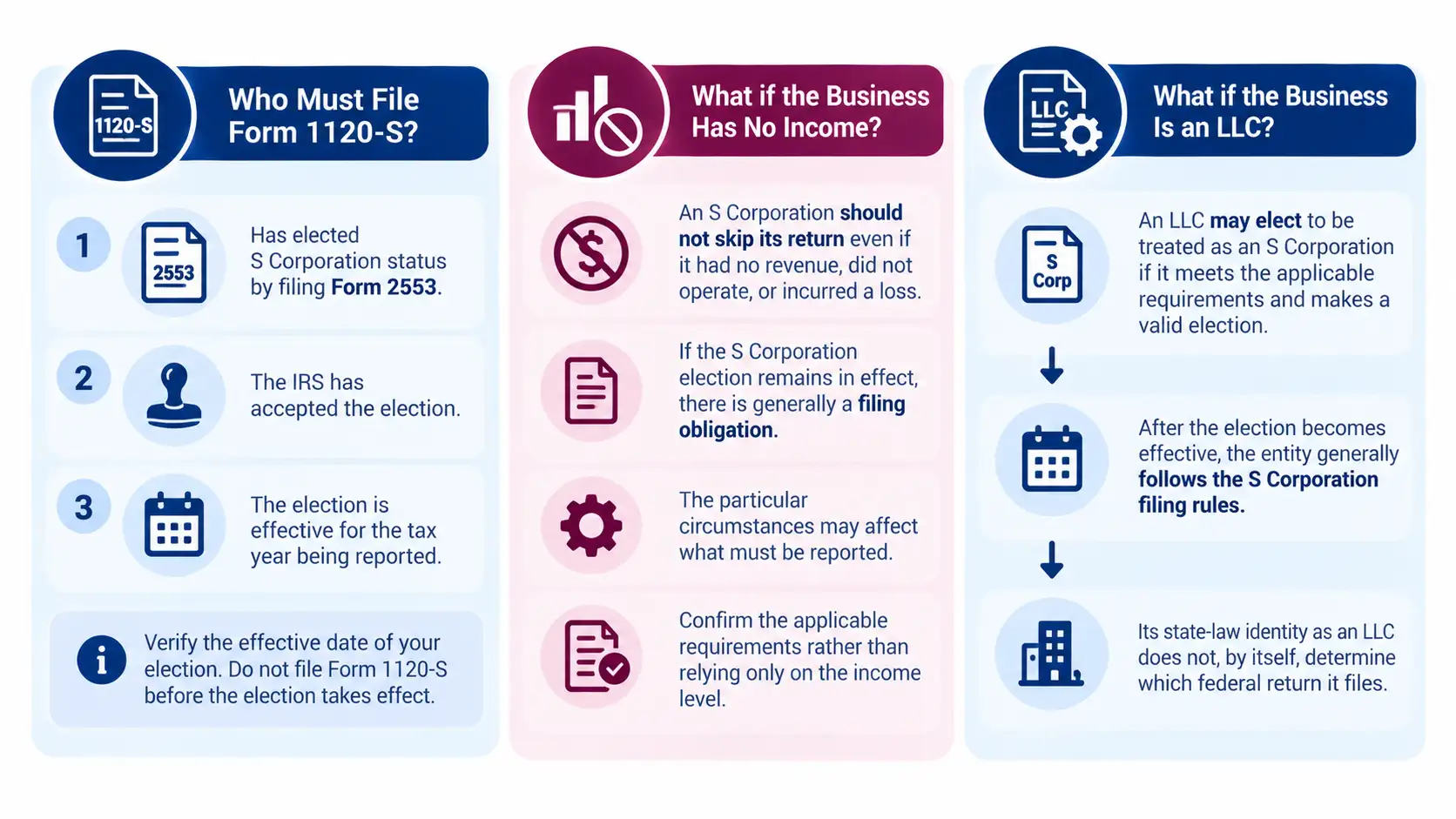
A corporation or other eligible entity generally must file Form 1120-S when:
Businesses should verify the effective date of their election before filing. An entity should not file Form 1120-S for a tax year before its S Corporation election takes effect.
An S Corporation must also meet the applicable shareholder eligibility requirements. Generally, a nonresident alien individual cannot be an S Corporation shareholder. Indian NRI status does not automatically determine whether an individual is a U.S. resident alien or nonresident alien for federal tax purposes.
An S Corporation should not assume that it can skip its return simply because it had no revenue, did not operate actively, or incurred a loss.
If the S Corporation election remains in effect, the corporation generally still has a filing obligation. Its particular circumstances may affect what must be reported, so the business should confirm the applicable requirements rather than rely only on its income level.
An LLC may elect to be treated as an S Corporation for federal tax purposes if it meets the applicable requirements and makes a valid election.
After the election becomes effective, the entity generally follows the relevant S Corporation filing rules. Its state-law identity as an LLC does not, by itself, determine which federal return it files.
The standard deadline is generally the 15th day of the third month after the end of the S Corporation’s tax year.
For calendar-year businesses filing the 2025 tax-year return, the deadline was March 16, 2026, because March 15 fell on a Sunday.
For a calendar-year S Corporation filing its 2026 tax-year return, the regular deadline is March 15, 2027, subject to the applicable weekend and holiday rules.
Fiscal-year businesses generally calculate their deadline using their own tax-year end date.
Yes. An eligible S Corporation can generally file Form 7004, Application for Automatic Extension of Time To File Certain Business Income Tax, Information, and Other Returns, by the original due date.
For a typical calendar-year S Corporation, a timely and properly filed extension generally extends the 2025 return filing deadline to September 15, 2026.
An extension gives the business more time to file the return, not more time to pay any tax due. Applicable tax payments remain due by the original deadline.
Businesses should also verify the extension rules if they have unusual circumstances, such as a short tax year or books and records maintained outside the United States.
Form 1120-S combines the corporation’s identifying information with its income, deductions, tax calculations, and shareholder reporting details.
The exact entries depend on the company’s activity and tax situation.
The return generally reports relevant items such as:
The corporation should maintain records supporting the amounts entered on the return. Deductibility depends on the applicable tax rules; recording an expense in the accounting system does not automatically make it deductible.
For more information on eligible expenses and recordkeeping, see the Savetaxs guide to S Corporation Tax Deductions.
Depending on the corporation’s circumstances, Form 1120-S may require supporting schedules and attachments.
| Schedule or form | Purpose |
|---|---|
| Schedule K | Summarizes the corporation’s pass-through income, deductions, credits, and other reportable items |
| Schedule K-1 (Form 1120-S) | Reports each shareholder’s allocated share of applicable tax items |
| Schedule L | Reports the corporation’s balance sheet, when required |
| Schedule M-1 | Reconciles book income with income reported for tax purposes, when required |
| Schedule M-2 | Tracks relevant changes in accumulated adjustments account and other specified equity-related accounts |
Not every S Corporation will need to complete every schedule in the same way. Applicable filing requirements, exceptions, and instructions should be reviewed for the relevant tax year.
Schedule K-1 is a key part of S Corporation tax reporting. It communicates each shareholder’s share of the corporation’s tax items, which may include income, deductions, credits, and other information.
Shareholders generally use their Schedule K-1 to prepare their individual federal income tax returns. The amount and tax treatment reported by a shareholder can depend on the type of item, basis limitations, at-risk rules, passive activity rules, and other applicable provisions.
Suppose an S Corporation has two shareholders, each owning 50% of the company throughout the year. If the company reports $100,000 of ordinary business income and the allocation rules support an equal allocation, each shareholder may receive $50,000 of ordinary business income on Schedule K-1.
This simplified example assumes equal ownership and no special allocation issues. Actual allocations must follow S Corporation tax rules and the company’s circumstances.
Important: Schedule K-1 income is not necessarily the same as cash distributed to a shareholder. A shareholder may have taxable pass-through income even when the corporation retains cash rather than distributing it.
The corporation should provide the required Schedule K-1 information to shareholders and complete any related filing obligations by the applicable deadlines.
A structured preparation process can reduce errors and help the company meet its filing obligations.
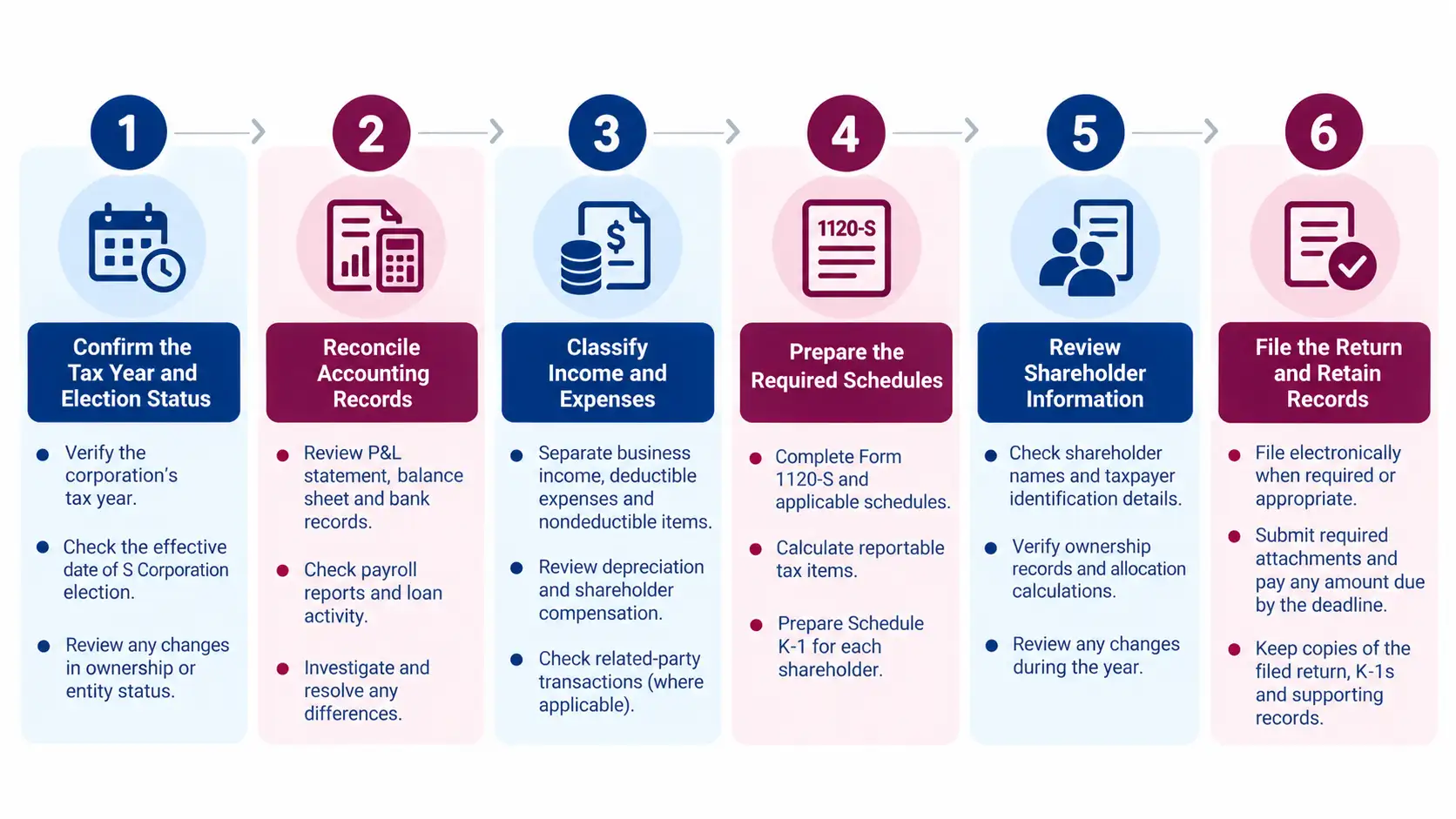
Verify the corporation’s tax year, the effective date of its S Corporation election, and any changes in ownership or entity status.
Review the profit and loss statement, balance sheet, bank records, payroll reports, loan activity, and supporting documents. Investigate differences before preparing the return.
Separate business income, deductible expenses, nondeductible items, and other tax adjustments. Review depreciation, shareholder compensation, and related-party transactions where applicable.
Complete the applicable parts of Form 1120-S and supporting schedules. Calculate the corporation’s reportable tax items and prepare Schedule K-1 for each shareholder.
Check shareholder names, taxpayer identification details, ownership records, allocation calculations, and any changes during the year.
File electronically when required or appropriate, submit required attachments, and pay any amount due by the applicable deadline. Keep copies of the filed return, K-1s, and supporting records.
Businesses should use the current-year IRS form and instructions rather than relying on a prior-year return without checking for changes.
Get support understanding S Corporation reporting, shareholder tax documents, and filing obligations for your business.
Avoiding the following issues can help an S Corporation improve filing accuracy.
Form 1120-S is an essential annual reporting requirement for eligible S Corporations. Businesses need to report their financial and tax information accurately, prepare required schedules, provide shareholder Schedule K-1s, and meet filing and payment deadlines.
Maintaining organized records throughout the year and reviewing current IRS instructions can help reduce avoidable filing errors. Businesses with complex ownership changes, unusual transactions, or uncertain tax classifications should obtain qualified tax guidance before filing.
This article is for general informational purposes only and does not constitute tax, legal, financial, or investment advice. Laws, regulations, rates, and procedures may change over time and may vary based on individual circumstances.
While SaveTaxs makes reasonable efforts to keep the information accurate and up to date, readers should verify applicable rules with official authorities or consult a qualified professional before making decisions based on this information.
Hatim Dudhiyawala is a Certified Public Accountant (CPA) with SaveTaxs and specializes in Indian and NRI taxation. He advises individuals, NRIs, and businesses on income tax filing, capital gains taxation, DTAA benefits, fund repatriation, and tax compliance. With experience in cross-border tax matters, Hatim helps taxpayers understand complex regulations and make informed decisions. Through his articles, he shares practical insights to help readers stay compliant and manage their tax obligations with confidence. See Full Bio

Want to read more? Explore Blogs